

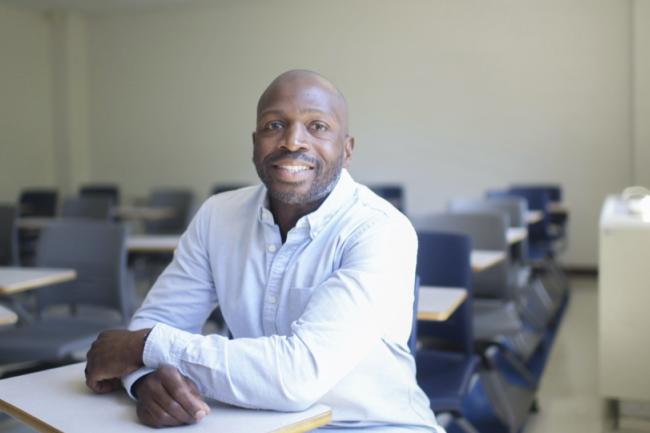
There was a time when Howard University’s Brandon Hogan, Ph.D., J.D., rarely saw philosophy conference papers focused on reparations or Black political thought. But the intellectual landscape has shifted dramatically over the past decade.
“The conversation rises and falls depending on the political environment, but we’ve seen actual policy movement,” said Hogan, a Howard University associate professor of philosophy. Hogan points to municipalities like Evanston, Illinois, that have implemented reparations related to redlining, as well as California's creation of a commission to study reparations policy.
“While some people think reparations are unrealistic, we’ve actually seen meaningful developments.”
Earlier this year, Hogan received a $50,000 fellowship from the American Council of Learned Societies (ACLS) supporting HBCU faculty whose work advances the mission of Historically Black Colleges and Universities. The award will allow him to step away from teaching for a year to focus on research, including three papers examining the legal, economic, and moral arguments for reparations.
Hogan was one of two Howard philosophy faculty members to receive ACLS support this year. Assistant Professor Mesi Walton earned a 2026 ACLS Fellowship for Afro-Venezuelan Culture in Motion, a study of how Afro-Venezuelan communities sustain identity and belonging through cultural traditions across generations and borders.
There’s a hunger for philosophy among Howard students generally. Howard students want a place where they can ask philosophical questions in a rigorous academic setting,” Hogan says.
The Question of Reparations
Through the ACLS fellowship, Hogan will spend the next year completing three major articles on reparations from legal, economic, and philosophical perspectives.
One examines a constitutional pathway for reparations claims. The second explores whether monetary reparations can avoid reinforcing the harms of capitalism. The third focuses on what Hogan calls “unjust enrichment” — the idea that the United States continues to benefit from wealth created through slavery.
“To what extent is it unjust for the beneficiaries of that system to continue benefiting from wealth created through slavery?” he said.
“Reparations are fundamentally a question of justice,” Hogan said of the broader debate. “Everyone agrees reparations were owed in the 1860s. The disagreement is over whether that debt disappeared over time or whether it still exists. I think the debt still exists.”
From Howard Student to Philosophy Professor
Raised in Florida, Hogan arrived at Howard on a wrestling scholarship and majored in political science. After graduating in 2003, he earned a law degree from Harvard Law School before completing a master’s degree in philosophy at Tufts University in 2008 and later a doctorate in philosophy at the University of Pittsburgh in 2013.
Hogan said the philosophy courses he took at Howard helped shape the academic path he would eventually pursue. Although he did not major in philosophy as an undergraduate, he now encourages students to consider the discipline as a major. Nearly one-third of Howard’s philosophy majors are also pursuing a second major.
“A lot of students realize in their sophomore or junior year that philosophy is what they really want to study, but by then they only have time for a minor,” Hogan said.
When a faculty position opened in Howard’s philosophy department in 2013, he returned to campus as a professor. Hogan said Howard was his “number one choice” when he began thinking about where he wanted to teach.
Today, Hogan teaches social and political philosophy, philosophy of law, and courses connected to race, democracy, and reparations.
He also directs Howard’s BA/JD program and advises pre-law students. Hogan said Howard helped prepare him not only academically, but personally, giving him the confidence to navigate elite legal and academic spaces.
Hogan is one of the faculty members helping fuel the department’s growth. Anika Simpson, Ph.D., who joined the department as chair in 2024, said the program is in the second year of a three-year strategic plan focused on growth and student success.
Howard is the only HBCU with a freestanding philosophy department.
The department has significantly increased its number of majors in recent years, including doubling enrollment over the past three years. This spring, Simpson said an analysis of BisonHub data found the number of philosophy majors had grown to 61 students, with enrollment increasing by as much as 35 percent in a single semester. The goal is to reach 100 majors.
“Students are choosing philosophy because they recognize it makes them better thinkers, better writers and more rigorous interdisciplinary scholars,” Simpson said.
Hogan added, “There’s a hunger for philosophy among Howard students generally. Howard students want a place where they can ask philosophical questions in a rigorous academic setting.”
A Discipline Under Pressure
Howard’s philosophy department once faced difficult questions about its future. In 2010, the university considered eliminating the undergraduate major as part of a broader academic overhaul. The department ultimately survived.
At the time, Hogan, then a graduate student at the University of Pittsburgh, wrote to Howard leaders arguing against the move.
“I argued that philosophy is one of the core subjects of a university,” Hogan said. “It would be absurd to have a university without a philosophy department in the same way it would be absurd to have a university without a math department.”
Hogan also argued that eliminating the department would have deprived future students of opportunities like those that helped shape his own academic and professional path.
Since then, the department has entered a period of renewed growth. Simpson said the department’s strategic plan focuses on strengthening recruitment, retention, curriculum, and post-graduate placement while expanding research, grant funding, and alumni engagement.
Hogan said the department’s progress has validated the arguments the other defenders of the department made more than a decade ago.
“I’m glad the university listened,” he said.
Howard philosophy students have historically performed well on the LSAT and gained admission to top law schools, which Hogan attributes in part to the department’s strong ties to the legal profession and its emphasis on legal reasoning and pre-law preparation.
He said the university also offers students opportunities to explore questions that are often marginalized elsewhere, including Black political identity, democracy, Black feminism, and reparations.
“At another university, you might only take one course in African American philosophy — maybe none,” Hogan said. “At Howard, students can consistently explore questions they’re already thinking about.”
“Students at Howard are getting the same quality education students receive at elite universities like Princeton,” Hogan added, “but they’re getting it from a Black perspective and in a more personal environment.”
###
Keep Reading
-
 Epiphanies, Discovery, and Research
Howard University Professor Lemir Teron Examines Environmental Justice
Jul 22, 2026 4 minutes -
 Epiphanies, Discovery, and Research
Howard University, NEON Bridge High School & Higher Education
Jul 15, 2026 6 minutes -
 Epiphanies, Discovery, and Research
Howard University Mental Health Advocates Discuss How Black Men Can Maintain their Mental Health Wellness with Resources Like Yoga
Jul 8, 2026 6 minutes