

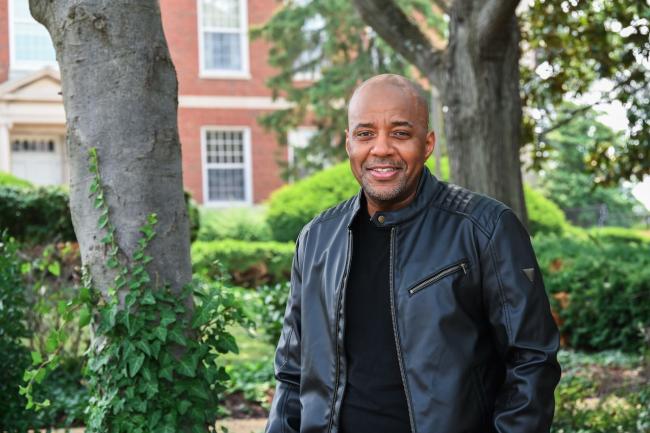
The world environmental crisis won’t be solved with solar panels and electric cars alone. Howard University scholar Lemir Teron said the conversation must shift toward systematic solutions, and questions of collective action and justice.
Teron, an associate professor in the Department of Earth, Environment and Equity (E3) in the College of Arts and Sciences, address this in his new book, “Unlearn Power: Strengthening Communities in the Age of Environmental Crisis.” The book explores how climate change, urban planning and environmental policy leave workers and neighborhoods bearing the greatest risks.
“Unlearn power is about resistance,” Teron said. “Throughout the book, we look at what that resistance looks like, whether we're talking about inner city communities, indigenous communities, or working with and alongside farm workers.”
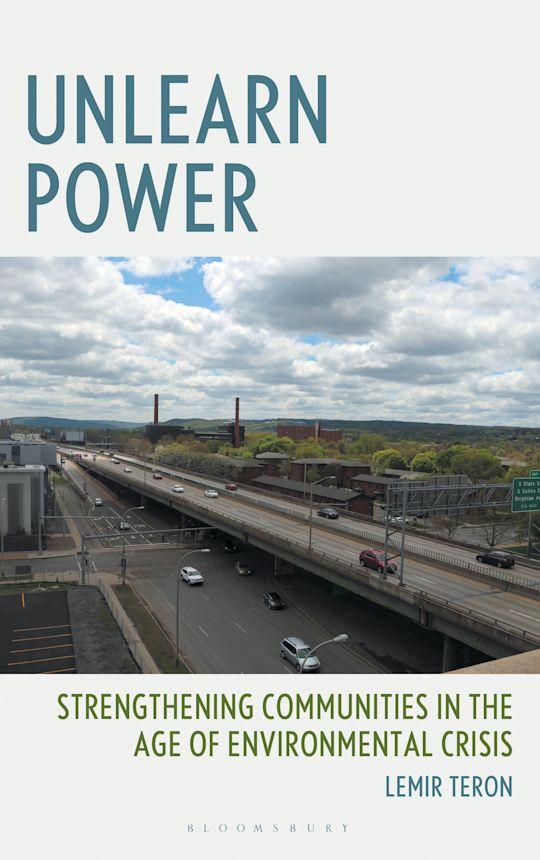
Teron said the book represents the culmination of more than a decade of research. It draws heavily from his research into energy policy, environmental planning, and urban forestry. He holds a doctorate in energy and environmental policy from the University of Delaware and completed a National Oceanic and Atmospheric Administration-funded postdoctoral fellowship at Florida A&M University, where he also taught at the College of Law
Before joining Howard, Teron taught at SUNY’s College of Environmental Science and Forestry in Syracuse, New York, a campus devoted exclusively to environmental education and research.
“Unlearn Power” incorporates case studies and a range of analytical approaches to explore environmental justice and climate policy. Other topics include balancing urban growth with environmental equity, the benefits of urban forests and green spaces, and the need for a food system that prioritizes the well-being of farmworkers.
The book concludes with an appendix featuring Teron's congressional testimony, opinion essays, blog posts, and other writings that extend its central ideas beyond the page. The collection emphasizes the book's core argument: that creating a more just and sustainable future requires rethinking power in every sense, from energy systems to political structures.
In a recent interview, Teron pointed to the D.C. region’s recent stretch of triple-digit temperatures as an example of how environmental issues are also labor issues. When temperatures in the Washington, D.C. area exceeded 100 degrees in early July, he said the conversation should extend beyond the weather to the workers most affected.
“If you’re delivering mail or working in a factory, you’re going to be exposed to temperatures probably well in excess of what that meteorologist says,” Teron said. “When we think about extreme heat, that’s an organized labor issue. In 'Unlearn Power' I ask the question, ‘Where’s labor?’ throughout.”
The College of Arts and Sciences officially launched Howard’s ’s Department of Earth, Environment and Equity in 2024. Despite only being recently established, the department is growing rapidly, with more than 100 students enrolled across three majors: B.A. Environmental Studies, B.S. Environmental Science and B.S. Atmospheric Science. It celebrated its first graduating class this spring. Teron was among the department’s first faculty members.
Teron described the Howard teaching environment as “a magical place.”
“As much as it was a treat to work at an environmental-only campus, there is nothing like engaging with the Howard student,” Teron said.
He added that “Students are coming from all over the world, all over the diaspora. They’re not just coming to get a degree. They’re coming with a lot of critical analysis, a lot of drive, and a capacity to move society forward.”
Teron teaches applied environmental justice, environmental inequality, science and public policy, and introductory environmental studies courses. He said he’s looking forward to teaching an honors section of introductory environmental studies this fall.
In his applied courses, Teron said he tells his students that if they spend more than half their time indoors, "we're doing something wrong." His classes have visited a Montgomery County microgrid facility, conducted tree maintenance, and learned at an urban farm.
Teron said “Unlearn Power” is meant to challenge readers to think about structures and systems, not just individual behavior. Extreme heat, he said, offers a clear example.
"Not everybody's going to have $20,000 to get solar panels. Not everybody's going to be able to afford a $40,000 or $50,000 geothermal system," he noted.
Instead, he advocates collective approaches: community solar projects, better public transportation systems, and policies that center communities that have historically been sacrificed, oftentimes majority Black neighborhoods.
In “Unlearn Power,” Teron explores the challenge of balancing urban growth with environmental equity, highlighting the role of community-driven planning in creating more just and sustainable cities. It also examines how urban forests and green spaces can cool neighborhoods, improve public health, and strengthen communities. Another chapter focuses on the experiences of farmworkers, arguing that a just food system must prioritize the people who grow and harvest our food.
When thinking about urban heat islands, Teron said cities need to examine not just climate change but the built environment, including heat-trapping buildings, concrete and asphalt, along with tree canopies.
"We shouldn't be resigned to catastrophic environmental impacts in the same way we shouldn't be resigned to economic and political forces undermining people's livelihoods," Teron said. Ultimately, he argued, the goal is “a planet that’s not just a coherent place to live, but a place that is commensurate with human dignity.”
Keep Reading
-
 *Accolades
Howard University CEA Professor Sonya Smith Elected to AIAA Class of 2026 Fellows
Sep 28, 2026 3 minutes -
 Epiphanies, Discovery, and Research
Howard University Researchers Advance Decade-Long Study of HIV and Sickle Cell Disease
Sep 23, 2026 4 minutes -
 *Research and Discovery
Howard University Study Links Medicaid Expansion to Lower Breast Cancer Deaths
Oct 6, 2026 5 minutes