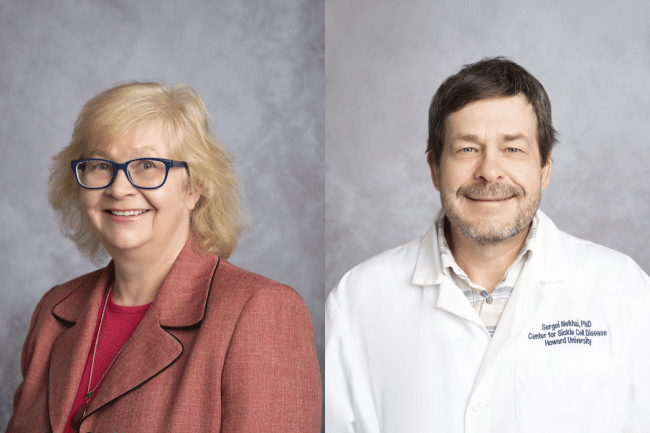
A team of Howard University College of Medicine researchers has received a $3.6 million National Institutes of Health grant to continue investigating why people with sickle cell disease and sickle cell trait are protected against HIV-1 infection — research that could eventually inform new approaches to HIV prevention. September is National Sickle Cell Awareness month.
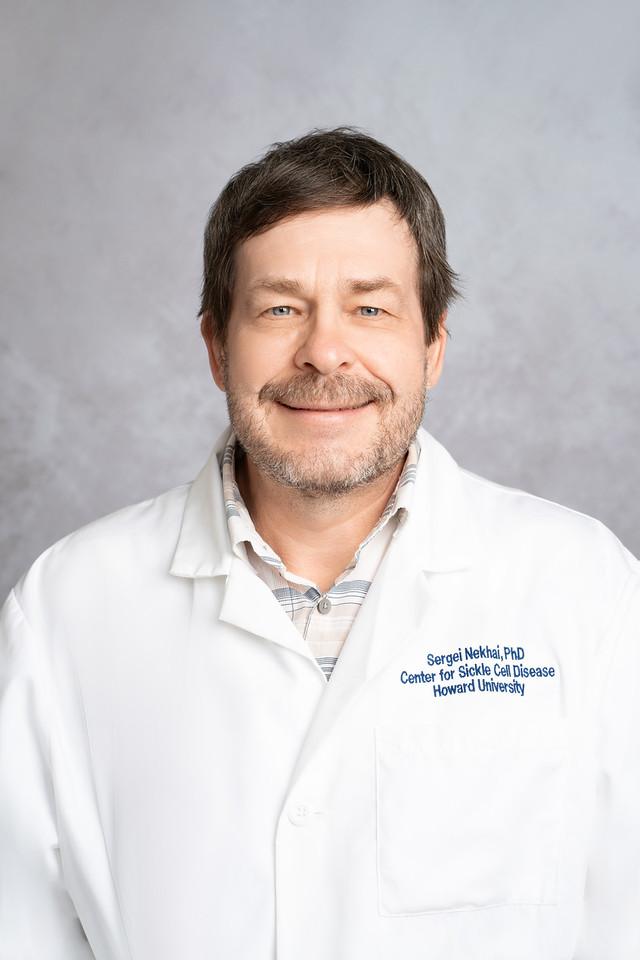
The five-year grant, titled “Molecular Mechanisms of HIV-1 Resistance in Sickle Cell Disease and Trait,” was awarded to Sergei Nekhai, Ph.D., professor in the Department of Medicine and deputy director of the Howard University Center for Sickle Cell Disease, and Marina Jerebtsova, Ph.D., an associate professor in the College of Medicine. They serve as co-principal investigators on the grant that runs from May 2026 through March 2031. Since the research began in 2014, the NIH has awarded $9.3 million through the R01 grant to support the work across three funding periods.
“This research exemplifies the kind of high-impact, interdisciplinary scholarship that defines Howard University College of Medicine,” said Andrea A. Hayes Dixon, M.D. “For more than a decade, our researchers have been investigating the relationship between sickle cell disease and HIV, and this latest NIH investment allows us to explore how those discoveries could inform new approaches to prevention.”
The research also reflects the College of Medicine’s longstanding role in HIV and sickle cell research. Nekhai said Howard researchers have participated in HIV clinical trials for many years and that the University has contributed to HIV research through the District of Columbia Center for AIDS Research, where he serves as a director of the Advanced Technology Core.

While HIV treatment has transformed the disease from the acute epidemic that defined the early years of the HIV/AIDS crisis into a manageable chronic condition, Howard researchers say significant challenges remain.
People living with HIV continue to experience health complications even when the virus production is controlled with medication. In the District of Columbia, where about 14,200 people are living with HIV, Nekhai said the disease remains a significant public health concern, particularly among Black residents. He cited an estimated infection rate of about 2% among African Americans in the District.
“HIV is no longer the acute disease it once was, but that doesn’t mean the problem has gone away,” Nekhai said. “But even when the virus is controlled with medication, people still experience other health problems, including kidney disease and cardiovascular and neurological complications. There is still a need to understand the virus and find better ways to prevent infection.”
Nekhai said HIV also continues to disproportionately affect minority populations, which he believes contributes to the disease receiving less public attention. The disparity extends globally, he said, particularly in parts of Africa where HIV remains highly prevalent, and access to treatment can be limited due to costs.
Howard research has evolved across three NIH funding periods since 2014. Nekhai said each cycle has allowed the team to build on previous findings and pursue increasingly specific questions about the relationship between sickle cell biology and HIV.
Earlier phases of the research found evidence that immune cells from people with sickle cell disease resist HIV infection, with later studies finding a similar effect among people with the sickle cell trait.
The current phase, running through 2031, focuses on a central question: What causes that resistance, and can the underlying mechanism be reproduced? Researchers will investigate whether “trained immunity” provides longer-term protection against HIV-1.
Nekhai said the team believes the sickle cell environment may create long-lasting changes that prime cells to respond more quickly to HIV infection. “We basically hypothesize that there are changes in the DNA structure,” Nekhai said, describing a process in which the cells may become “primed” to respond to infection.
The researchers ultimately hope to determine whether the protective response can be reproduced without sickle cell disease or trait, potentially leading to a drug or other intervention against HIV.
The work builds on a broader body of research from Howard University examining the relationship between sickle cell disease and HIV. A 2016 study by Howard researchers found that increased iron export by ferroportin was associated with restriction of HIV-1 infection in sickle cell disease, while subsequent research has continued to examine the role of the body’s innate antiviral response.
Nekhai also traced the sickle cell and HIV connection to earlier work by Howard researchers. He pointed to research involving Howard University Interim President and President Emeritus Wayne A. I. Frederick, M.D., MBA, and led by Oswaldo Castro, M.D., that helped establish an early epidemiological observation about the apparent absence or reduced prevalence of HIV infection among people with sickle cell disease.
Keep Reading
-
 *Accolades
Howard University CEA Professor Sonya Smith Elected to AIAA Class of 2026 Fellows
Sep 28, 2026 3 minutes -
 Legacy and Lineage
Howard University Honors Retirees, Inaugurates Academic Year at 159th Opening Convocation
Sep 25, 2026 6 minutes