

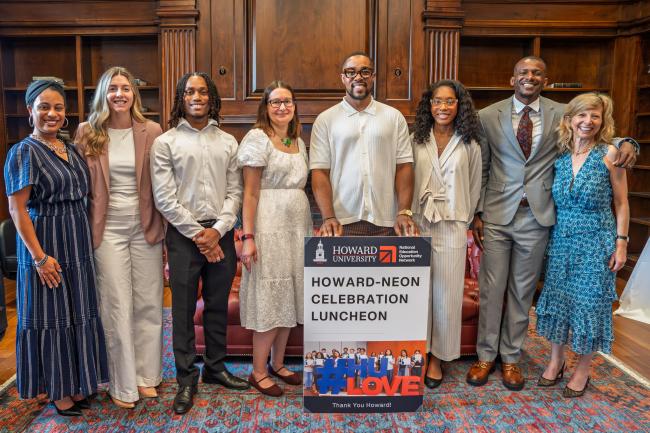
above, from left to right: Ariel Murphy Bedford, Alexandra Slack, Nathan Hinds, Janelle Burke, Andre Ross, Naysa Harraway, Shaquille Dunbar, and Leslie Cornfeld (Credit: National Education Opportunity Network)
For thousands of high school students across the country, experiencing Howard University no longer requires first setting foot on campus.
Through a growing partnership with the National Education Opportunity Network (NEON), Howard faculty and students have brought the university’s academic rigor, culture, and commitment to service directly into historically underserved high schools.
The initiative gives students from low-income communities access to college-level courses, transferable credits, mentorship, and an early understanding of what it means to learn within an HBCU environment, all at no cost to participating scholars.
“Howard University has been a leader with NEON since its earliest days because our missions are deeply aligned: bringing opportunity, support, and hope to students across our nation regardless of their financial situation, background, or geography,” said Wayne A. I. Frederick (B.S. ’92, M.D. ’94, MBA ’11), interim president and president emeritus of Howard. “We are proud to share the profound power of Howard in communities that rarely have such opportunities for their young people.
Howard University has been a leader with NEON since its earliest days because our missions are deeply aligned: bringing opportunity, support, and hope to students across our nation regardless of their financial situation, background, or geography.
Extending Howard’s Reach
Through the partnership, Howard has served 8,589 scholars attending 253 high schools in 91 cities. Participating communities include Washington, D.C.; Nashville, Tennessee; New York City; Phoenix, Arizona; and Jackson, Mississippi.
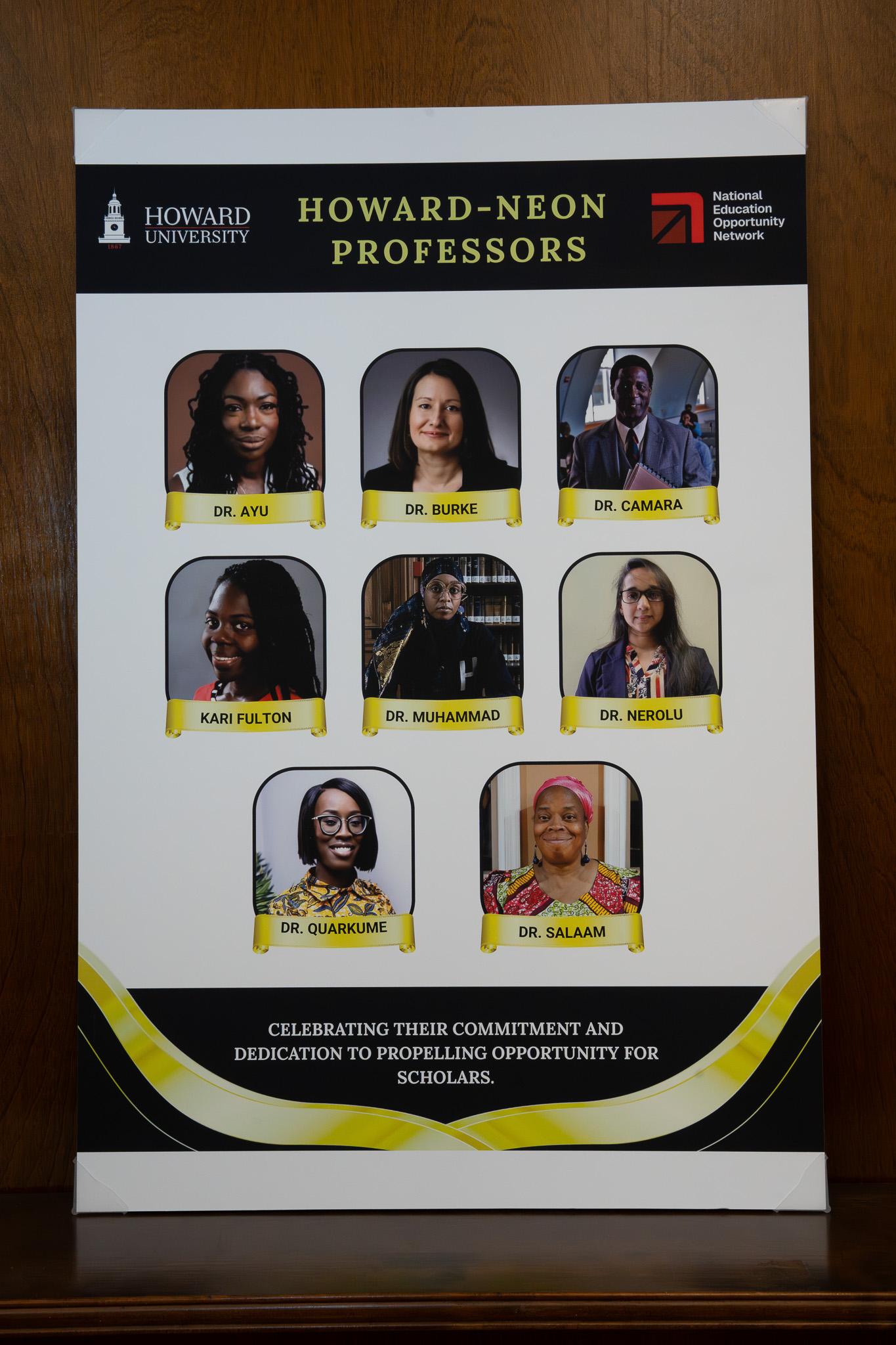
The university has offered eight courses through the initiative, spanning criminal justice, environmental studies, college algebra, leadership, psychology, data analytics, and technology ethics. Courses have been led by Howard faculty members including Bahiyyah Muhammad, Ph.D.; Janelle Burke, Ph.D.; Lifoma Salaam, Ph.D.; Moussa Doumbia, Ph.D.; Meenakshi Nerolu, Ph.D.; Mohammed Saliou Camara, Ph.D.; Oritsegbubemi Ayu, Ph.D.; Amy Yeboah Quarkume, Ph.D.; and environmental justice advocate Kari Fulton.
The model pairs university faculty with high school educators and Howard undergraduate and graduate students who serve as teaching fellows. These fellows provide academic guidance, mentorship, and a tangible connection to the Howard student experience.
To date, 150 Howard students have served as teaching fellows. Among those surveyed, 95% reported that they grew professionally through the experience, while 94% described the fellowship as one of their most valuable experiences of the year. The structure creates benefits on both sides of the virtual classroom: high school scholars receive support from near-peer mentors, while Howard students gain experience in teaching, leadership, communication, and community engagement.
The results also extend beyond individual courses. At least 51 NEON scholars have matriculated at Howard, transforming an initial online encounter with the university into a full undergraduate experience on campus.
Howard and NEON celebrated the partnership’s continued growth during a June 11 gathering on the university’s campus. The event convened NEON leadership, Howard faculty members and teaching fellows, educators, and former NEON scholars who have since become Howard students and graduates.
The discussion centered on the role historically Black colleges and universities can play earlier in the educational pipeline, particularly for students who may live hundreds of miles from the nearest HBCU or have had little exposure to the institutions. Participants also examined how early access to Howard courses can strengthen students’ academic confidence, clarify the expectations of college-level work, and help young people recognize that they belong in higher education.
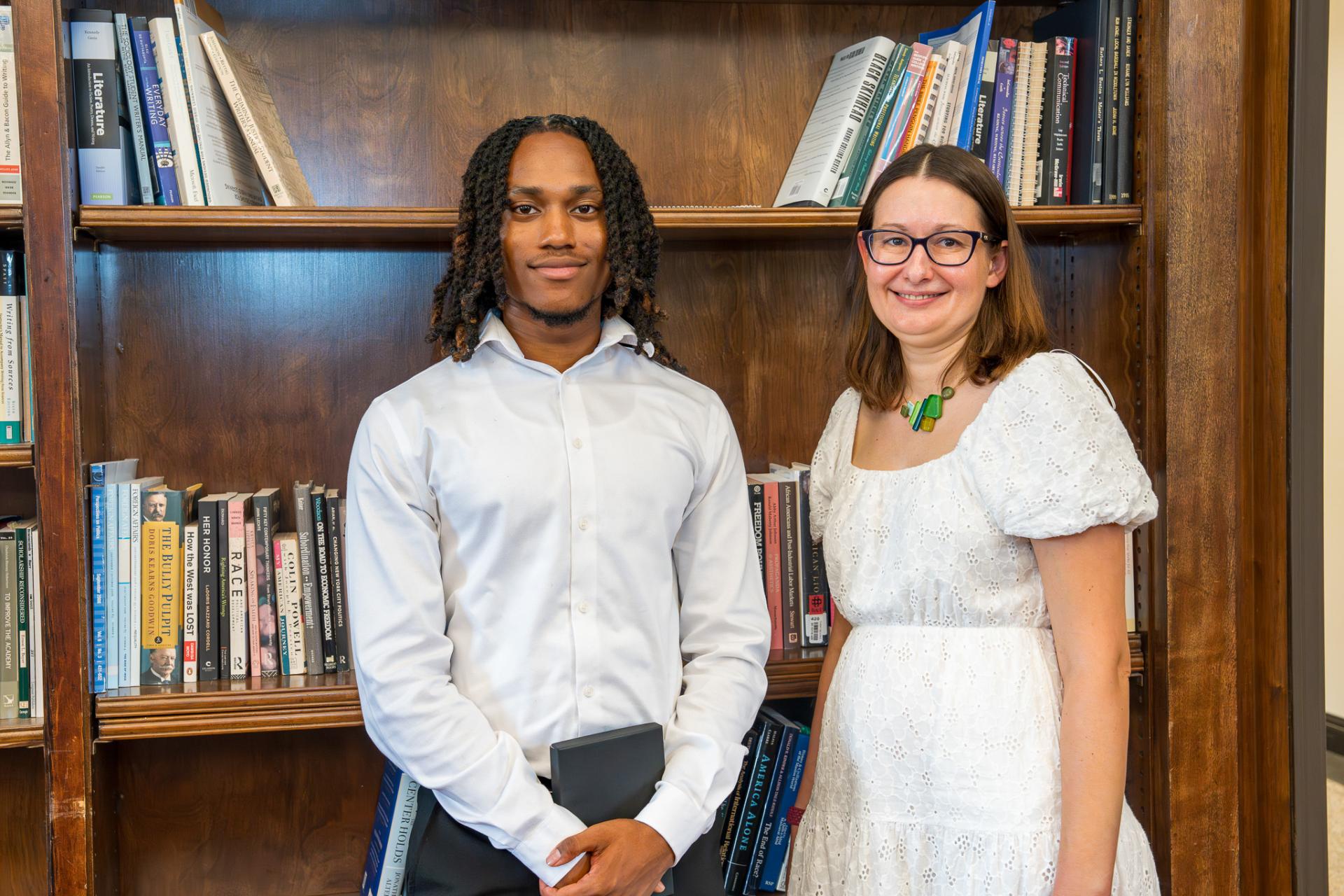
Interim chair of Howard University’s Department of Earth, Environment and Equity Dr. Janelle Burke with NEON teaching fellow and Howard undergraduate Nathan Hinds. (Credit: National Education Opportunity Network)
Turning Exposure into Confidence
For Howard alumna Naysa Harraway (B.A. ’25), the pathway began while she was a student at the Young Women’s Leadership School of Queens in New York.
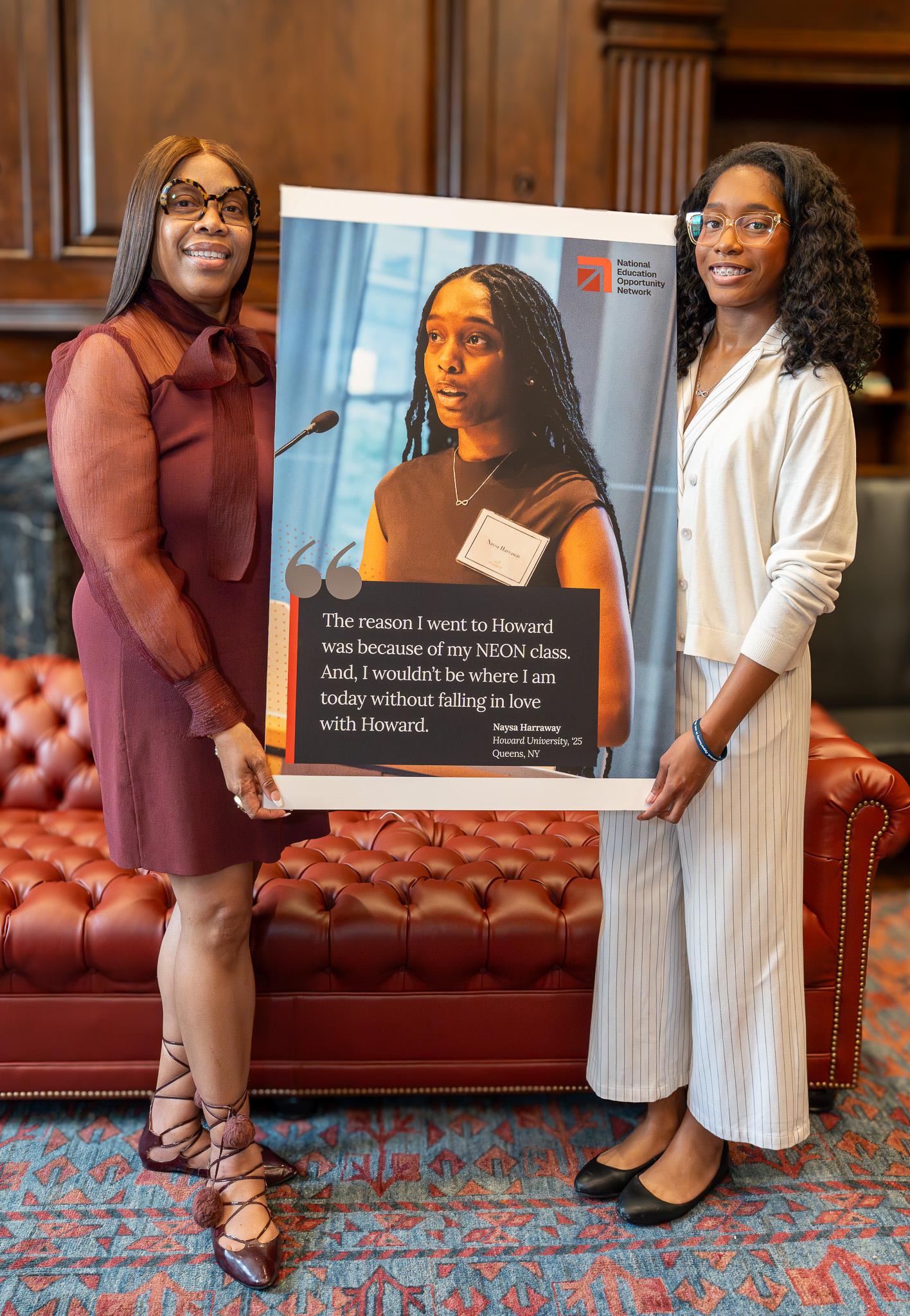
Harraway enrolled in Howard’s “Principles of Criminal Justice” course through NEON. Although she initially questioned whether she was prepared for college-level work, she earned an A and had her final paper published by Howard at age 17. The course introduced her not only to the demands of a university classroom, but also to an institution and educational tradition that had received little attention in her previous schooling.
“Where I’m from in NYC, they don’t teach us about HBCUs,” Harraway said. “The reason I went to Howard is because of this (NEON) class.”
Harraway subsequently enrolled at Howard, where she studied political science and criminology, graduated in May 2025 with a 3.7 GPA, and completed an internship with the U.S. House of Representatives. She is now preparing for the next stage of her journey toward a legal career.
“I wouldn’t be where I’m at if I didn’t take this class and fall in love with Howard,” she said.
Current Howard chemistry major Maya Cherubin had a similar opportunity while attending Sewanhaka High School in New York. Cherubin completed Howard’s environmental studies course before enrolling at the university, giving her early access to Howard faculty, academic expectations, and teaching methods.
The experience showed her how a Howard education could combine scientific concepts with history, social justice, and the experiences of marginalized communities. It also helped her picture herself as a Howard student before she arrived on campus. Cherubin, who is expected to graduate from Howard in 2028, hopes to become a cosmetic chemist.
“You really get a chance to prepare yourself for what college looks like,” Cherubin said. “You get that experience taking a college course for the first time and really being able to put yourself in the shoes of a college student.”
You really get a chance to prepare yourself for what college looks like. You get that experience taking a college course for the first time and really being able to put yourself in the shoes of a college student.
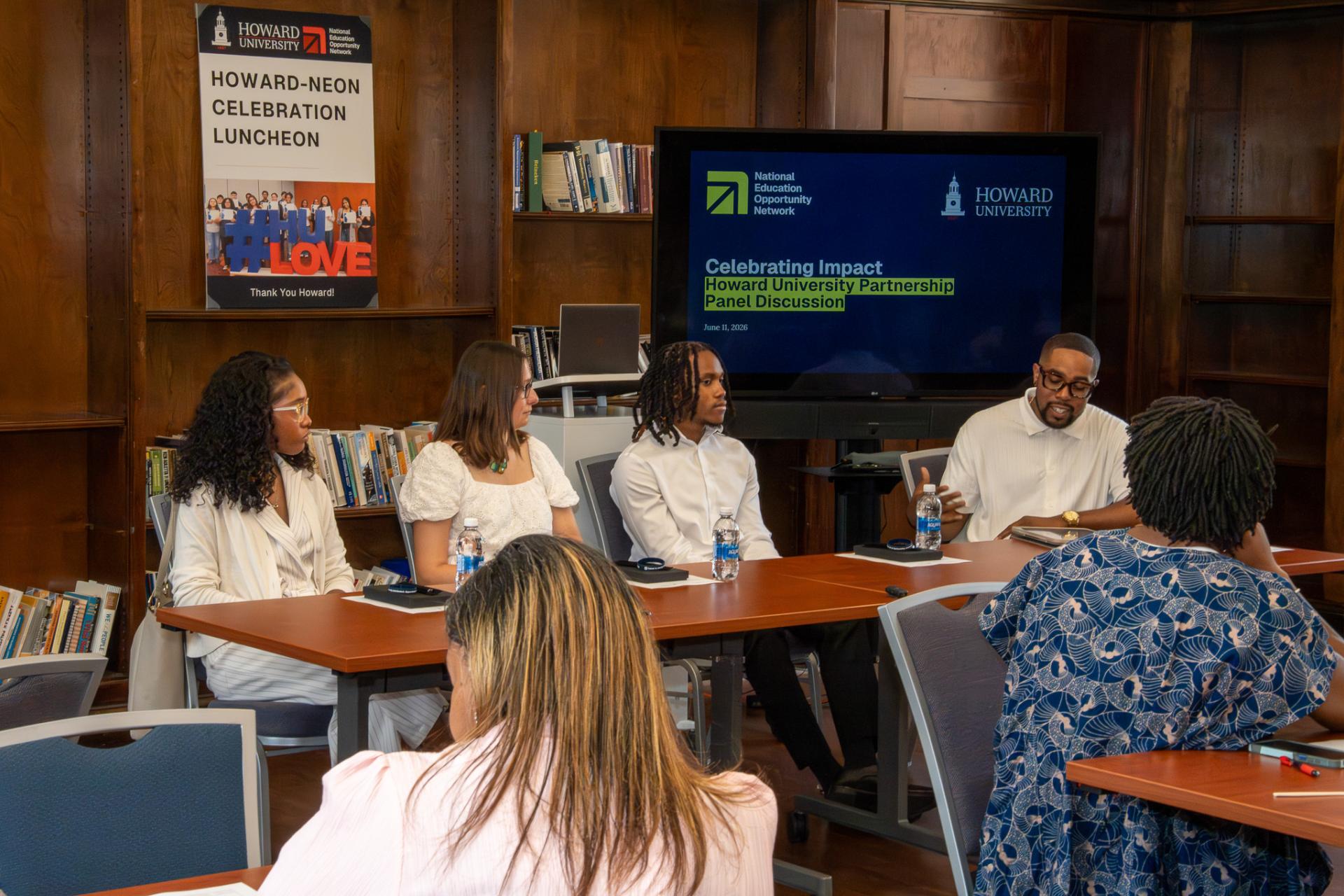
NEON Course Success Manager Andre Ross led a panel during the June celebration featuring Harraway, Burke, and Hinds. (Credit: National Education Opportunity Network)
Related Story

Keep Reading
-
 *Accolades
Howard University CEA Professor Sonya Smith Elected to AIAA Class of 2026 Fellows
Sep 28, 2026 3 minutes -
 Epiphanies, Discovery, and Research
Howard University Researchers Advance Decade-Long Study of HIV and Sickle Cell Disease
Sep 23, 2026 4 minutes -
 Legacy and Lineage
Howard University Honors Retirees, Inaugurates Academic Year at 159th Opening Convocation
Sep 25, 2026 6 minutes