

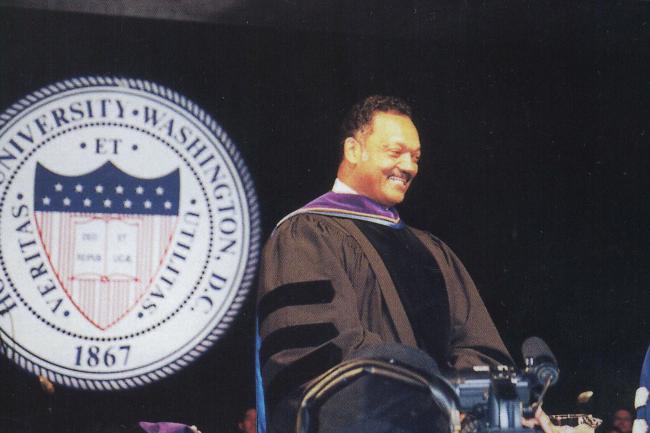
Because of the courageous life work and advocacy of Reverend Jesse Louis Jackson Sr. (D.H. ’70), the link in the chain of history that connects democracy and human rights is incalculably stronger. A titan of the Civil Rights Era, he served as a lieutenant in Dr. Martin Luther King Jr.’s Southern Christian Leadership Conference, confronting segregation and discrimination, challenging economic inequities, pushing for voting rights, and forcing the nation to open doors of equality that he later walked through on his quests for the highest office in the land. His impact on the American political system was like an earthquake that shook its very foundations, and from its rubble a more inclusive process was built — one that more closely mirrored the principles expressed in the Constitution and Declaration of Independence. He held America to account for its treatment of all its citizens and was unyielding in his demands for unquestionable, unapologetic equity. His impact extended well beyond politics, however. Having grown up in poverty as the son of sharecroppers, Jackson ensured that young people embraced their full potential regardless of their socioeconomic background, leading crowds around the world in chants of "I am somebody." And when Jackson opened doors, he held them open for others to follow him through.
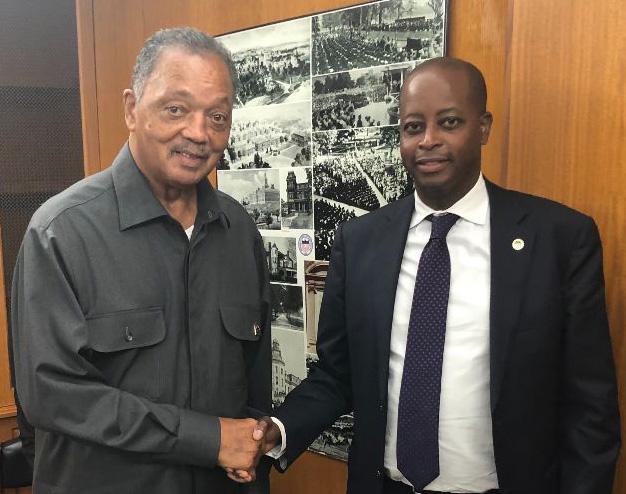
“What stood out most was his unwavering clarity of purpose, his moral courage, and his abiding faith in young people as agents of change,” said Wayne A. I. Frederick (B.S. '92, M.D. '94, MBA '11), interim president, president emeritus, and Charles R. Drew Professor of Surgery, in a statement to the Howard University community. “He believed, as we do at Howard, that each generation inherits both the responsibility and the opportunity to advance the cause of justice, and that leadership must be rooted in service and that hope must be made visible through action.”
Jackson’s presidential campaigns in 1984 and 1988 were milestones in American democracy. In order to change the political system, he realized that the demographics of the electorate would have to change. Jackson’s aggressive voter registration drives enfranchised people from previously marginalized minority and LGBTQ+ communities, women, and disaffected white rural voters, many of whom have become consistent voters. By late March 1988, Jackson was the front-runner in the Democratic primary, an unheard of feat for a Black candidate. He forced the Democratic Party to change the way it made presidential nominations, allying with other leaders to award delegates more openly and transparently. But perhaps most impactful was just his highly visible example. Less than two decades after the passage of the Voting Rights Act, Jackson was the first Black candidate for president taken seriously by the political establishment. His courage, confidence, charisma, eloquence, and the depth of his ideas inspired countless future leaders to believe that they too could make a difference in this country.
Clarence Lusane (M.A. ’94, Ph.D. ’97) worked on Jackson’s 1984 and 1988 campaigns before coming to Howard for graduate school and eventually becoming chair of the Department of Political Science. He followed in the footsteps of Ronald Walters, Ph.D., a longtime adviser to Jackson who also chaired Howard’s political science department and helped devise Jackson’s campaign strategies. Lusane remembers vividly Jackson’s work to bring people together.
“He was a unifier,” said Lusane. One of the things that was a strength of Jackson is that he brought together wildly different parts of the Black community in terms of politics. You had people who were Black nationals, people who were liberal, people who considered themselves socialist, women who considered themselves feminist — Jackson brought all of those communities together. He also reached out to farmers, people in the peace movement, people who were working on environmental issues, and people doing anti-nuclear work. He really had a vision of what eventually would be what he called the Rainbow Coalition — not just this group or that group, but people who could unite around a progressive agenda.”
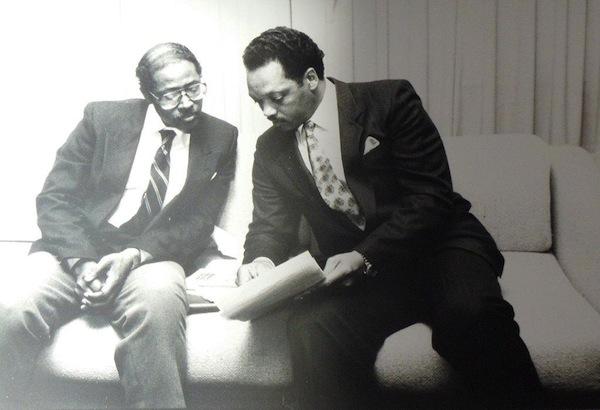
Walters taught at Howard for a quarter of a century and was one of the most respected political scientists in Washington, having worked with the Congressional Black Caucus in its infancy and serving as an architect of the anti-apartheid strategy related to South Africa. Jackson immensely respected Walters' knowledge of political processes and the nuances of the electoral system. Working with Jackson, Walters was instrumental in engineering a change to the process of selecting delegates who chose the Democratic presidential nominee, moving from a state primary system where each candidate who received votes in a given state received a proportional share of delegates from that state if they received a relatively high minimum percentage of the vote to a system where candidates could receive delegates even if they received fewer votes. Each of those delegates had a voice in shaping the party's infrastructure, and the new system allowed candidates like Jackson to earn a significant number of nominating convention delegates even if they didn't win the primary. Those delegates, in turn, could shape the rules of the party and its nominating convention. It gave Jackson tactical leverage inside the party, and his delegates were able to force through changes to the party platform and other significant policies. Members of Jackson's political team eventually became highly influential officials in the party and in the government. Ronald H. Brown (LL.D. '93), for example, led Jackson's 1988 convention team before becoming Democratic National Committee Chairman and then United States Secretary of Commerce in the administration of U.S. President William Jefferson Clinton (LL.D. ’13). Alexis M. Herman (LL.D. '97) also managed Jackson's convention teams and eventually became Clinton's United States Secretary of Labor. A constant and trusted consultant and confidant, Walters' work with Jackson changed the whole perception of advisers to a political campaign, according to political scientist Elsie Scott, Ph.D., who is the founding director of Howard's Ronald W. Walters Leadership and Public Policy Center.
"Ron Walters was the best known political scientist around," said Scott. "Reverend Jackson expected to win, and that's the reason he pulled in Ron Walters to plot the strategy needed to win the presidency. Once people saw that he could carry South Carolina and other states, they decided that they weren't throwing their votes away, because Jackson was out to win."
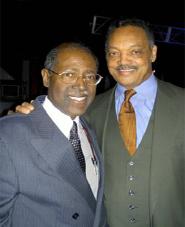
A close friend of Walters', Jackson ministered to him during his terminal illness and eulogized him at his funeral and burial. When the Walters Center was established, Jackson served as one of the first members of its Advisory Council. Today, the center remains an important voice in public policy development and analysis, carrying on the legacy of Walters and the spirit of Jackson.
"When some Black leaders were downplaying the ability of Rev. Jackson to run a credible race for President, Dr. Walters gave him data and policy analyses that supported the slogan, 'Run Jesse Run,' read a statement by Scott and Patricia Turner Walters, chair of the Ronald W. Walters Leadership and Public Policy Center. "In the words of Jesse Jackson Jr., 'Dr. Walters was the driving force behind the adoption of proportional allocation of delegates in the Democratic primary system.'"
Jackson set the stage for scores of formerly locked-out civic servants to have a seat at the table and forever changed the way we elect our leaders. Much of the system Jackson helped create is still in place today. U.S. President Barack Obama (LL.D. ’07, D.Sc. ’16), for example, used the proportional delegate system as his key to winning the presidential nomination in 2008 before eventually being elected president of the United States.
“A lot of the discussion about Rev. Jackson now is that he was wonderful, but when he ran in 1984, there was resistance from the Democratic establishment, from other church leaders, and from other civil rights leaders,” said Lusane. “But there was grassroots support. By the time we get to 1988, Jackson is really a power force in the party, and the Rainbow Coalition is really driving a lot of activism. He doesn’t win the nomination, but he changes the party. Jackson’s work to make the party more democratic in terms of the nomination process laid the foundation for Obama to win in 2008.”
Jackson was a proud graduate of a sister historically Black college or university (HBCU), North Carolina Agricultural and Technical State University (NCA&T), and a student leader. He was student body president and a member of Omega Psi Phi Fraternity, which was founded on Howard’s campus. As a student, he rose within the organization to become the Second Vice Grand Basileus, the highest role for an undergraduate. With an unwavering faith in the power of young people, Jackson made Howard University an integral part of his ongoing public engagement even as he rose in prominence. His daughter, singer Santita Jackson, attended Howard and became a member of the Alpha Chapter of Delta Sigma Theta, also founded on Howard's campus with a mission to serve. As her father was leading Washington, D.C. protests against the South African apartheid government while she was a student, Santita Jackson ventured into the nation's capital to protest as well, as did her Howard classmate Kamala Harris (B.A. '86), who would go on to become the only woman vice president in the history of the United States. Later, as a law school student back in her home state of California, Harris sported a "Jackson for President" bumper sticker on her car.
"The chants of 'I am somebody' had poor, young, forgotten, disrespected, rejected, and unprotected people lifting their heads, getting involved, knowing that they were God’s children," read the statement from Walters and Scott.
Rev. Bernard Richardson, Ph.D. (B.A. ’75), dean of the Andrew Rankin Memorial Chapel, knew Rev. Jackson for the better part of 40 years. He was with Jackson during many of his visits to Howard, and remembers Jackson’s ability to connect with people on the highest rungs of the societal ladder while also having the common touch.
“What was special about Jesse is that he could speak truth to power and also speak truth to the powerless,” said Richardson. “He just had a way of speaking to the hearts of people. I think that’s what allowed him to go to other countries and bring back hostages. He knew the basic humanity of people and he had hope in the basic goodness of people. He understood that the potential for goodness is there in each and every one of us. He was always the same person, whether he was with students or members of Congress, politicians, or religious leaders. I think that’s why he was respected.”
Jackson's speeches are legendary, and his 1984 and 1988 Democratic National Convention speeches are both among American Rhetoric's top 50 speeches of the 20th century. "Keep hope alive," Jackson would often say as his soaring oratory inspired millions through their television screens and newspapers. Just as important, however, was his lifetime of work on the ground. As a college student, he was arrested while protesting a segregated library in North Carolina. He led marches during the Civil Rights Movement and mobilized masses to confront discriminatory businesses as head of Operation Breadbasket and later Operation PUSH (People United to Save Humanity). It was his grassroots work that put him in closest connection with those advocating for justice on the front lines, and also put him in danger. Richardson points out that Jackson persisted boldly even as others fighting for the same cause were killed. His courage is something Richardson believes should not be taken lightly.
"Jesse would talk about times when you have to be on the right side of history but on the wrong side of public opinion," Richardson said. "He understood the cost and lived with it."
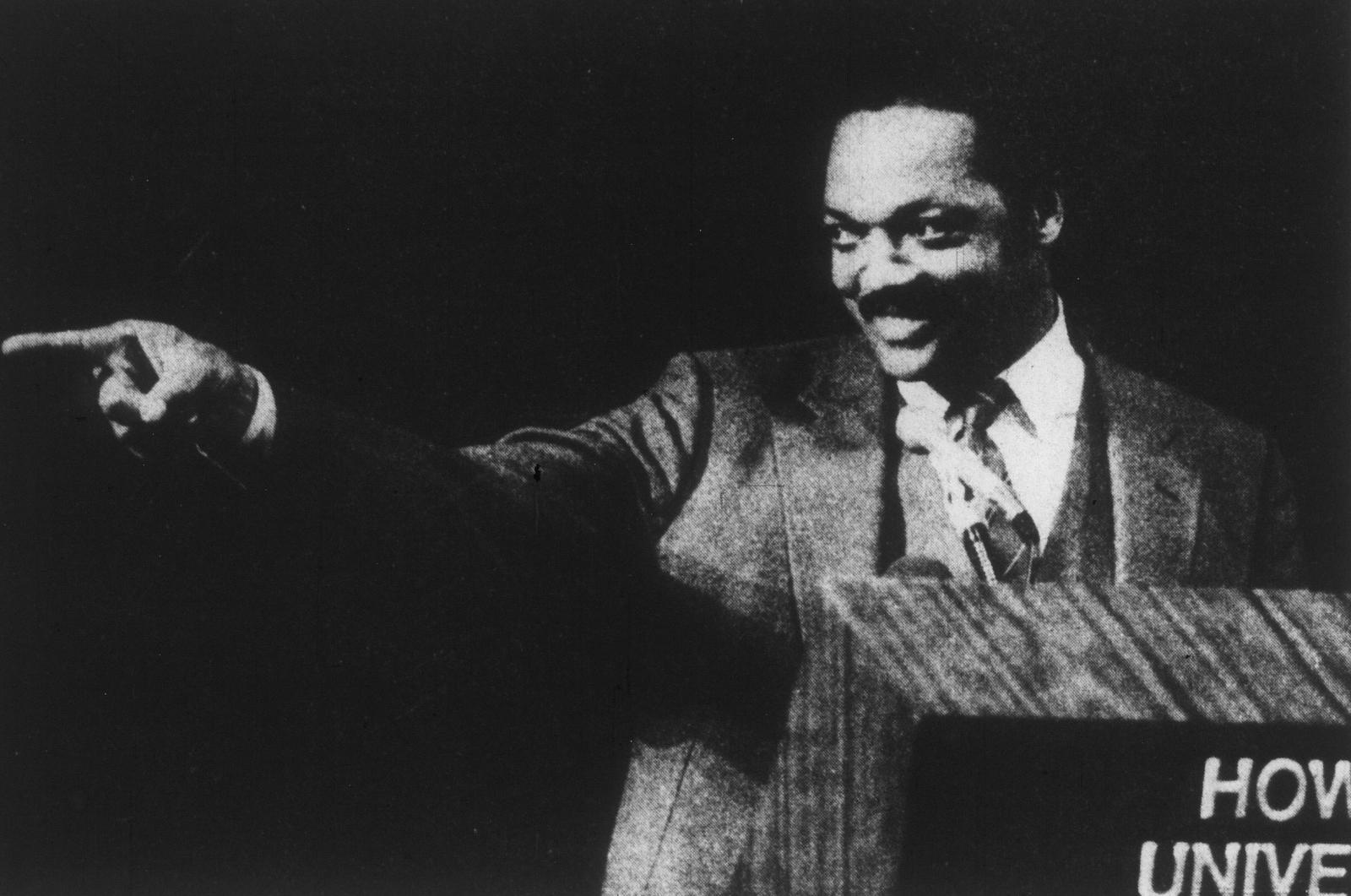
Jackson had a house a few blocks from Howard and visited campus frequently, not just to give speeches and take photographs, but to substantively engage with students, faculty, and other civil rights and public policy leaders who used Howard’s campus as a connection point. Jackson asked Howard students to follow in the footsteps of the young leaders who energized the Civil Rights Movement by tackling the most urgent issues of their time. During his speeches at Howard, he called the highest-ranking elected leaders to account while also demanding that everyday people do their part to make life better for themselves and others. He served as Howard’s Commencement speaker in 1970 and was presented with an honorary doctorate in the humanities. He marked the first national holiday honoring King in January 1986 by coming to Howard and delivering a passionate speech in which he implored listeners to contextualize King’s “I Have a Dream” speech not as an amorphous, idealistic, futuristic fantasy, but as a call for immediate action.
“Jackson came out of the HBCU environment and was big promoter of it,” Lusane said. “So his coming to Howard or Grambling or Spelman was like coming back to family. He would have the kind of discussion and engagement at Howard that was really about the political and moral future of the Black community and the need for students to be on the front lines. Those would be the discussions he would have as he presented an overview of the issues of the moment, whether it was around voting rights, civil rights, or workers issues, he would give it a context of calling for students to take responsibility and be part of the leadership.
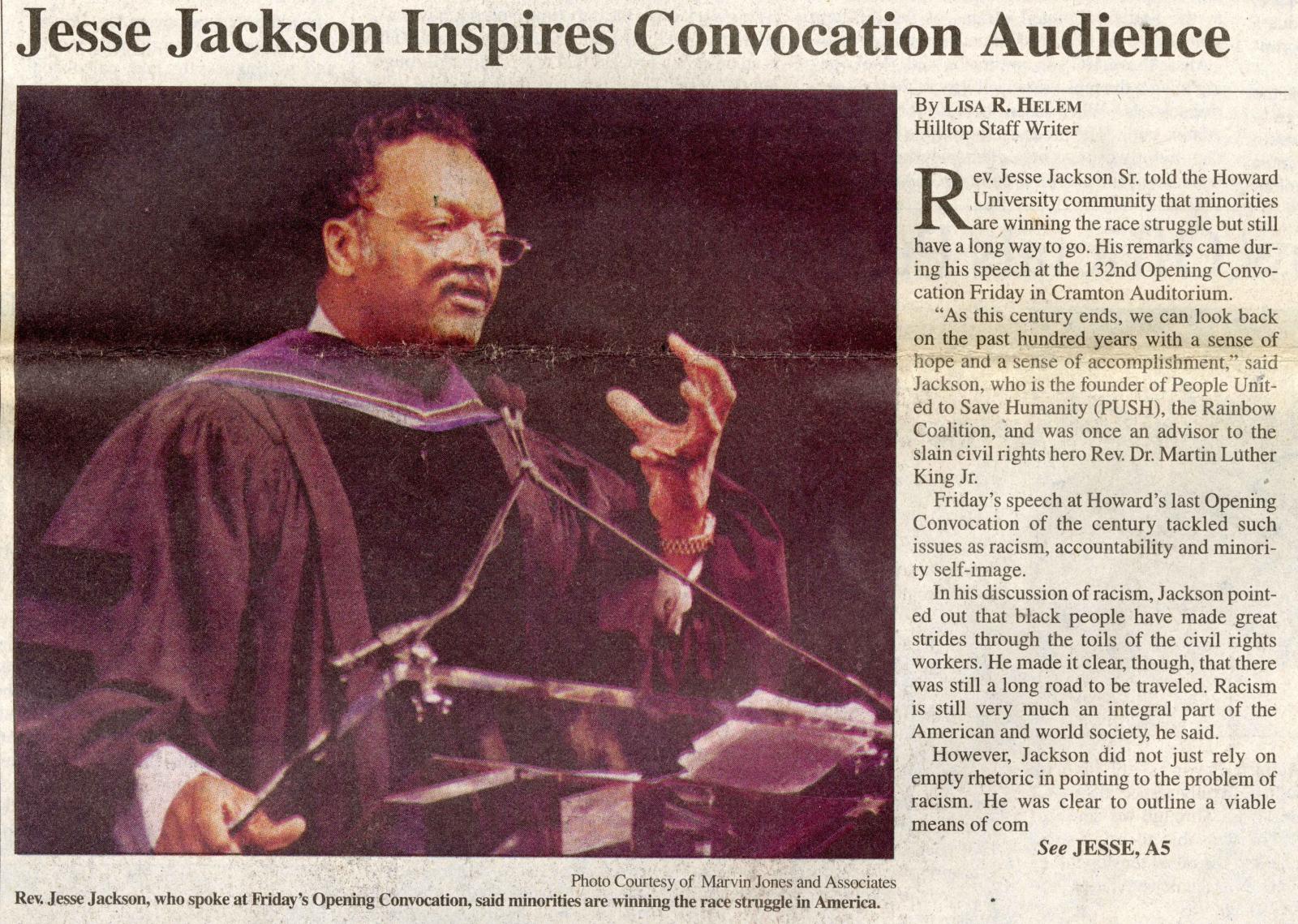
During a Jan. 18, 1985, speech in Cramton Auditorium marking Rev. Dr. Martin Luther King Jr.’s birthday, for example, Jackson demanded that the Reagan administration cut ties to the racist South African apartheid government and argued against cuts to social programs affecting the poor and minorities. He also pushed the students to do more to end drug abuse among youth.
“He really was impressed with students and believed we could be hopeful because of what they were doing on campus,” said Richardson. “He was really behind them. When we talked about the movement, he understood that the heart of the movement would come from young people on college campuses.”
Jackson didn’t just give a motivational speech to the students seeking to become future leaders; he challenged them to be active participants in solving the challenges facing the world at that moment. Known for his knowledge about international affairs, Jackson used the occasion to involve students in the intricacies of foreign policy, painting the drug epidemic as a full-fledged national security issue in which South American drug dealers were seeking to undermine the United States from within.
Jackson was involved in addressing virtually every major civil rights issue of the past seven decades. His commitment to the cause was ceaseless. He was well known for showing up whenever there was a battle to be fought for justice and dignity, and he didn’t shy away from challenging his friends. His unrelenting pressure helped force the U.S. Congress to adopt sanctions against the apartheid regime in South Africa. He led boycotts which pushed corporations to eliminate discrimination in hiring, promotion, and leadership. He helped give global visibility to the incarceration of South African freedom fighter Nelson Mandela (DHL '94) and came to Howard’s campus to see Mandela receive an honorary degree on The Yard. His success in registering Black voters led to a surge of Black elected officials, particularly in the South. Jackson was prolific in finding common ground among different segments of society, but his work often faced high hurdles.
It was perhaps fitting that Rev. Jackson returned to deliver the final Opening Convocation keynote speech of the 20th century on Sept. 24, 1999, during which he put the millennium in perspective. His remarks in Cramton Auditorium were hopeful but cautionary, noting the nation’s progress in the journey towards equality but acknowledging the depth of work yet to come. As was his custom at Howard, he didn’t shy away from addressing high-level national and international policy, using his speech to inspire Howard students to aspire to the highest standards.
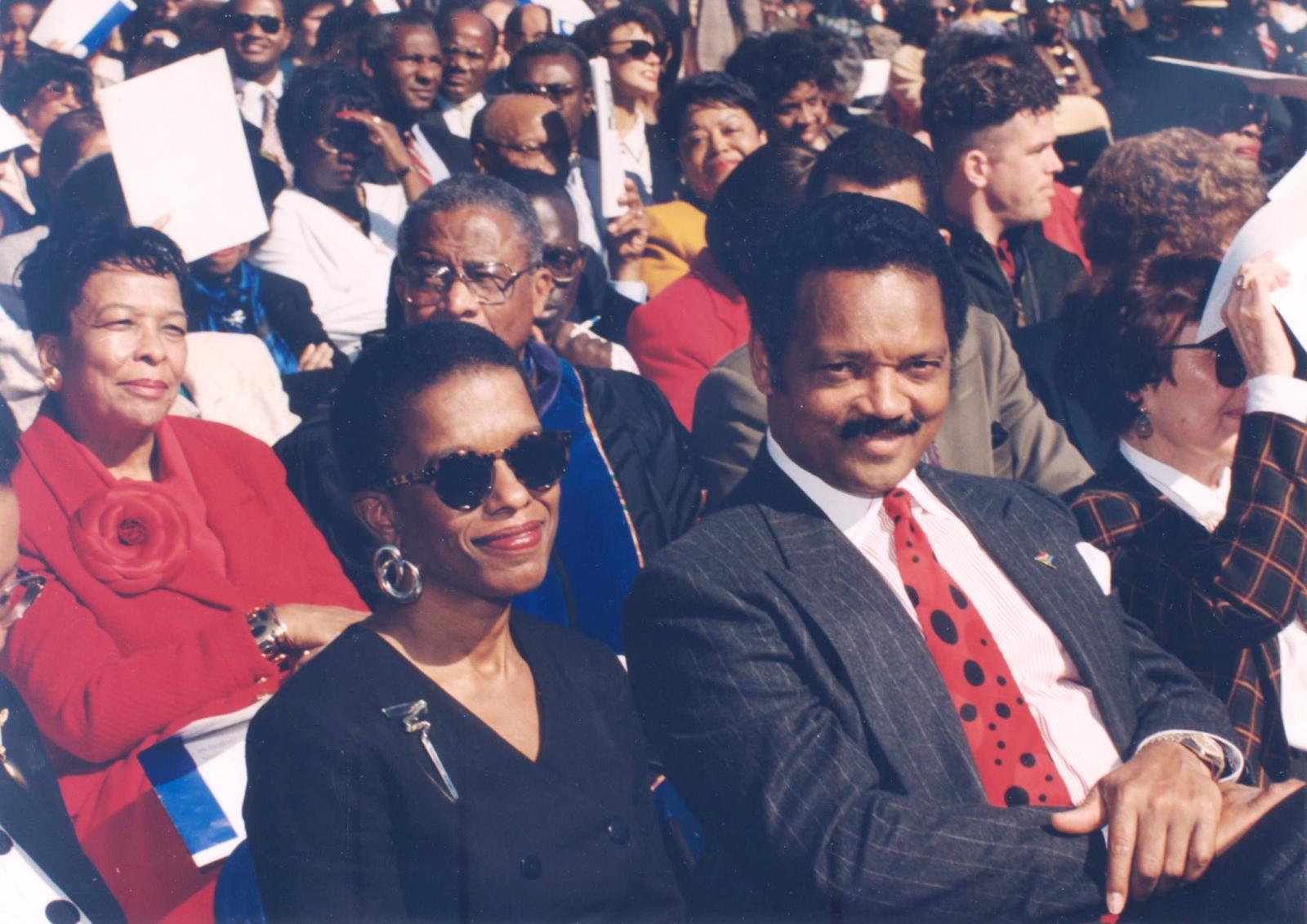
“You cannot strive for a big goal if you think of yourself as a grasshopper,” he said. “Strong minds beak strong chains.”
In his 80s, Jackson was still showing his support for students, on campus and beyond, including Payton Garcia. Garcia, now Howard University Student Association (HUSA) vice president, grew up spending time with Jackson and his family in Chicago's Hyde Park neighborhood. Garcia viewed Jackson as a living legend and was inspired by Jackson's ability to overcome personal challenges as well as those related to his work in social justice. After he enrolled at Howard and became a student leader, Garcia looked to Jackson's time as president of the NCA&T student body as a model for his work through HUSA.
"Prior to when he got much of his acclaim during the Civil Rights Movement, he was already very involved in the rights of his own students and those of students at Historically Black Colleges and Universities," said Garcia.
Lusane emphasized the importance of ensuring that the lessons from Jackson’s legacy transcend generations and is taught to Howard students today and in the future.
“He was a servant. He had a moral calling to do the right thing, to give people hope, to be active and on the ground. I think he has to be remembered as one of the major people in this country to push democracy forward in the second half of the twentieth century. He was just a bridge to the next period.”
Clinton awarded Jackson the Presidential Medal of Freedom in 2000. Even though books have been written about Jackson and tributes are now pouring in, Richardson feels like Jackson's message will have even more resonance in the years to come.
"When you are spreading that prophetic message, not everybody is going to accept that message at that time," said Richardson. "But they will come to understand it."
Keep Reading
-
 News
NewsHoward University Names Jasmine Gurley as Senior Director of Public Relations
Oct 14, 2026 3 minutes -
 *Accolades
Howard University CEA Professor Sonya Smith Elected to AIAA Class of 2026 Fellows
Sep 28, 2026 3 minutes -
 *Legacy and History
Cathy Hughes School of Communications Honoring Legacy Through ‘55 for 55’ Celebration
Oct 15, 2026 4 minutes