

As part of the university’s Black History Month programming, the Office of Corporate Relations facilitated an event with the Warner Music and Blavatnik Center for Music Business Education titled, “Power & Platforms: The Influence of Entertainment of Social Change.”
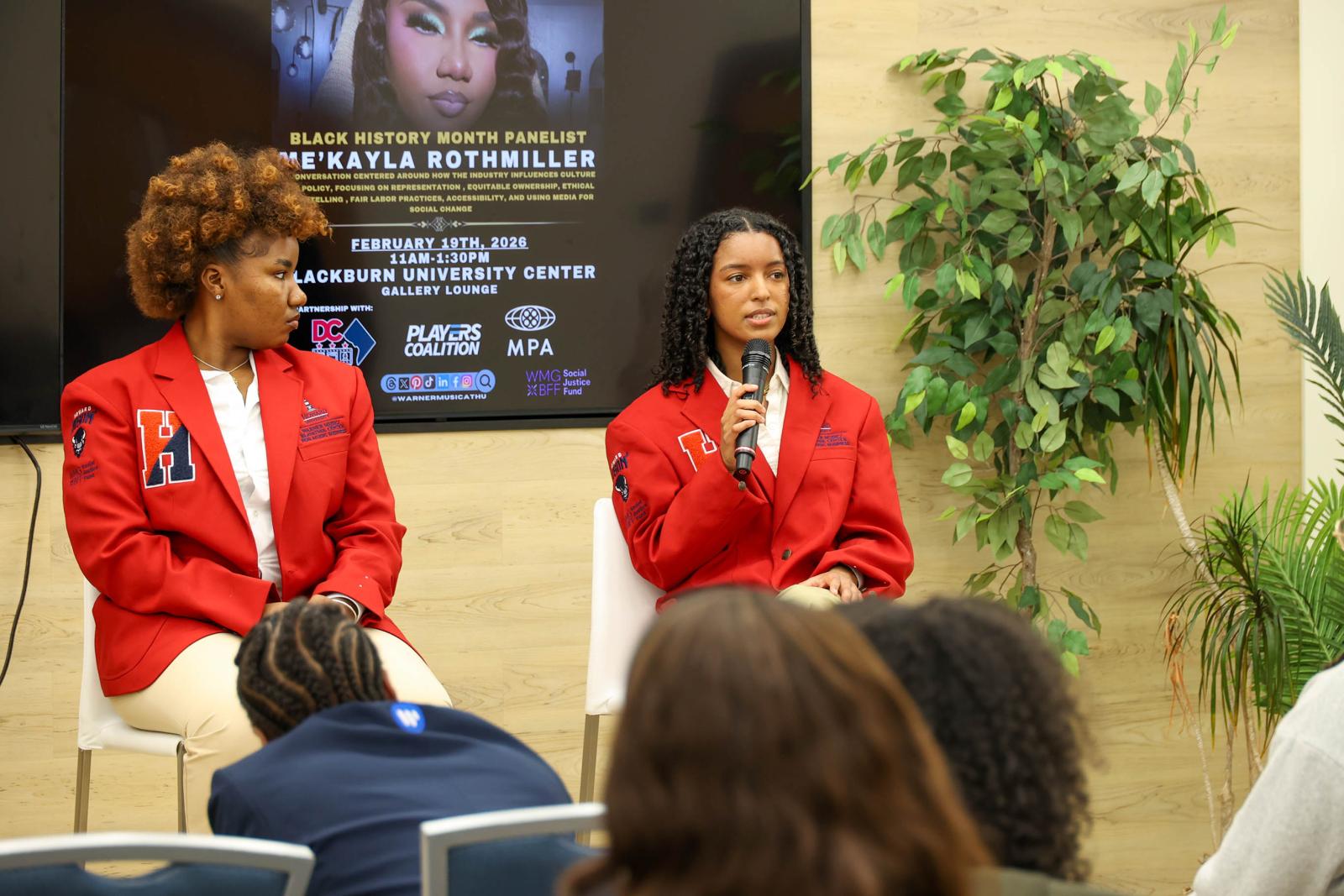
Graduating seniors and artists Me’Kayla Rothmiller and Aralyn Hillard sat alongside esteemed members of the entertainment industry and the government discussing how the industry shapes public discourse, influences policy, and impacts community outcomes.
Advocacy being the core of the discussion, moderator Jordyn Taylor (B.A. ’24) kicked things off by asking the panelist what advocacy means to them.
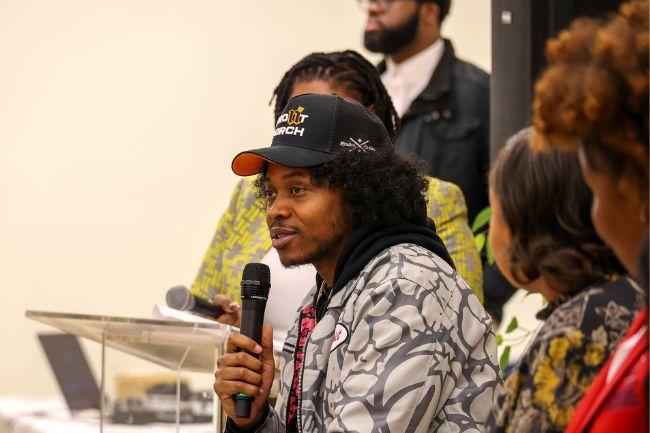
“Being an artist from this area and trying to lend your voice to the story that we tell is where my advocacy begins,” said artist Noochie, a DMV-based rapper and host of the popular, independent music series “Noochie’s Live From The Front Porch.”
Based out of his Temple Hills, Maryland home (or the front porch of said home), Noochie’s series showcases live performances from local and mainstream artists. He feels that his advocacy is at its strongest due to that fact that he was able to bring regional representation to a national and global audience via social media platforms — gaining the attention of national artists and in turn amplifying the stories coming out of his community.
“Having Snoop Dog and Pattie LaBelle come here and work with Go-Go musicians, and people of the culture actually having to pull up to our spot and embrace it — I feel like that’s where the advocacy is at its strongest,” he explained.
The Power of Advocacy and Mentorship
For the students in the room, using their voices to make sure that their concerns, opinions, and beliefs — as well as those of the people around them — were heard is something they’ve been doing since grade and high school.
“I will honestly say my advocacy began when I gained consciousness,” said Rothmiller, a radio, television, and digital communication major. “Always, since a child in elementary school, I felt like I should be able to speak up for how I felt or speak up for how a peer felt.”
Hillard, a singer-songwriter and student in the College of Arts and Sciences echoed her fellow Bison, stating that she found her voice and confidence to lead and desire to be of service while attending military school. “Advocacy for me means service, because I’m not always the loudest, so I got involved in a lot of nonprofits in my city,” she said. “Now, being at Howard and having access to so many people that are wanting to do big things, I think just being involved and figuring out what people’s missions are and how you can mobilize people to join, has really been the process for me.”
Seeking out mentors who have walked the path you are currently walking, or who’ve fought a similar battle, is always a good idea. They often understand the inner workings of organizations or industries, as well as process and procedures to get things done — not to mention the laws and policies that influence one’s ability to mobilize, for example, and ultimately move the needle toward the change being sought.
When asked what knowledge she hoped to impart upon the students before the panel discussion began, Renata Colbert, the director of State Government Affairs at The Motion Picture Association, stressed the importance of understanding policy.
“You can have all the access you want, but policy creates that avenue, and without an understanding of how a bill becomes a law, and how your craft is affected by policy, you would do yourself a disservice.” –Renata Colbert
“You can have all the access you want, but policy creates that avenue, and without an understanding of how a bill becomes a law, and how your craft is affected by policy, you would do yourself a disservice,” she explained. “So, while they’re in the foundation and the learning phase, I want them to know, in order to fine tune that craft, you have to know the policy part of it, and that governs how successful you can be.”
Colbert’s own advocacy journey started after college when she began working on Capitol Hill, which taught her the significance of understanding policy. “Advocacy for me is expanding policy and working with legislators across the board to make sure those policies don’t limit what you want to do,” said Colbert.
“For me, my advocacy is giving back,” said Monique Davis-Carey, chief of staff in D.C.’s Office of Cable Television, Film, Music and Entertainment. “Someone taught me how to move and groove and shake in the music industry, and I continue to give back, being a part of different activities for the youth.” She went on to encourage the young people in the room to tap into the experience that she and her peers have to give. “We have experience and knowledge,” said Davis-Carey. “There are some things that we still got in our pockets.”
Industry Insight
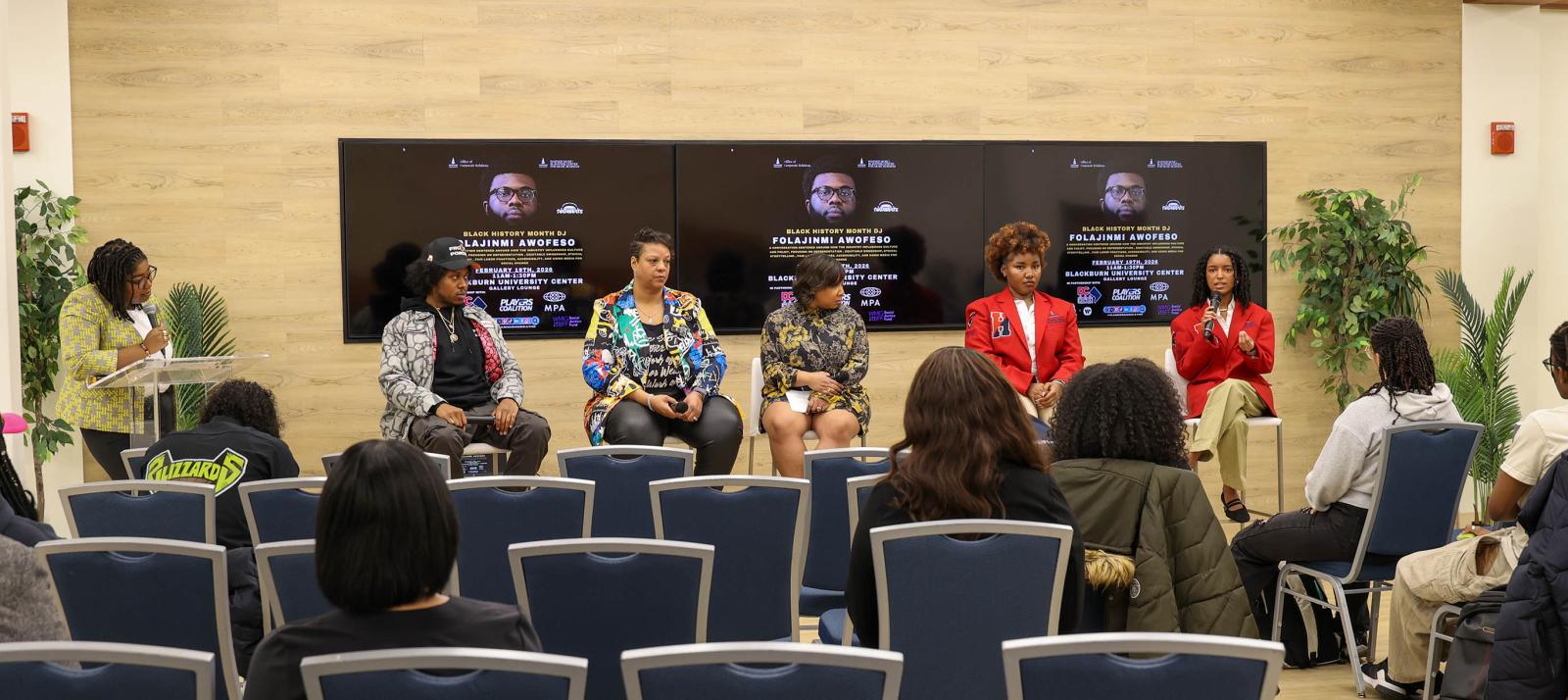
In addition to advocacy, the panel discussed representation and the artists, executives, and media producers’ responsibility when it comes to making sure it happens.
“As an artist, I personally feel like our responsibility, first and foremost, is to create,” said Rothmiller. “The things that we are being told to create, by our ultimate creator, is for a reason. And in that moment of creation, we might be able to create another perspective for somebody to go out into the world and move in a different way.”
She explained that artists must reflect current times with their art, which can sometimes get heavy. This is why, according to Davis-Carey, one responsibility of those who may be in an executive capacity or representing an organization like hers is to be available to artists in need.
“Our responsibility is creating a safe space for artists to come to,” she said noting that musicians, for example, often express not having anyone to talk to. “I think that is very important and I think becoming a mentor is important.”
Giving back and participating in events like this one were also mentioned by the panelists, as was learning about aspects of the industry (and potential career pathways) that may be lesser known to those in attendance.
For example, Colbert shed light on how her agency can have a major impact on the economy, explaining how rallying for films to be made in D.C. can bring financial security to many in the community.
“Our industry, the motion picture and television industry, supports over 2,000,000 jobs worldwide, and the production tax credits that we promote, protect, and defend nationally, those are economic drivers, and that is the domino effect of a studio coming into a city,” explained Colbert. “Here in D.C., the ‘House of Dynamite’ filmed here and infused $5 million into the economy.”
She went on to use the state of Georgia as a bigger example, noting that the movie “Superman” infused $82 million into its economy. “You can imagine if you own a business in Georgia, you have a sliver of that pie,” she said. “So, understanding that the motion picture and television industry is a driver of economic opportunity for everybody; everybody gets a sliver of the pie when Hollywood comes to town.”
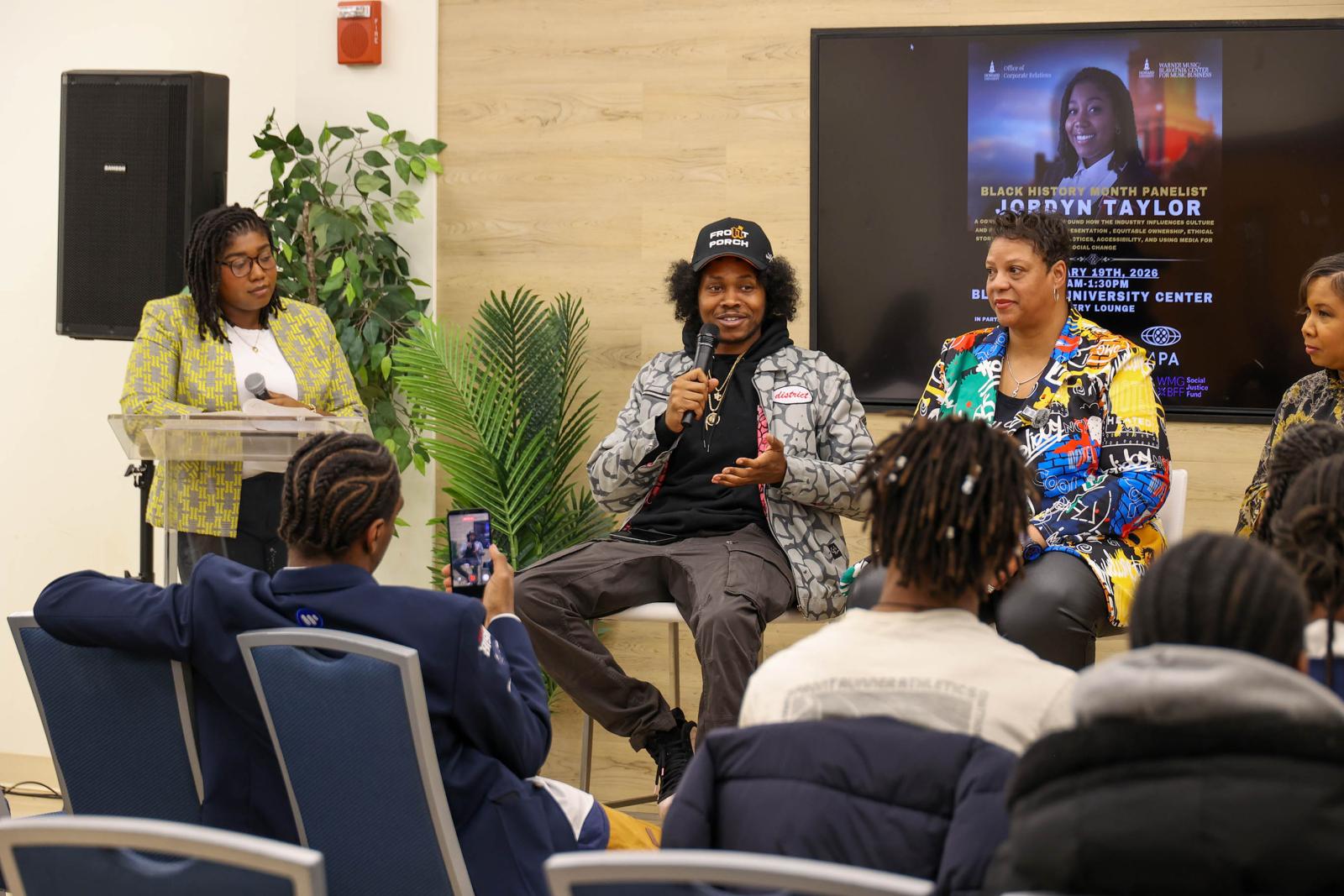
The panel closed out with a few questions from the audience, which resulted in a promise of connection and possible mentorship between a student panelist and a student in the audience, as well as advice from the panelists.
Davis-Carey told students to acquire more than one skill and go beyond what’s in their job description. “You need to become valuable; you want them not to be able to live without you,” she said, going on to advise stepping out of what’s comfortable, and stressing that artists should encourage each other.
Sometimes networking can be one of those uncomfortable things, but doing so was a common thread in all the advice shared by the panelists. Hillard credits her mentors with helping her learn how to network in a way that not only demonstrates what you have or can offer, but also how you are able to align with people, create mobilization, and use your resources in ways that are beneficial to all.
“Know what you have — so much of leadership comes from competence — but also know how what you have can help others,” Hillard shared, quoting one of her mentors. “I think that’s a key thing that we sometimes miss networking with people.”
When asked to reflect on his success and offer his own words of encouragement for the young Bison in the room hoping to one day emulate his success, Noochie said to be yourself and move with pure intentions.
“I got where I’m at by being authentic, that’s really all I know how to do,” said the NAACP nominated rapper and host. “At the end of the day, if my intention was anything other than representing us well, and representing D.C. well, representing Black people well, representing Black music well, representing the culture well — I don’t feel like it would even get to the point of people recognizing it.”
Other advice revolved around the purpose of social media, and the necessity to produce content that resonates. “Instagram is pretty much a business card now, use it as such,” he added.
One lasting piece of advice was for when the art, and the artist, start to “blow up.” Speaking from his own experience as his platform grew and those visiting his front porch became more and more recognizable, Noochie reminded students to stay focused on what they are there to do: work.
“You can’t let everybody in.”
Keep Reading
-
 Lineage: Howard Students and Alumni
Who’s Bad? Howard University Alum Marci Rodgers, a True Thriller as ‘Michael’ Movie Costume Designer
Jul 16, 2026 8 minutes -
 Culture Creators: Arts and Entertainment
Celebrating the Rhythmic Connection Between Howard University and Go-Go Music During Black Music Month
Jun 30, 2026 18 minutes -
 Artificial Intelligence
Howard University Researcher Kamilah Woodson Develops A.I.-Powered Platform to Expand Mental Health Support for Students
Jul 31, 2026 6 minutes