

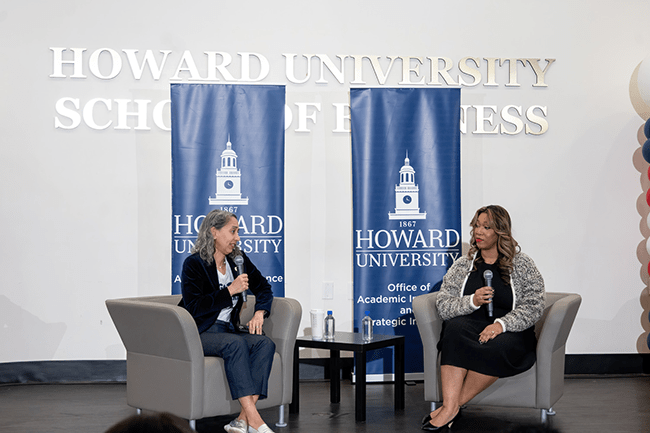
On Tuesday, Feb. 17, students packed into the Howard University School of Business auditorium to listen to a conversation between Dr. Talitha Washington, executive director of Howard University’s Center for Applied Data Science and Analytics, and Ashley Gatewood, head of change and transformation strategy at Google.
Over the course of three sessions, Dr. Washington and Gatewood discussed the growing importance of artificial intelligence in addition to how to tackle professional setbacks and remain authentic to oneself as a leader.
Barron Harvey, associate provost for Academic Innovation and Strategic Initiatives and Dean Emeritus of the School of Business, welcomed students to the event.
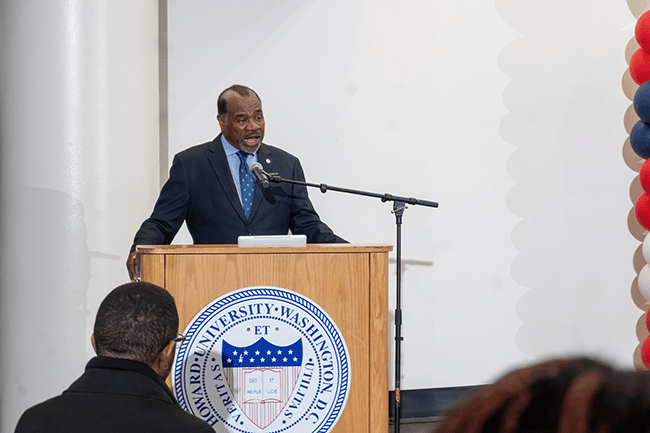
“This lecture series is designed to provide a platform for thought leaders, policymakers, executives, experts, all who want to come to Howard and share their perspective with its extended community,” Harvey said. “We are grateful to the Howard University School of Business and the award-winning 21CAP Program for playing host to this important event.”
Balancing Human Understanding and Hard Skills
During the chat, Gatewood, who studied both marketing and operations and information management at Georgetown University, emphasized the need to balance human-centered approaches with tech-focused hard skills, and to learn to take a long-view of situations as a leader.
“Marketing is a great field to go in. It will help you understand human behavior and get people to adopt and use your products, but at the end of the day, data and hard skills are going to be so important.”
She recalled how this intersection helped her throughout her career, which includes positions at SAS, Booz Allen Hamilton, and Deloitte. Gatewood pointed specifically to how it shaped her career as a consultant.
“That is where I really fell in love with the intersection of people and technology, and I didn’t expect to fall into that,” she said. “Consulting really taught me what I would call ‘systems thinking’ — the ability to not just look at a specific moment in time or event that was happening but to really think bigger and look at the causality of situations. For example, if we create a new system or we change a policy at a company, how do we then in six months look at how that changed the culture of our organization.”
Being a Leader in an AI World
Much of the discussion — in particular questions from students — centered on how AI is transforming the business landscape. While Gatewood spoke optimistically about the technology, bringing up its efficiency and the rise of new uses like “vibe coding,” she again emphasized the balance of the human and the technical, and praised the ongoing discussion around the ethics of AI.
“In an environment where there is a lot of fear about AI, the idea that we are making sure our lens for product development is around the human is so critical at this point in time,” she said, before talking about the possibilities of agentic AI — machine learning models that can complete specific tasks with minimal human intervention.
“Truly seeing agentic AI making progress is really exciting,” Gatewood said. “Seeing it be able to do more multi-step processes, take on complex tasks, and that in turn freeing up brain space for us to focus on things only humans can compute, things like empathy.”
The chat was a tremendous example of that ongoing discussion, as Gatewood fielded questions from students with genuine concerns about AI’s current and future place in society. Asked about the environmental costs of the technology, for example, she placed it in a larger context of other technological changes that have affected the environment, saying that while the specifics of AI are new, the concept of addressing those costs is an ongoing issue that requires “continuing to mature in figuring out how we work with communities, cities, towns in figuring out where these data centers are going in order to understand the impact and directly address it.”
Resiliency and Confidence
Gatewood also gave insightful, often personal advice on dealing with resiliency and setbacks. During the second session, a student brought up her LinkedIn article “The Big Lie About Resiliency,” which ends with the advice: “The most important truth about resilience is that when you let go of the way that things have always been or what you perceive that they should be, you create room for improvement.”
I could lose it all today and still be who I am; I would still have the love of my family, and I would still be able to pick myself up again.
The student asked how her experience of losing a dream consulting job three months after giving birth informs her instincts in her current role at Google. Along with a better understanding of her own personal strength, Gatewood spoke about how it changed her understanding of where she placed her career in her life.
“At the end of the day, going through that showed me that we can’t and should not be defined by our careers,” she said. “I could lose it all today and still be who I am; I would still have the love of my family, and I would still be able to pick myself up again.”
She also emphasized the importance of not just picking yourself up but having a community to support you.
“If you are going through a hard time, if you’re not sure where your career’s going, if you’re experiencing difficult things in your own personal life, know that you can be resilient; you can bounce back from that. And make sure you have a village that’s going to help you, because I would not be here today without the people that supported me.”
All three sessions of the chat were streamed live and are available to watch on the Howard University YouTube channel.
Keep Reading
-
 News
NewsHoward University Names Jasmine Gurley as Senior Director of Public Relations
Oct 14, 2026 3 minutes -
 *Accolades
Howard University CEA Professor Sonya Smith Elected to AIAA Class of 2026 Fellows
Sep 28, 2026 3 minutes -
 *Change Makers
Howard University Trustee Arne Duncan’s Anti-Gun Violence Organization Takes the Spotlight in Documentary
Oct 2, 2026 6 minutes