

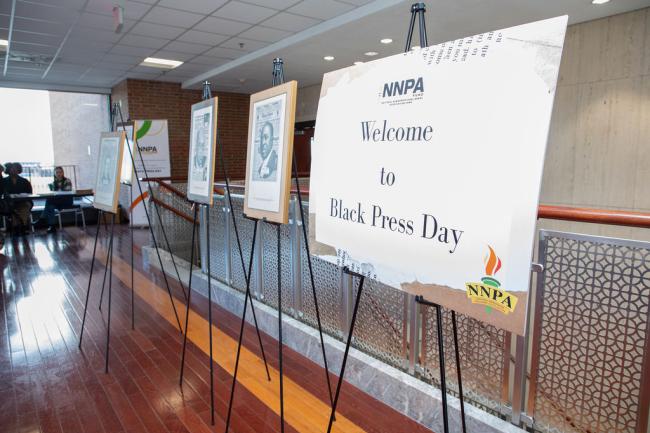
Howard University’s Moorland-Spingarn Research Center hosted journalists, publishers, students, and industry leaders this week for Black Press Week 2026, a five-day convening that examined the future of Black-owned media as the industry approaches its 200th anniversary. Organized by the National Newspaper Publishers Fund and Moorland-Spingarn.
The event, which convened March 16-20, centered on the theme, “Truth, Trust, and Technology: Approaching 200 Years of the Black Press in a Transforming Information Age.” The event linked the Black press’ historic mission to today’s debates over artificial intelligence, archives, credibility, and community accountability. The week aligned with the March 16, 1827 anniversary of Freedom’s Journal, widely recognized as the first Black-owned and operated newspaper in the United States.
The marquee reception was serenaded by the Howard University Community Choir who sang several touching Gospel renditions. The Black Press Day 2026 event took place Mar. 18 at Howard’s Blackburn Center and featured the State of the Black Press address by Rev. Dr. Benjamin F. Chavis Jr., president and CEO of the National Newspaper Publishers Association, as well as the enshrinement of Bernal E. Smith II, publisher of the New Tri-State Defender, in the NNPA Gallery of Distinguished Publishers.
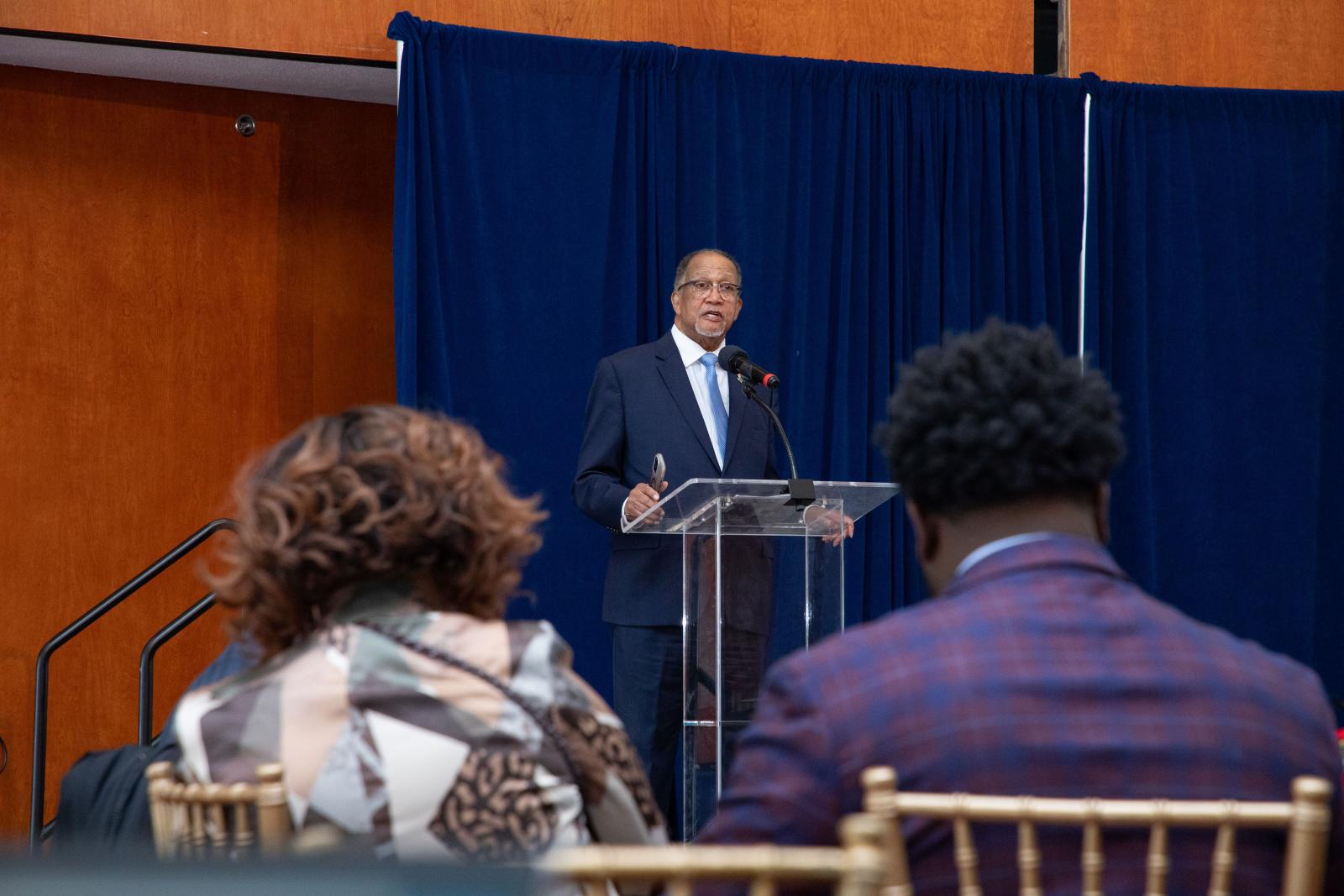
In his keynote remarks, Chavis casted the Black press as far more than a media business, calling it “a moral and historical record” and declaring that it “has never been just about news,” but also about “freedom, justice, dignity, and self-determination.”
Speaking from Howard’s campus, he also praised the “ongoing partnership between the Black press and this prestigious university,” underscoring the role Howard continues to play in preserving and advancing Black media history.
Navigating AI in Journalism
That Howard connection ran throughout the week’s programming. In remarks on the Black press legacy, scholar Dr. Benjamin Talton, professor of history and the executive director of Moorland-Spingarn, highlighted The Hilltop, Howard’s student newspaper, as a key part of the broader Black press tradition. Talton said the paper was born from the conviction that Black people must tell “their own stories on their own terms and with their own voices.”
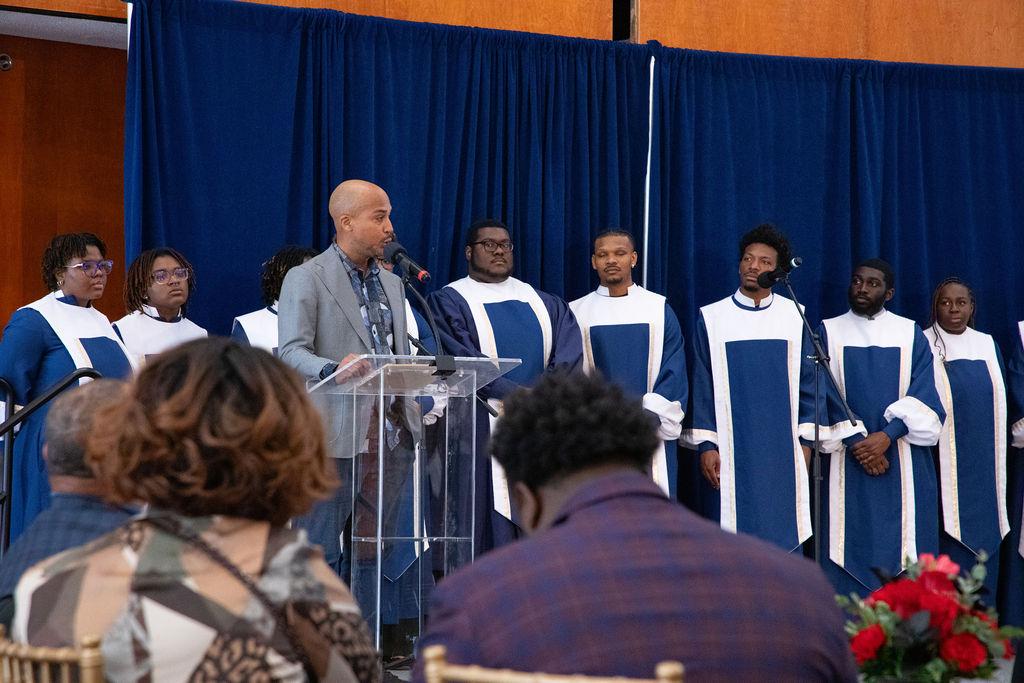
Talton also described Howard as a global institution rooted in the Black diaspora and praised Moorland-Spingarn’s Black Press Archive Digitization Project for preserving fragile historical records so that the words of generations of Black editors and publishers “will not be lost.” The emphasis on archives also resurfaced in the AI panel, where one moderator called the Black Press Archive a “superpower” and “our lifeline” to the work of earlier generations.
A major focus of the week also centered on how Black-owned publications are navigating artificial intelligence without sacrificing trust. The fireside chat included Ra-Jah S. Kelly, who is the chief officer of technology at The Washington Informer; Paris Brown, publisher of The Baltimore Times; Dr. Ingrid Sturgis, an associate dean in the Cathy Hughes School of Communications; and Alexandria Green-Jones, the CEO and founder of AG Media Agency. The discussion was moderated by Philip Lewis, deputy editor at HuffPost.
Panelists repeatedly framed AI as a tool, not a substitute for journalism.
Lewis described AI as “a partner, but a very unreliable partner,” while Kelly mentioned that the work of Black media is “more than just text generation. We need to keep a human in the loop somewhere.”
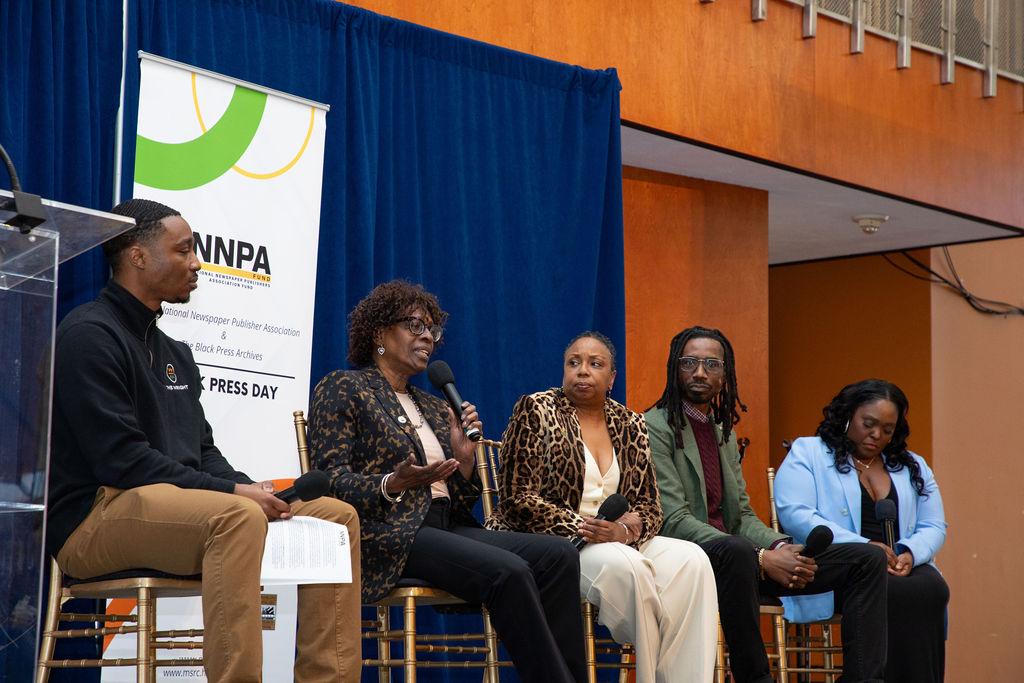
Publishers discussed using AI to streamline design, distribution, and other time-intensive tasks for small newsroom staffs while remaining transparent about when and how those tools are used. Brown said AI allows small publications “to scale and do some things that as a small publication … we’re able to do that we cannot do,” but warned that “there’s an opportunity, and then there’s responsibility.”
That balance between innovation and integrity shaped the event’s strongest conversations. Journalism educators and media professionals argued that younger reporters must still learn how to report and write at a high level, even as AI tools become more common in newsrooms.
“Students do need to go learn how to write, because writing helps you to learn how to think,” Sturgis said, while warning against allowing technology to weaken the Black press’ personal connection to the communities it serves.
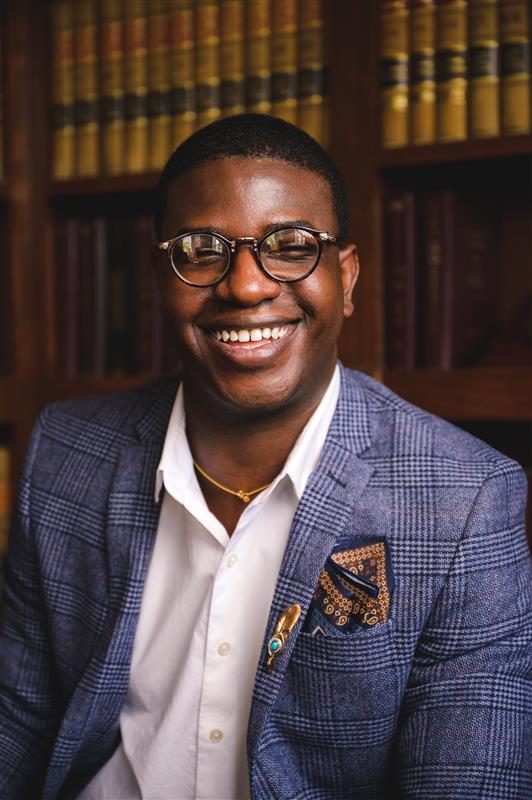
“The event was a tremendous success,” said Brandon Nightingale, senior program manager at Moorland-Spingarn. Nightingale’s department is responsible for digitizing millions of documents that archive Black press across the United States. He and his team do the arduous work of archiving these precious accounts.
“It brought together scholars, students, and the broader community to reflect on the legacy of the Black press while also highlighting the innovative work happening through the Black Press Archives Digitization Project,” Nightingale noted.
Trust, in fact, emerged as the week’s clearest through line. Panelists emphasized that Black media organizations must be explicit with readers about how AI is used, whether in image generation, workflow support, or audience engagement. “You have to let your readers or users know exactly how you’re using it,” Sturgis said, while Green-Jones summed up the panel consensus in three words: “Transparency. Transparency. Transparency.”
That focus reflected the broader purpose of Black Press Week itself — to honor nearly two centuries of Black journalism and prepare the institution for the next era without losing the credibility, community grounding, and truth-telling mission that made it indispensable in the first place.
“I think the entire event went off with minimal hitches,” said Aaron Jacobs, Moorland-Spingarn’s program manager. “It was full of energy, important conversations, and plenty of moments that reminded me why this work matters. It was a celebration, a showcase, and a reminder of the power of the Black press.”
Keep Reading
-
 Legacy and Lineage
Anthony Anderson to Host Howard University’s Fifth Annual Chadwick A. Boseman Day
Aug 20, 2026 3 minutes -
 Culture Creators: Arts and Entertainment
A Howard University Alumna Rises in the World of Poetry
Aug 18, 2026 7 minutes -
 Artificial Intelligence
Howard University College of Engineering and Architecture Expands STEM Pathways with Transformative Summer AI and Robotics Programs
Aug 14, 2026 4 minutes