

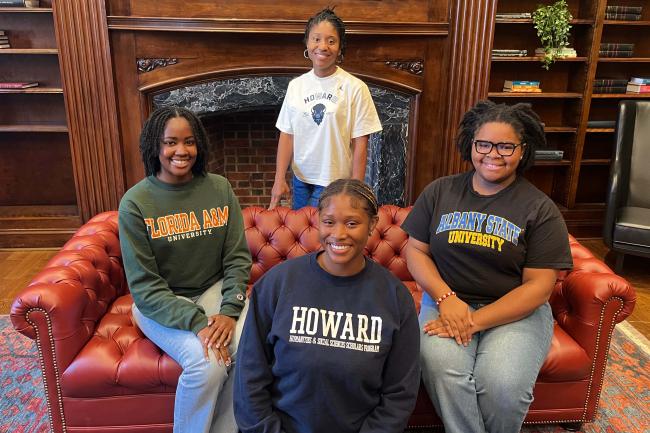
Pictured above: Pre-Ph.D. Summer Enrichment Program participants include (bottom, left to right) Sydney Demar from Florida A&M University, Ama Baffour from Howard University, and Leah Cowen from Albany State University, along with program director Keneshia Grant, Ph.D. (top). Photo by Cedric Mobley.
This summer, Howard University expanded its work to increase the number of minorities with doctorates by hosting the 10th cadre of students in its Pre-PhD Summer Enrichment Program (PPSEP). Throughout its history, the program has been successful in increasing the number of minorities entering Ph.D.-level programs in the humanities and social sciences by helping participants learn how to submit competitive graduate school applications, connecting participants with mentors, and helping them establish a network of other pre-professional students.
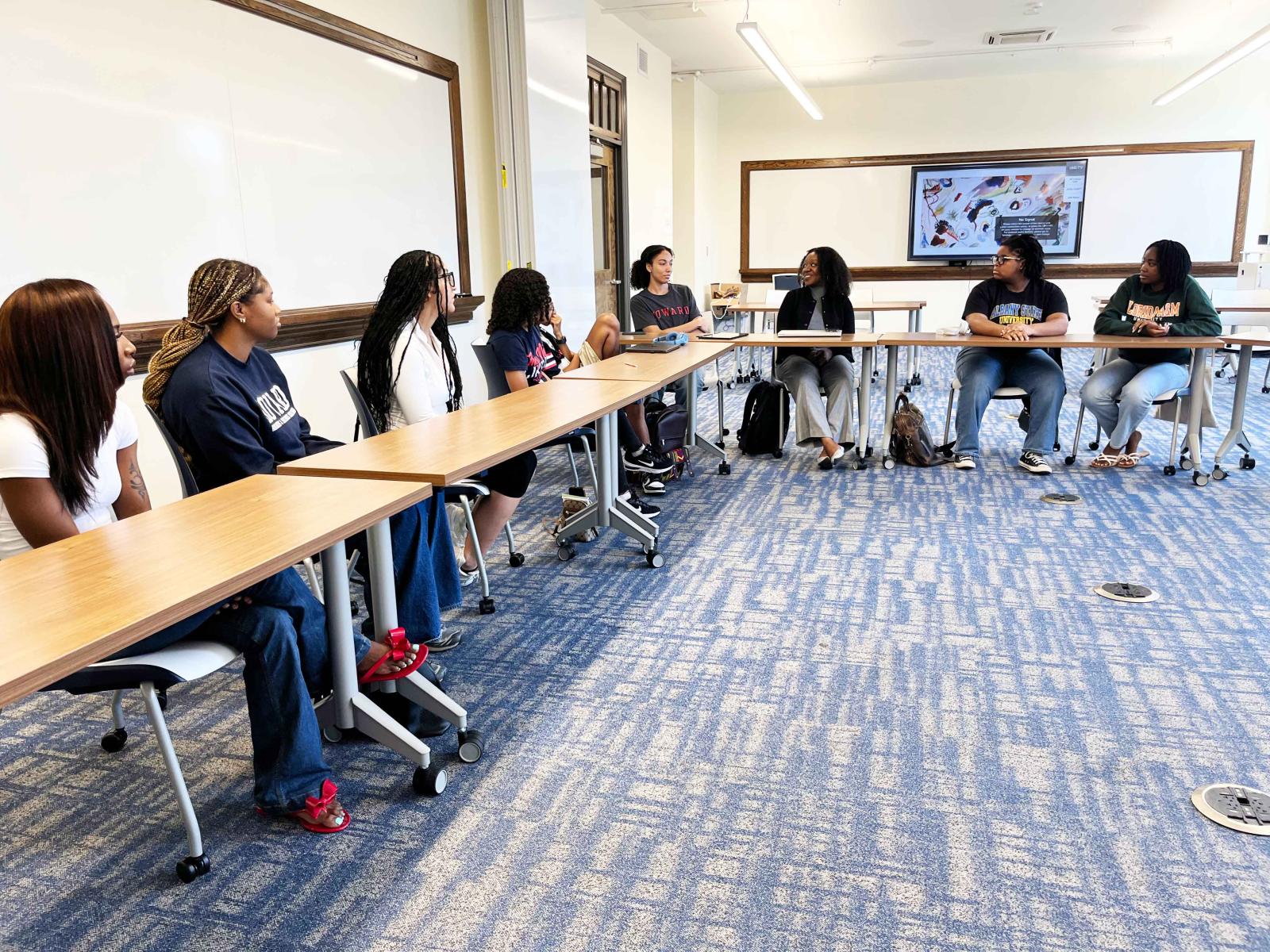
With support from Wayne A. I. Frederick (B.S. ’92, M.D. ’94, MBA ’11) Howard University’s interim president, president emeritus, and Charles R. Drew Professor of Surgery, Keneshia Nicole Grant, Ph.D., created the program based on her experiences applying to graduate school.

“I suspected that if undergraduate students at historically Black colleges had more information about Ph.D.'s, then more of them would consider Ph.D. study,” said Grant, program director and associate professor of political science at Howard. “Many of the students I meet come to me describing a desire to be a doctor or a lawyer and don't have notions of other career trajectories. My idea was that exposure to the Ph.D. trajectory would increase the likelihood that HBCU students would choose it, and I wanted to make sure they had the tools necessary to pursue it.”
The program is open to students from HBCUs across the nation who have an interest in English, history, philosophy, philosophy, political science, or sociology. Of the approximately 95 college graduates who were program participants, about 84 percent have earned a master’s degree, juris doctorate, or are enrolled in a Ph.D. program. Overall, some 105 graduate school aspirants have participated.
The first PPSEP program participant to earn a Ph.D. was Chloe Leavings, who earned a Ph.D. in rhetoric and writing studies from Wayne State University in May. Her research has revolved around the intersectionality of antiracism, culturally relevant pedagogy, hip-hop-based education, and linguistic justice that promotes inclusive learning spaces in writing classrooms. She credits the program with guiding her decision to maximize her educational achievement and expand her expertise in her chosen field.
“I didn’t know what I wanted to do yet, but by working in the program, I saw how the professors were interested in our research and they wanted to work with us,” Leavings said. “I was inspired by the amount of care that we received. I didn’t know that there were any other doctors other than a medical doctor, so I learned that I could continue to work in my field and create a sustainable life by obtaining a Ph.D.”
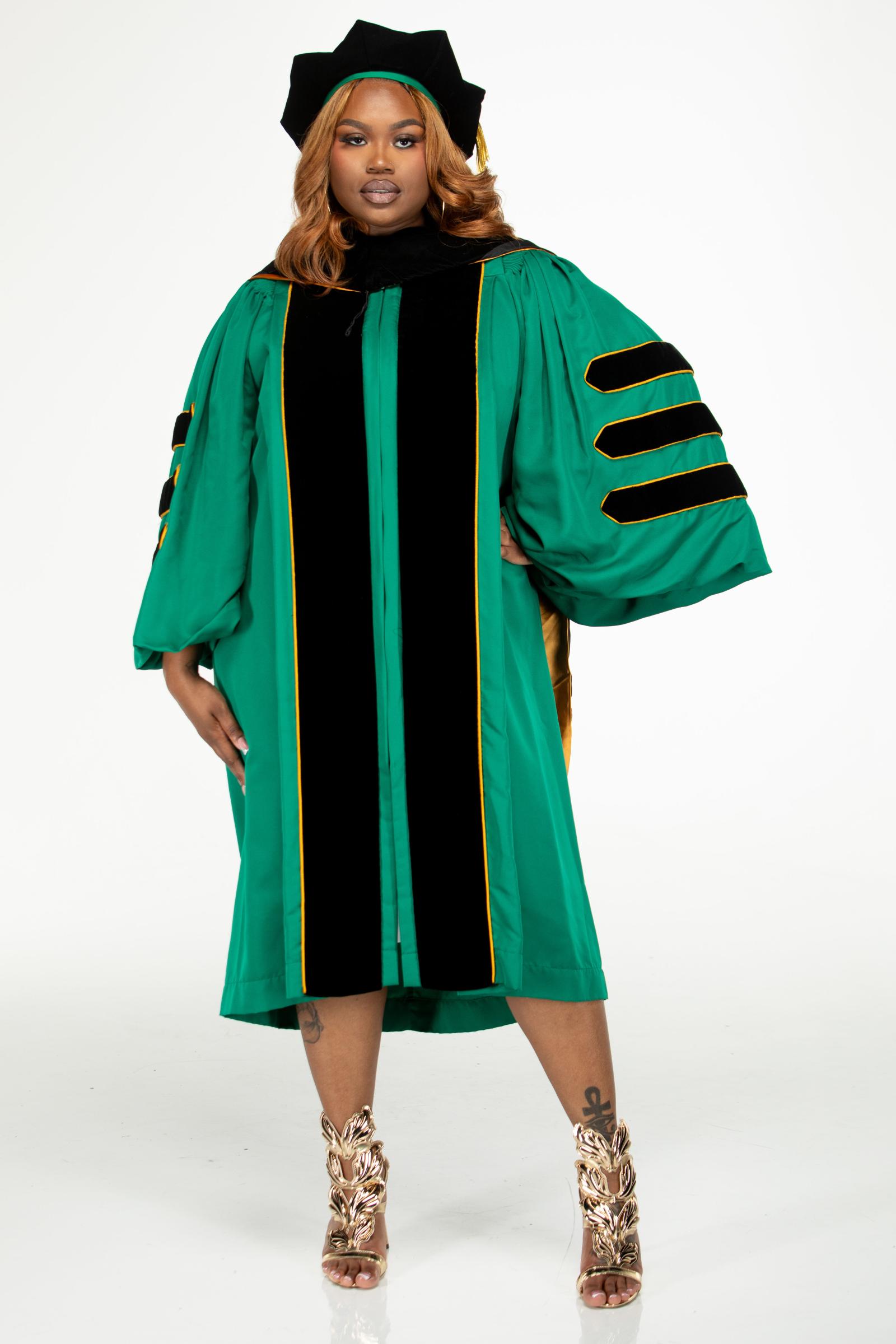
Leavings is looking forward to her first full-time faculty role and creating new avenues to uplift Black positionality. She wants to extend her dissertation research to help improve health communication as it relates to Black men and women. In addition, she wants to look more closely at the diversification of composition practices so that all voices are fairly heard in the classroom, even in a socio-political climate where diversity and inclusion are often villainized. She admits that she feels more confident that her expertise will be respected now that she has earned a Ph.D.
“People listen to me now,” she joked.
One of the reasons Howard obtained R1 status in 2025 was its prowess in producing graduates with doctorates, a fulfillment of its transformative work to perpetuate the spread of truth and knowledge in the world. In fiscal year 2023, for example, Howard awarded 96 doctorates in an array of fields. According to the latest data from the U.S. Department of Education, Howard is the nation’s #1 producer of Blacks with professional doctorates, the #1 HBCU producer of Blacks with research doctorates, and is the nation’s top producer of Blacks with doctorates in history, communications, and journalism. This follows a long tradition of programming to support doctoral education. For example, Howard and Yale University founded the Edward Alexander Bouchet Graduate Honor Society in 2005, named for the first African American to earn a doctorate degree, “recognizes outstanding scholarly achievement and promotes excellence in doctoral education and the professoriate.”
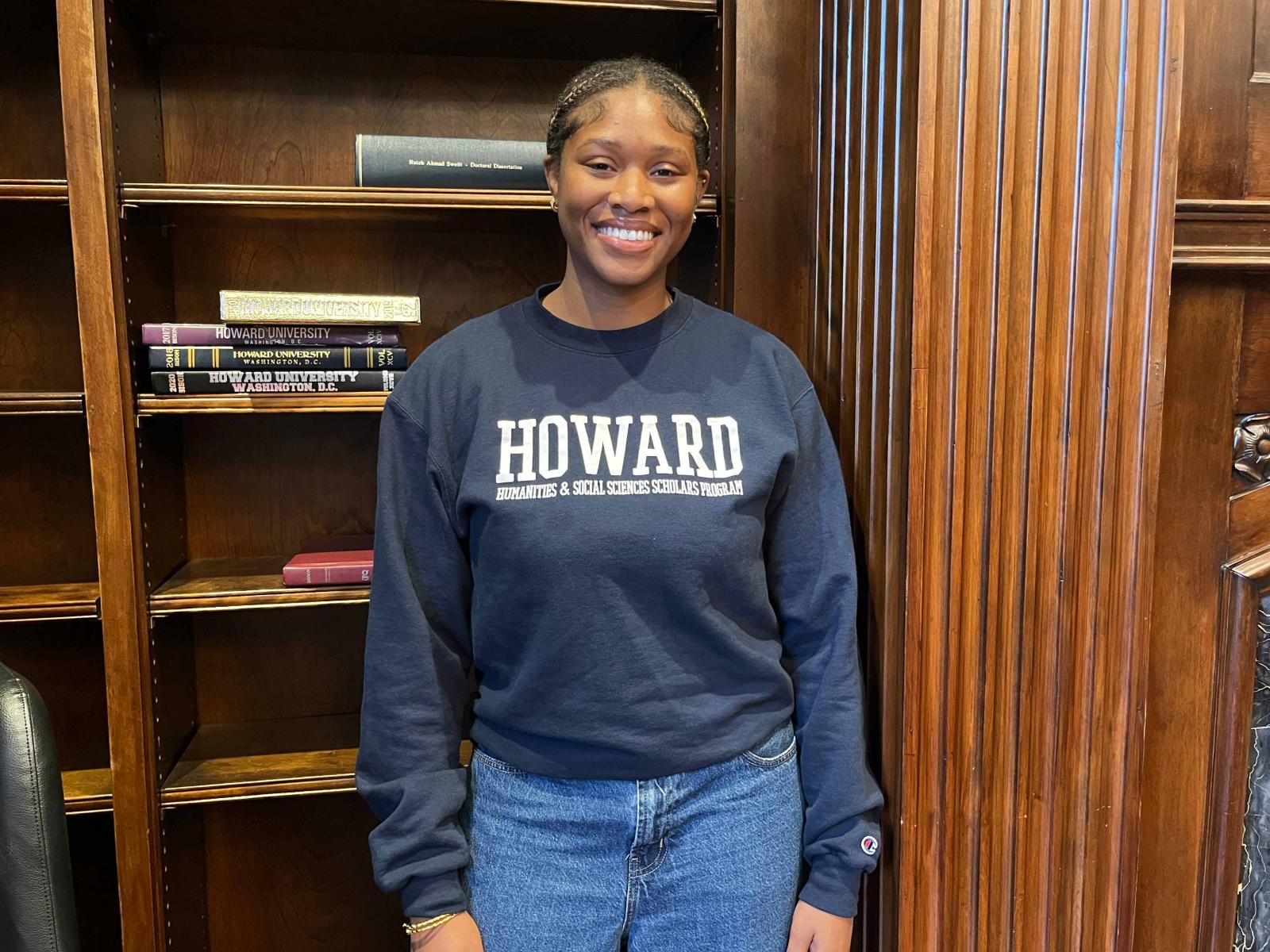
2026 PPSEP participant Ama Baffour is a rising senior at Howard with a major in international affairs and minors in political science and history. Her research interests primarily focus on political systems and governance in West Africa and hopes to conduct research that helps explain why governments in Sub-Saharan Africa sometimes fail their citizens and what can be done to improve governance and accountability.
She wants her work to matter, and is giving serious consideration to pursuing a doctorate. She said that PPSEP has helped her better understand the process. In addition, she said, the program has made her more confident that she is capable of the work required to earn the degree.
“Before entering the PPSEP program, I had many questions about graduate school, particularly regarding funding opportunities and what it takes to build a competitive application that would make faculty members excited to work with me,” she said. “I also wondered what graduate school life was really like beyond the admissions process. Now that I have completed the PPSEP program, I feel much more prepared to pursue a Ph.D. Before the program, I had concerns about whether I would be ready for the level of rigor that graduate school requires straight out of undergraduate studies. Through PPSEP, I gained a better understanding of what doctoral study entails, and I now find myself genuinely looking forward to graduate school and the opportunity to conduct research that I am passionate about.”
PPSEP is an intensive four-week program which includes course work, professional development, and experiential learning activities related to succeeding as a graduate student in the humanities or social sciences, ending with the production of competitive graduate application components. Among the topics covered are GRE test preparation, the African diaspora, and research methods and proposal writing. The program is free and covers coursework, housing, food, and local transportation.
“Ph.D.s are the individuals in our society who produce new knowledge, and it is important that the knowledge we have about the world reflects a diversity of experiences,” said Grant. “We need to expect that the people who are on the cutting edge of knowledge production have like the highest quality information and so they will be well positioned in society to talk to the general public about what is actually happening in a way the public can consume and trust.”
Though Howard is a national leader in producing graduates with doctorates, that commitment extends beyond its campus. Program participants have gained their undergraduate education from HBCUs including Alabama Agricultural and Mechanical University, Albany State University, Bennett College, Fisk University, Florida Agricultural and Mechanical University, Hampton University, Jackson State University, Lincoln University, North Carolina Agricultural and Technical State University, North Carolina Central University, and Tuskegee University.
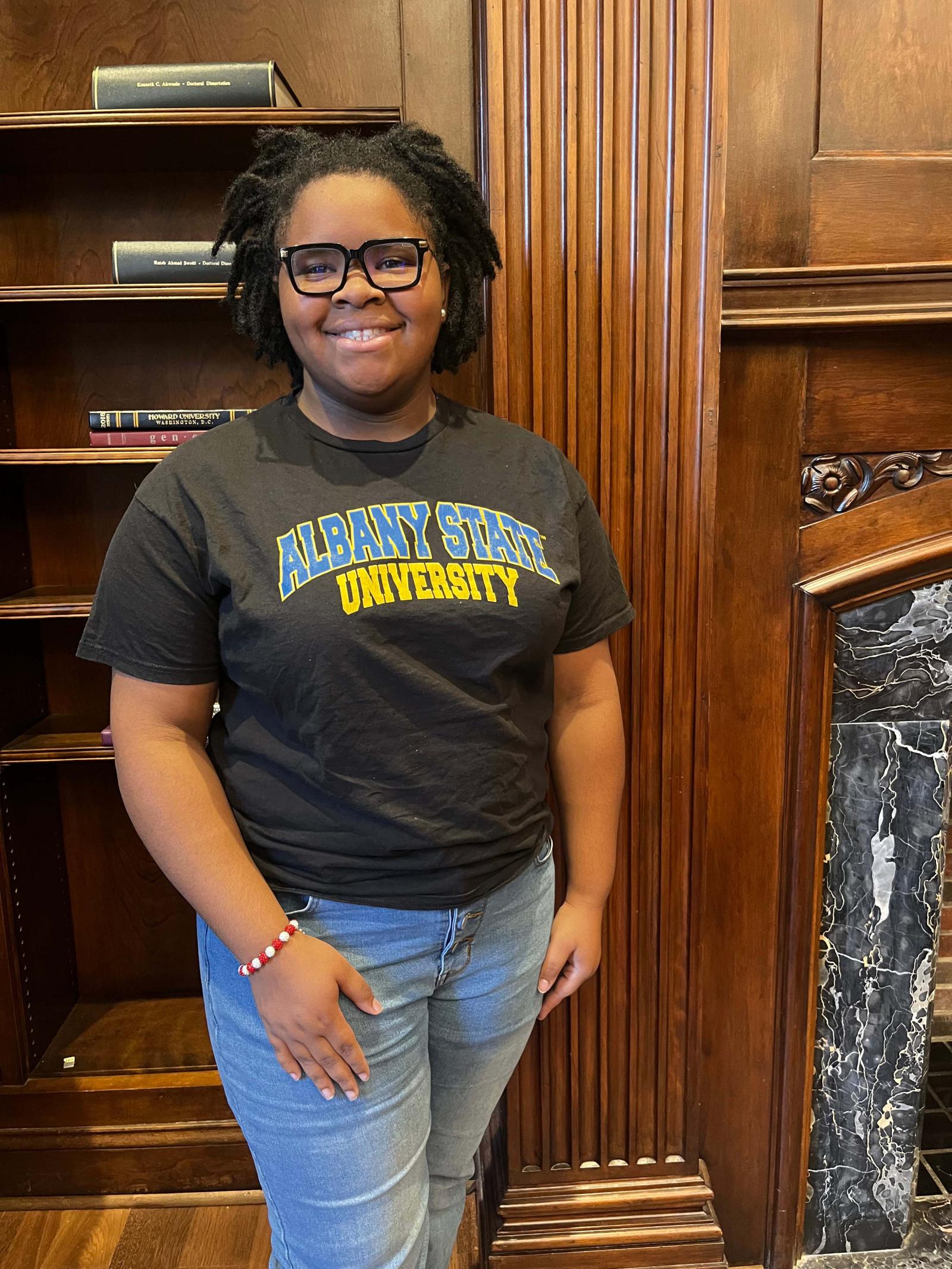
“Attending the program has shown me that pursuing a Ph.D. is not only about gaining advanced knowledge, but also about developing the skills to conduct meaningful research that can create real-world impact,” said Leah Cowen, a Summer 2026 PPSEP participant and Albany State University student with plans to graduate in 2027. “I hope to contribute through research, public service, and policy development that addresses community needs and improves opportunities for underserved populations. I hope to grow into a stronger researcher, more effective leader, and lifelong learner who can bridge academic knowledge with practical solutions in government and nonprofit work. “
In an era characterized by deliberately created false or misleading information, or disinformation, Grant feels that it is critical to prepare well-educated, well-informed academic leaders with true expertise based on rigorous research and tested perspectives. This imperative becomes increasingly important given the virtually unchecked rise of technology and its algorithmic control of the information to which people are exposed.
“The predominance of disinformation is being accelerated because of the changing ways knowledge comes to exist via large language models and AI," said Grant. "I think it's important that humans continue to produce knowledge and maintain forms of knowledge production because they are the ones who experience the world.
Keep Reading
-
 Epiphanies, Discovery, and Research
Howard University Doctoral Student Receives Competitive Dissertation Fellowship, Examines Faith in Educational Experiences of Black Students
Sep 4, 2026 5 minutes -
 Epiphanies, Discovery, and Research
Howard University Chemical Engineering Professors Secure Nearly $1M DoD Award to Expand Bioindustrial Manufacturing Research and Student Training
Sep 1, 2026 4 minutes -
 Global and Diaspora
Former President of Trinidad and Tobago Visits Howard University for Fireside Chat on Global Leadership
Sep 3, 2026 6 minutes