

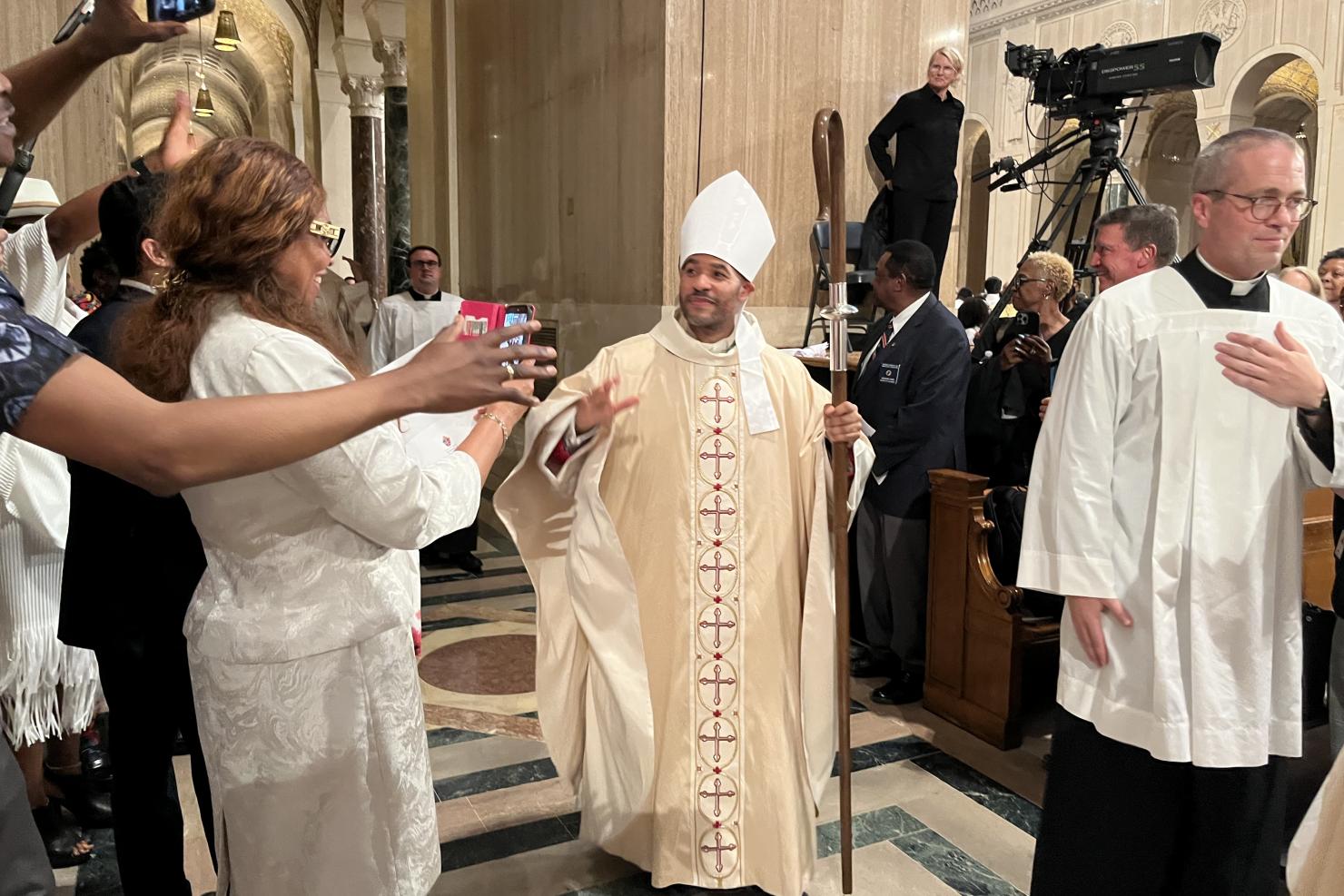
For decades, faith has played a central role guiding members of the university community in their pursuit of “truth and service.” That faith has been consistently stewarded by leaders from a spectrum of religious traditions who inspire, nurture, educate, and connect the Howard community with God. One of those leaders, Most Reverend Robert P. Boxie, III, who most recently served as Howard’s Catholic chaplain through the Office of the Dean of the Chapel in coordination with the Sister Thea Bowman Catholic Student Center for six years, has been newly ordained as the youngest bishop in the United States after his selection by Pope Leo XIV.
In this role, he will perform pastoral and ministerial duties at the highest levels of the Archdiocese of Washington, which serves the District of Columbia and five adjacent counties in Maryland. Boxie will serve alongside Cardinal Robert W. McElroy, the archbishop, and the Rev. Gary R. Studniewski, who was also ordained as an auxiliary bishop during the ordination ceremony.
“He [Boxie] has a priestly heart and keen intelligence, as well as the prayerful compassion and evangelizing core that will be a great gift to our local church in deepening our outreach to all and helping particularly to enrich our Black communities,” McElroy said.
Faith at Howard
Faith has always been central to the Howard experience. The university was founded in 1867 by members of Washington D.C.’s First Congregational Church, including one of its most prominent members, Maj. Gen. Oliver O. Howard, for whom the institution is named. Since that time, numerous theologians and faith leaders have used the university as a platform to promote spiritual growth and national healing. The fabric of religion is woven throughout Howard’s history, from the students who have attended the historic Andrew Rankin Memorial Chapel to faculty members who set the standard for Black preachers, including the first dean of Rankin Chapel, Howard Thurman (D.Div.’55). A spiritual mecca, the campus has served as a backdrop for seminal sermons and speeches by the world’s foremost spiritual icons, including Nobel laureates Rev. Martin Luther King Jr., Ph.D. (LLD ’57) and Archbishop Desmond Tutu (DHL ’84).
Boxie was asked to grow the Catholic ministry at Howard by Archbishop Wilton Cardinal Gregory, the first African American cardinal in the history of the Roman Catholic Church. Boxie wanted the students he worked with to recognize the significant contributions made by Black Catholics — from Pierre Toussaint, a freed slave who raised funds to build the first Catholic orphanage and first Catholic school for Black children in New York City, to Diane Nash, an architect of the Civil Rights Movement. He worked to expose the students to Catholicism around the globe, leading them on pilgrimages to Rome and historic sites in the South. He knew that many students are on their own for the first time and wanted to present the church as a guide to help them grow, succeed and flourish as they navigate their newfound freedom.
At Howard, Boxie worked closely with Rev. Bernard Richardson, Ph.D. (B.A. ’75), dean of the Andrew Rankin Memorial Chapel. Richardson noted that Boxie has been instrumental in the spiritual growth of Howard students, as well as their holistic development as emerging professionals and community leaders.
"Father Boxie embraced and contributed to Howard University’s enduring legacy of developing leaders who understand the vital role that religious and spiritual life plays in leadership formation," said Richardson. "In addition to serving as Chaplain for the Catholic Ministry, he also served as an advisor for the Howard University Alternative Spring Break program in Chicago, where he helped mentor students as they engaged in meaningful service and reflection. Reflecting on his experience with Alternative Spring Break and the impact of Howard students, Bishop Boxie wrote, 'The students represented the school extremely well and truly touched the lives of countless individuals. We will never know the real impact of their presence in the schools, youth centers, the detention center, and the community garden where they served, and the Churches that hosted us.'"
"His words remind us that the true measure of service is often found not in what can be counted, but in the lives quietly touched and transformed through compassion, presence, and faithful engagement," said Richardson.
Howard’s Catholic ministry hosts weekly Bible studies, fellowship nights, dinners, daily Masses at the Bowman Center, and a Sunday Mass in Howard’s Frederick Douglass Hall. It also offers retreats, lead community service, and connect with other students and faith-based organizations across the country. Additionally, they also host social activities. As chaplain, Boxie wanted students to know that they can have fun while practicing their faith.
“Many people think that Catholicism is European or a ‘white church,’ but that is not true, and it ignores facts and history,” Boxie said. “Catholicism arrived in Africa before it went to Europe. And Black Catholics helped to shape the church as we know it today, in figures like St. Augustine of Hippo, St. Athanasius, St. Monica, Origen, and Tertullian, among many others. We have worked inside and outside our ministry to dispel those false narratives and educate students about their faith and the role Black Catholics have played in the history of Christianity and the Catholic Church. Our mission is to form the next generation of Black Catholic leaders who impact not only the church but also society at large.”
Boxie’s success in enlarging programming for Howard’s Catholic community would come as no surprise to those who have followed his career. The Lake Charles, Louisiana, native initially pursued a law career after earning a bachelor's degree in chemical engineering from Vanderbilt University and a juris doctorate from Harvard Law School. A member of Alpha Phi Alpha, he was called into the ministry after clerking for a federal judge in Maryland and practicing law in the District, saying that he wanted to help young people “excel in what they do, and to see the world as an opportunity to discover who you are and what God has in store for you,” according to Catholic Standard.
As bishop, he wants to expand the work he began at Howard, particularly inviting disaffiliated and disconnected young people to engage with the church. He also wants to encourage young Blacks to consider becoming priests, brothers, and nuns.
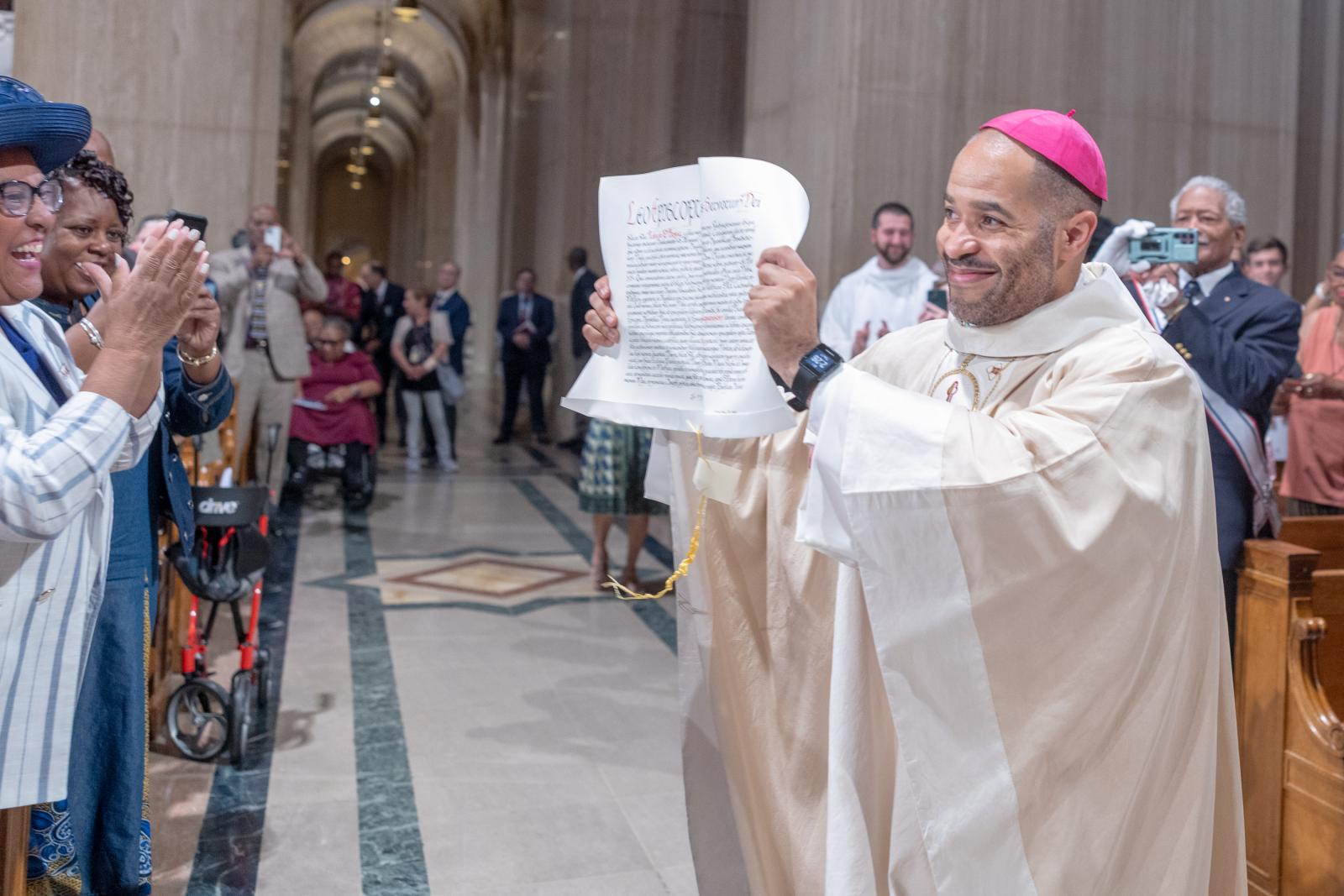
“The church needs the witness, presence, spirituality, and faith of Black Catholics and especially in the clergy and hierarchy of the church,” he said. “I know for a fact that God calls all people to this ministry and this life and not just from certain communities. The Catholic Church is not fully who she professes and proclaims to be without the witness and presence of Black priests and Black religious sisters and brothers.”
At a May press conference announcing his selection, Boxie pointed to the Howard community as a key factor in his ascension.
"I sent a message to our community at Howard,” he said. “‘You made your chaplain a bishop,'" he said, adding, “And Holy Mother Church thanks you.”
At 45 years of age, Boxie has already had a dynamic career of service to the Catholic Church. He serves on the board of trustees for Catholic University of America, where he began his theological training as a seminarian. Prior to his work in the Howard community, he served as parochial vicar at St. Joseph Parish in Largo, Maryland and parochial vicar at St. Francis of Assisi Parish in Derwood, Maryland. He has also served the archdiocese as an assistant director of priest vocations and a professor in its permanent diaconate program, which prepares church members to serve as deacons. As he steps into his new role, Boxie wants to make the Catholic Church a more welcoming place for all people, including those put off by pasts wrongs in which the church has been complicit.
“Catholic means universal, and everyone should be able to find their place in it,” he said. “I am encouraged by Pope Leo's apology in his recent encyclical ‘Magnifica Humanitas,’ for the church's involvement in slavery and its delay in condemning this scourge on humanity which caused so much harm to the dignity of so many people. I think this is an important step to help people to reconcile their connection to the institutional Catholic Church that has recognized its wrongdoing, and especially for young people who often consider themselves spiritual but not tied to any organized religion. I hope this gesture begins for them their journey of returning to the Catholic Church and opening new paths for others to consider the Catholic faith.”
A Historic Ordination
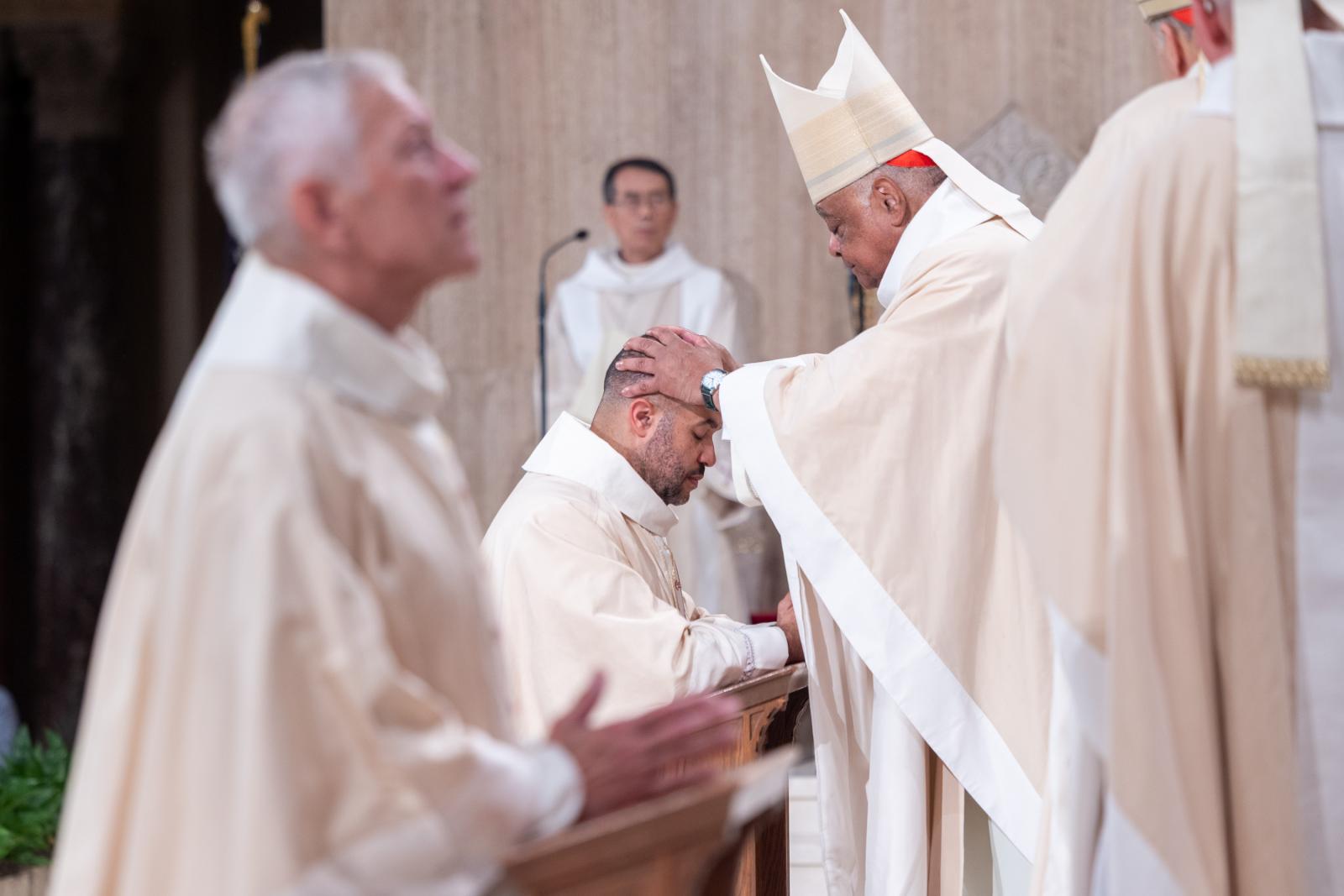
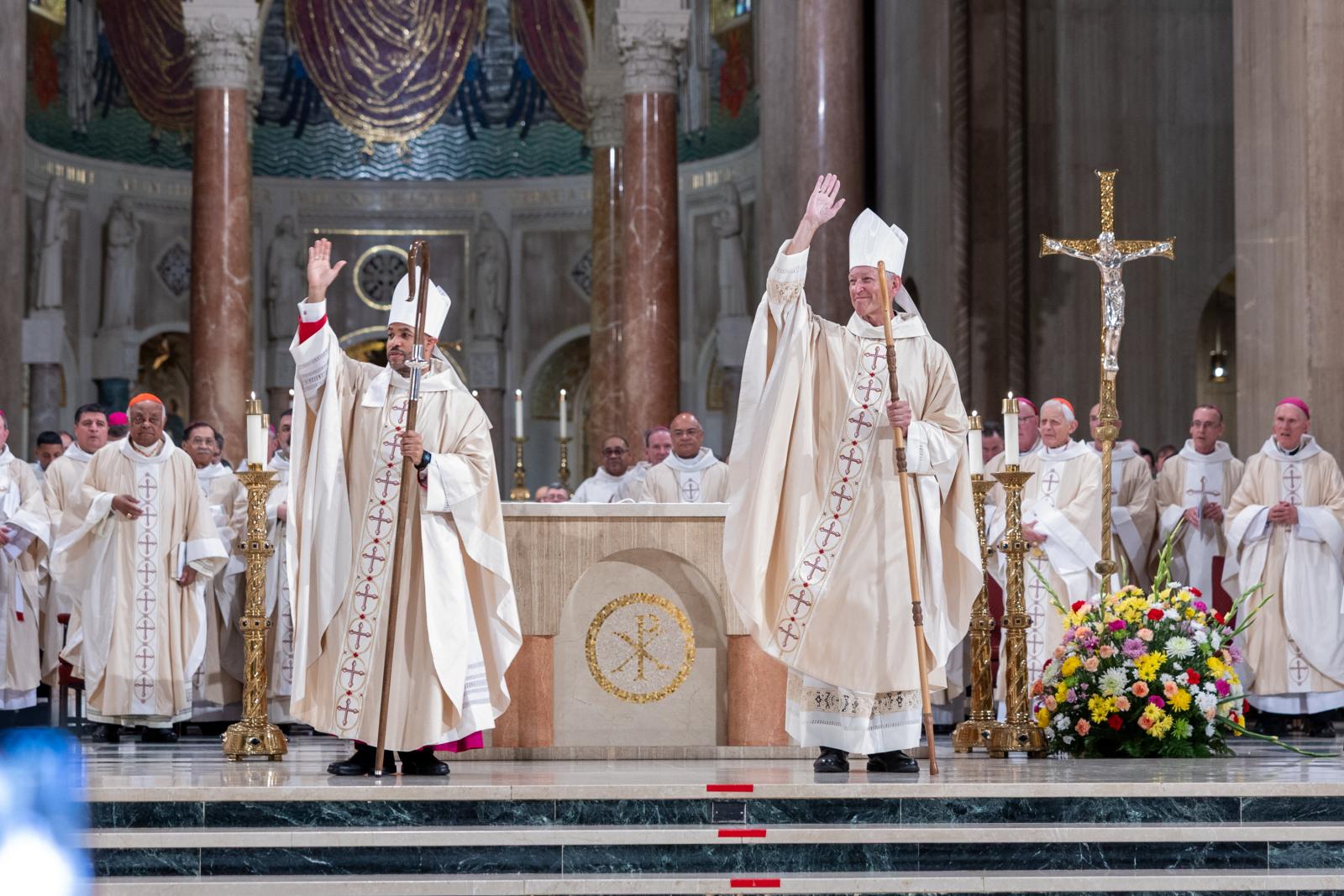
In the elaborate ordination held on July 7 at the Basilica of the National Shrine of the Immaculate Conception in Washington, D.C., Boxie was officially consecrated into the episcopacy as an auxiliary bishop. The ceremony was replete with pomp and circumstance in the grandest traditions of Catholicism, with poignant oratory, dramatic processions of clergy, ancient liturgies and litanies, and soaring music, which bounced off the Basilica’s marble floors and columns and descended down from its ornate ceilings and the 14 million tile pieces making up its Trinity Dome.
A packed audience watched the awe-inspiring ordination ritual, during which Boxie and Studniewski were presented with the Book of the Gospels, along with a ring symbolizing fidelity and spiritual marriage to the Catholic church. They also received a pastoral staff to symbolize the bishop’s role in shepherding his flock of believers, and a miter — the tall, pointed headdress worn by bishops. Cardinal McElroy and other bishops delivered extensive prayers and laid hands on Boxie and Studniewski to officially ordain them, invoking the Holy Spirit, according to the official program. As they knelt, the Book of Gospels was held over the heads of the new bishops to signify their subservience to their ministry. They were also anointed with oil, a rite of the church dating back to the ministry of Jesus Christ and used in baptisms, confirmations, church and altar building, and ordinations.
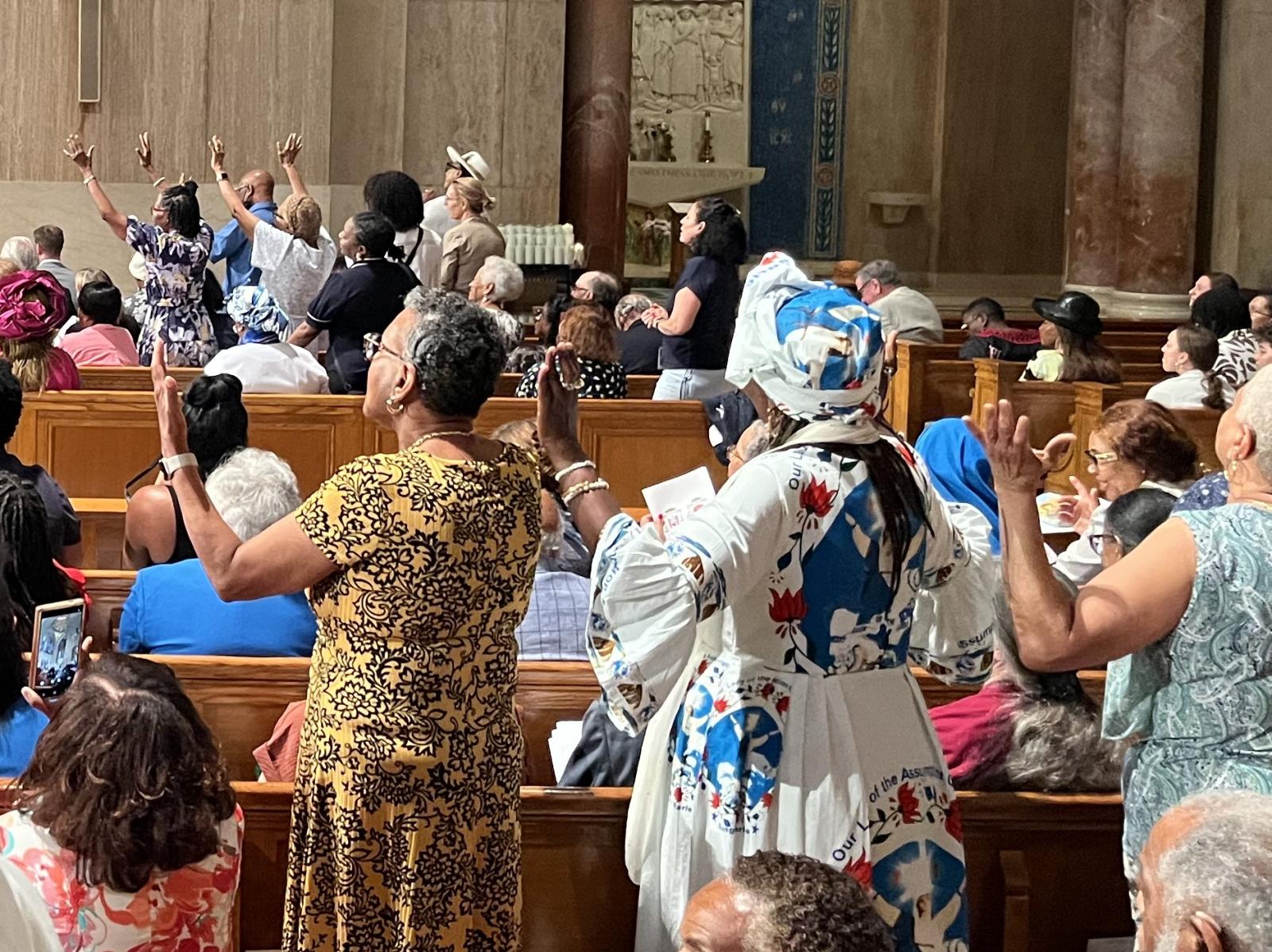
Perhaps the most moving moment, and most meaningful for the Howard community, came shortly after Boxie and Studniewski participated in their first communion as bishops. The organist dramatically played the ten single iconic notes now widely recognized as the introductory measures of “Total Praise” by Howard alumnus Rev. Richard L. Smallwood (B.A. ’71, M.Div ’04). In stark contrast to the sober, stately music that punctuated the ceremony up to that point, Smallwood’s defining gospel music anthem, which thanks God for supplying strength even during life’s most difficult moments, brought the crowd to its feet. With hands lifted into the air, the archbishop and other church leaders joined the choir in singing Smallwood’s testament of faith and gratitude.
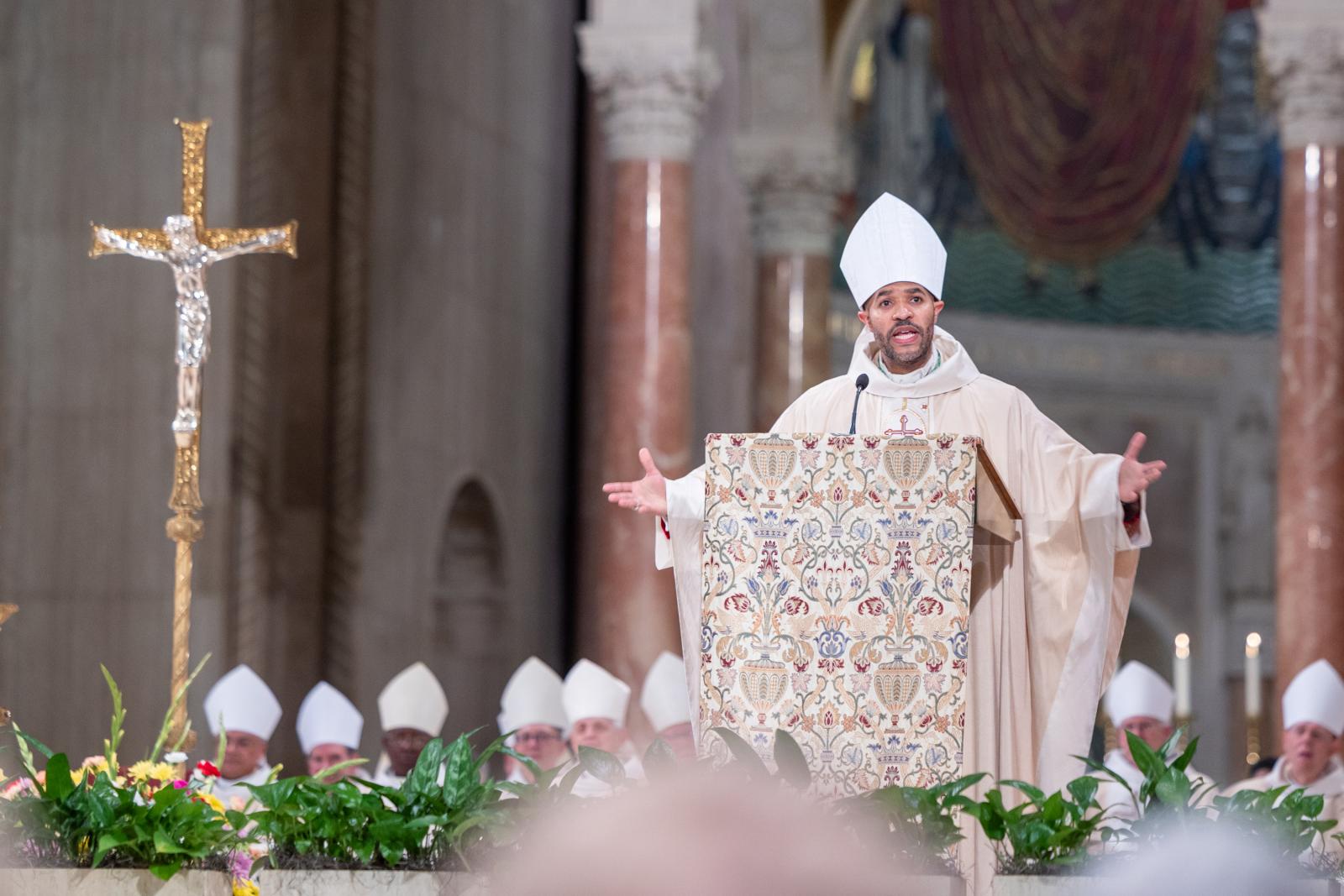
In remarks following his ordination, Boxie reflected on the meaning of the moment and its potential to inspire others to follow in his footsteps into the faith. He acknowledged that he is one of few Black bishops and recognized that he stands on the shoulders of other Black Catholic leaders who have come before him. He appealed to those listening who may be encountering difficulties in their lives to turn to the Church for solace.
“If you have ever felt discouragement from the Church or challenged by the world in which we live, let this be a moment of hope,” he said. “If you have been hurt or disappointed or disillusioned or drifted away, let this be a moment to return. You have a home here. The church needs you.”
Header photo: Bishop Robert Boxie processes through the Basilica of the National Shrine of the Immaculate Conception during his ordination. Photo by Cedric Mobley.
Keep Reading
-
 Uplift
Howard University School of Business: Taco Bell CEO Tresvant to Headline Executive Lecture Series
Sep 22, 2026 3 minutes -
 Epiphanies, Discovery, and Research
Howard University Doctoral Student Receives Competitive Dissertation Fellowship, Examines Faith in Educational Experiences of Black Students
Sep 4, 2026 5 minutes -
 *Accolades
Howard University CEA Professor Sonya Smith Elected to AIAA Class of 2026 Fellows
Sep 28, 2026 3 minutes