

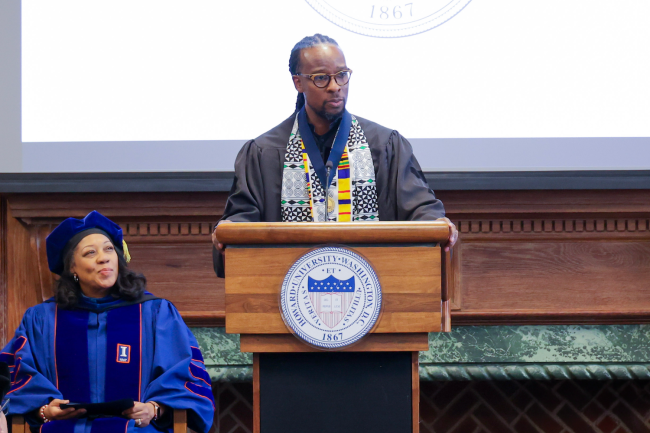
WASHINGTON, DC – Howard University today announced Ibram X. Kendi, Ph.D., as the inaugural Carter G. Woodson Endowed Chair in History for the College of Arts and Sciences. Named after the “father of Black history,” the Woodson Chair was created to foster influential, field-defining research and scholarship on Black history, social justice, and American policy which accelerates systemic change and shapes public discourse. The creator of Black History Month, Woodson was a legendary historian, Howard professor, and dean of the College of Arts & Sciences. The Woodson Chair is underwritten by $3 million in gifts from several key benefactors including donations from the Stupski Foundation.
“The establishment of the Carter G. Woodson Endowed Chair in History affirms Howard University’s enduring responsibility to steward Black history with rigor, integrity, and purpose. Dr. Woodson believed that truth, when carefully studied and widely shared, has the power to liberate minds and transform societies,” said Wayne A. I. Frederick, M.D., MBA, interim president and president emeritus of Howard University. “In appointing Dr. Ibram X. Kendi as the inaugural holder of this chair, we honor that legacy while advancing it. Dr. Kendi’s scholarship, public engagement, and commitment to translating historical insight into meaningful societal change reflects the very best of Howard University’s mission and global impact.”
Dr. Kendi’s internationally recognized scholarship and public work consistently challenge conventional wisdom on historical and contemporary conceptions of anti-Black racism. He has been awarded a Guggenheim Fellowship and MacArthur “Genuis Grant” Fellowship, and is the author or co-editor of many award-winning and best-selling books, including Stamped from the Beginning: The Definitive History of Racist Ideas in America, How to Be an Antiracist, and Four Hundred Souls: A Community History of African America, 1619-2019. Dr. Kendi is also the inaugural director of the Howard University Institute for Advanced Study. Kendi has written often about Dr. Woodson, particularly how he challenged systemic racism through the study of Black history.
“To be able to sit in the newly established Woodson Chair at the Mecca is a momentous honor,” said Dr. Ibram X. Kendi. “I have long been inspired by Dr. Woodson’s pioneering work as a historian, institution builder, and organizer of the field. I have long been guided by his commitment to making the rigorous study of Black history accessible to everyday people. There are so many historians of Black America carrying on Dr. Woodson’s legacy, and I’m delighted to continue to do so with new vigor and determination in the Woodson Chair.”
Kendi will also serve as the director of the newly established Howard University Institute for Advanced Study. Built on the highest standards of intellectual inquiry, the institute is dedicated to interdisciplinary study advancing research of importance to the global African Diaspora, including inquiry into race, technology, racism, climate change, and disparities.
###
About Carter G. Woodson
Carter G. Woodson (1875–1950) was a pioneering American historian, author, journalist, and the foundational figure known as the “Father of Black History.” A graduate of Berea College and the second African American to earn a Ph.D. in History from Harvard University (after W. E. B. Du Bois), Woodson dedicated his life to correcting the historical record by ensuring the history and achievements of people of African descent were rigorously researched and preserved. He achieved this primarily by founding the Association for the Study of Negro Life and History (ASNLH) in 1915, and subsequently launching both The Journal of Negro History and the Associated Publishers press to disseminate this scholarship. His most enduring legacy is the creation of Negro History Week in 1926, which evolved into the modern celebration of Black History Month, fundamentally transforming the way Black history is taught and understood globally. Woodson taught at Howard University, shaping an entire generation of scholars and establishing the institution as a central hub for the study of the Black experience.
About Howard University
Howard University, established in 1867, is a leading private research university based in Washington, D.C. Howard’s 14 schools and colleges offer 140 undergraduate, graduate, and professional degree programs and lead the nation in producing African Americans with professional doctoral degrees. Howard is the top-ranked historically Black college or university according to Forbes and LinkedIn, the only HBCU with an R1 research institution designation, and the only HBCU ranked among U.S. News & World Report’s Top 100 National Universities. Renowned for its esteemed faculty, high achieving students, and commitment to excellence, leadership, truth and service, Howard produces distinguished alumni across all sectors, which have included the first Black U.S. Supreme Court justice and the first woman U.S. vice president; a Nobel Prize laureate; Schwarzman, Marshall, Rhodes and Truman Scholars; prestigious fellows; and over 170 Fulbright recipients. Learn more at www.howard.edu.
Keep Reading
-
 Media Release
Howard University Achieves Highest U.S. News & World Report Ranking in University History
Sep 25, 2026 3 minutes -
 Media Release
Howard University Hosts Machine Learning Symposium in Collaboration with Amazon Web Services
Sep 25, 2026 3 minutes -
 *Accolades
Howard University CEA Professor Sonya Smith Elected to AIAA Class of 2026 Fellows
Sep 28, 2026 3 minutes