Editor's Note: This article originally appeared in the January edition of “The Sway,” the newsletter of The Graduate School at Howard University.
By any standard, 1976 was a threshold year. When Howard University launched the nation’s first Ph.D. program in mathematics at a historically Black college or university, it didn’t simply add another graduate credential. It built a durable pipeline — one that would carry generations of Black mathematicians into research, classrooms, laboratories, agencies, and leadership roles around the world. It was also the culmination of decades of work toward what faculty today refer to as building "The Mathematical Mecca": a center of excellence in research, teaching, and community service.
But the story of Howard mathematics is older than the modern doctorate. It’s a narrative of continuity — of ideas, people, and purpose — running from the late 19th century to today’s research-active department. That throughline begins with Kelly Miller, a foundational figure who helped shape mathematics and science education at Howard at the turn of the 20th century. Often cited as perhaps the first African American to undertake graduate study in mathematics, Miller’s influence extended beyond pedagogy; he laid intellectual and institutional groundwork for a department that would become nationally significant.
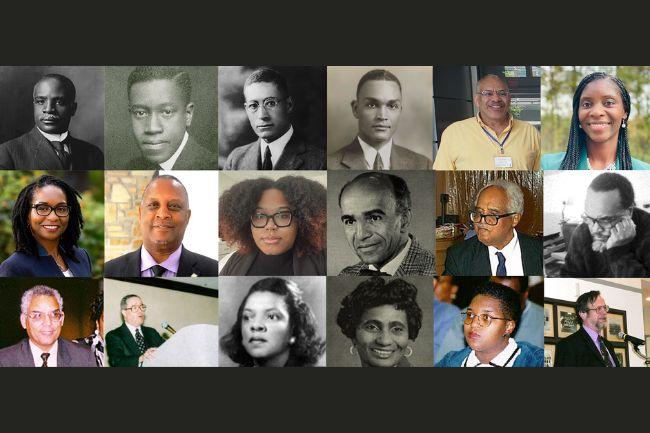
By the 1920s and 1930s, Howard had become an unparalleled center for early Black mathematical scholarship. Dudley Weldon Woodard, the second African American to earn a mathematics Ph.D. (1928), was the first mathematics Ph.D. to teach at Howard and initiate the master's program in 1928. In 1929, he recruited Elbert Frank Cox to the faculty — who, in 1925, became the first Black person in the world to earn a Ph.D. in mathematics. Cox would later emerge not only as a scholar but as a builder and mentor; he supervised a record number of master’s students — often cited as 30. The master's program emphasized rigorous graduate analysis, algebra, geometry/topology, and a thesis grounded in independent work.
By the 1920s and 1930s, Howard had become an unparalleled center for early Black mathematical scholarship.
William Schieffelin Claytor was the third Black Ph.D. to join the faculty, in 1933. Together, these three faculty at Howard anchored a community of scholars whose presence created momentum. They were able to attract some of the earliest Black Ph.D.s to campus, including Dr. George H. Butcher Jr. The result was a program whose reputation among HBCUs was elite and whose influence radiated far beyond.
The mid-century years added fresh velocity. David Blackwell arrived in 1944 and became department chair in 1947. A brilliant probabilist and statistician — and later the first African American inducted into the National Academy of Sciences — Blackwell helped recruit Claytor and, alongside colleagues like Jeremiah Certaine (assistant professor from 1947-1951), fostered a culture of scholarship that would shape the department for decades. By the time he left for the University of California, Berkeley in 1954, Blackwell had published 20 papers, and Howard Mathematics had deepened its research roots. Cox later chaired the department from 1957 to 1961, part of a lineage of leadership that would culminate in a modern transformation.
That transformation began in earnest in the 1970s. In 1972, Howard attracted James A. Donaldson, then one of the most promising young African American research mathematicians in the country. Under Donaldson’s guidance — and with the counsel of mathematician/physicist/nuclear engineer J. Ernest Wilkins — Howard built the case for, and soon launched, a doctoral program. In 1976, the Ph.D. era officially began, and with it a new chapter: a research-centric department whose graduates would populate faculties, federal agencies, and international universities. In 1984, Howard graduated its first Ph.D., Abdulkeni Zekeria. By 1990, seven scholars had earned doctorates through the program, which quickly became a major producer of African American doctorates. in mathematics in the United States. In the decades that followed, faculty such as Neil Hindman — renowned for his work in topological semigroups and Ramsey theory — and colleagues like Raymond Johnson helped cement the program’s stature and expand its reach.
“I met Jim at the International Congress of Mathematics (ICM) in Canada in 1974," recalled Dr. Fern Hunt, former faculty member of the department. "I was a graduate student and I had passed the oral preliminary examination As a kind of reward, I decided to take a train trip across Canada and attend the ICM when I arrived in Vancouver. He was the first Black mathematician I ever met. At first as a New Yorker I found his conversational style rather perplexing. He would often begin with a sly observation; then he would roll forward slowly and deliberately to a witty and often hilarious conclusion punctuated by his loud and infectious laugh. His tone was wry, sometimes sardonic but always humane. My puzzlement soon turned to admiration and respect. By the time I arrived at Howard in the fall semester of 1978, Donaldson had hired a lively and very distinguished group of young PhD faculty eager to do research and innovative teaching. I learned a tremendous amount about teaching from my peer/colleagues who imparted a wealth of tips and tricks about lecturing, student psychology and grading They inspired me to be creative in my teaching approaches."
Cheyenne Henry, a first-year Ph.D. student, already feels a connection to this rich living legacy. “If it was not for the community within the Math Department, I wouldn't be where I am today. They encourage me to keep challenging myself and expose me to how I can facilitate change through mathematics. The encouragement isn't just words of advice, it is being able witness math alumni, especially women, solidify their marks in the mathematical community.”
A Signature Contribution: Riordan Arrays and a Research Community
If mathematics departments are judged by the fields they shape, Howard’s imprint on Riordan arrays stands out. Riordan arrays generalize the familiar structure of Pascal’s triangle, offering a powerful algebraic framework to encode and manipulate entire families of counting rules through generating functions. In practical terms, they are tools for organizing and transforming combinatorial information — compact, elegant engines for uncovering patterns that underlie recursion, algorithms, and discrete models.
Howard mathematicians — notably Lou Shapiro, Seyoum Getu, Wen-Jin Woan, and Leon C. Woodson — were central to the theory’s modern development. Their work helped formalize the Riordan group and turned a loose constellation of techniques into a coherent area of research. Through publications, graduate mentorship, and sustained conference leadership, Howard became one of the intellectual homes of Riordan arrays. When the university hosted the 9th International Conference on Riordan Arrays and Related Topics, it wasn’t just another scholarly gathering; it was a symbolic return to one of the field’s academic hearths.
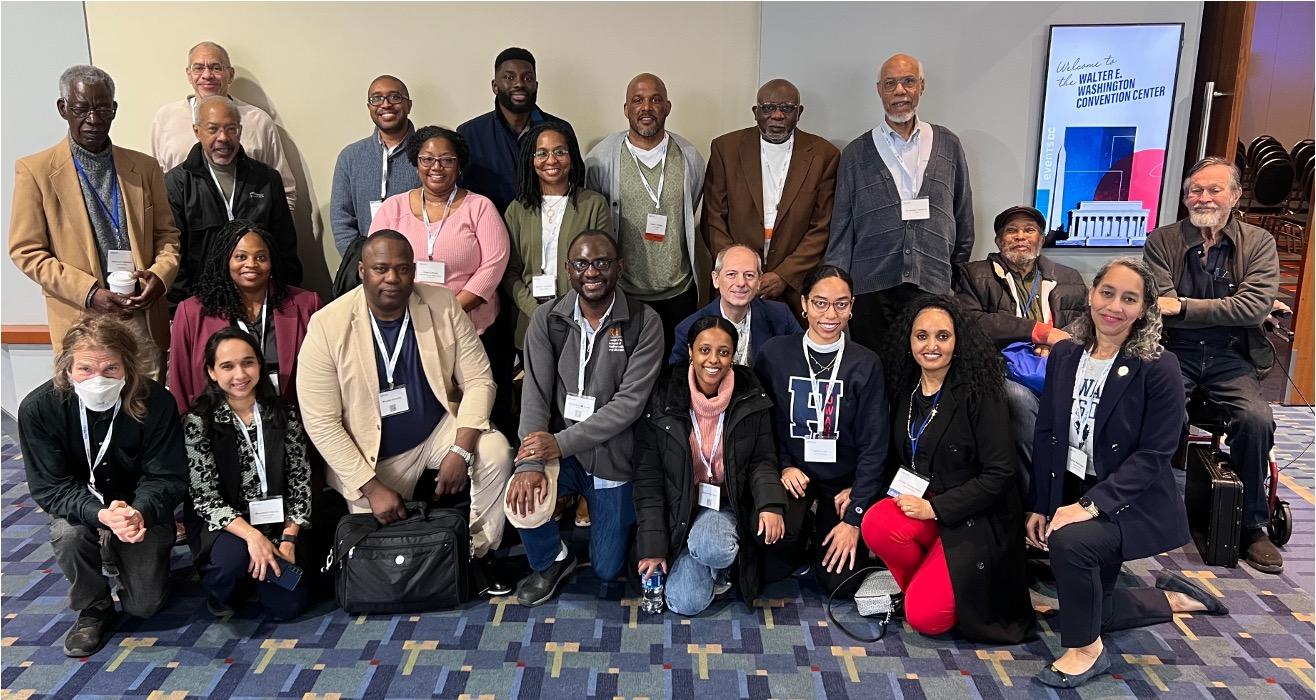
That legacy continues. Faculty today publish in combinatorics, organize special sessions at major venues like the Joint Mathematics Meetings, and advise doctoral students pushing Riordan theory into new territory. One recent example is Dr. Shakuan Frankson, whose dissertation work on Riordan arrays has earned national attention through conference presentations and professional recognition — evidence that the pipeline forged in 1976 remains very much alive.
From Pure Ideas to Applied Impact
Riordan arrays may be rooted in pure mathematics, but their usefulness extends far into applied domains because they operate on generating functions — the lingua franca of structured processes. Those functions animate probability, statistics, computer science, and data modeling, making Riordan techniques valuable for understanding recursion, analyzing algorithms, and building symbolic computation frameworks. Howard alumni have helped build those bridges. Dr. Asamoah Nkwanta, for instance, has linked combinatorial and algebraic methods to problems in mathematical biology, including the analysis of sequence-based data. More broadly, the department’s methods and mindset have proved relevant to both theoretical and real-world problems, from algorithmic complexity to discrete modeling.
That breadth reflects the department’s wider research portfolio — now spanning pure mathematics, applied mathematics, computational mathematics, mathematical biology, financial mathematics, and statistical sciences — supported by a 65‑faculty body, around 100 undergraduate majors, and roughly 30 graduate students.
“Today Howard offers a B.S. in Mathematics, a BS in Data Science, and the Ph.D. in Mathematics, with faculty contributing across algebra, topology, analysis, applied mathematics, and STEM education,” says Dr. Toni Bourama, department chair.
Read the rest of the article in “The Sway.”
Related Story
Photo credits: Indiana University 1917 Yearbook, Moorland-Spingarn Research Center, The Dolph Briscoe Center for American History, Mathematically Gifted and Black, Morgan State University, National Research Foundation, Mathematicians of the African Diaspora, Dr. Dennis Davenport. gs.howard.edu
Keep Reading
-
 Legacy and Lineage
The Howard University Student-Led Bus Protest that Challenged Virginia’s Jim Crow Laws
Jun 25, 2026 5 minutes -
 Culture Creators: Arts and Entertainment
Walking in Rhythm: The Blackbyrds’ Enduring Legacy from Howard University to the International Stage
Jun 17, 2026 8 minutes