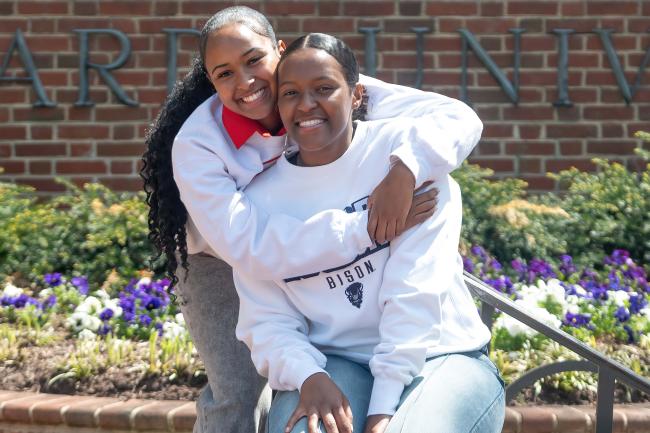
Above photo: Howard seniors Lulu Mohamed (left) and Safiya Mohamed (right). Photo by Justin Knight.
Commencement is bittersweet for many Howard students, who are saying goodbye to a found family and a community they have grown to know as home. For Lulu and Safiya Mohamed, that family is literal — the twins were born within one minute of each other. They came to Howard through separate journeys, but like most twins, they found their way back to each other. As they prepare to graduate, their paths are again set to diverge, but they share a common career mission and life vision.
“My twin sister, Lulu, and I have always been two halves of the same heartbeat,” said Safiya. “In a childhood filled with uncertainty, fear, and constant change, the one thing that never shifted was us. From the moment we came into this world, our lives were intertwined. We shared everything—beds, clothes, whispered secrets, and dreams that felt bigger than the lives we were living. When things were good, we celebrated together. When things fell apart, we held onto each other even tighter.”
In many ways, the twins are mirrors of each other. Lulu is a political science major with a criminology and military science minor; Safiya is a criminology major with a political science minor. But they came to Howard on different paths. Lulu knew that she wanted to be a Bison right after high school, while Safiya spent two years at a predominantly white institution before transferring. At Howard, Safiya said that she not only reunited with her sister, but also found the extended academic family she was missing at her former institution, where she felt isolated.
“I tried to branch out and find friends, but it just wasn't coming to me easily,” Safiya said, describing her prior collegiate experience. “I play club volleyball, and I tried to make friends there, but it just wasn't working. I tried to join like the African Student Association, but they were very standoffish. It just wasn't a community that felt welcoming in a sense. I just became accustomed to not talking. I feel like I went mute for two years. When I came to Howard, so many people are not only talking to you, but are wanting to get to know you. I feel like it helped me grow. I feel like I'm more outgoing and more talkative, and I'm able to connect to people more.”
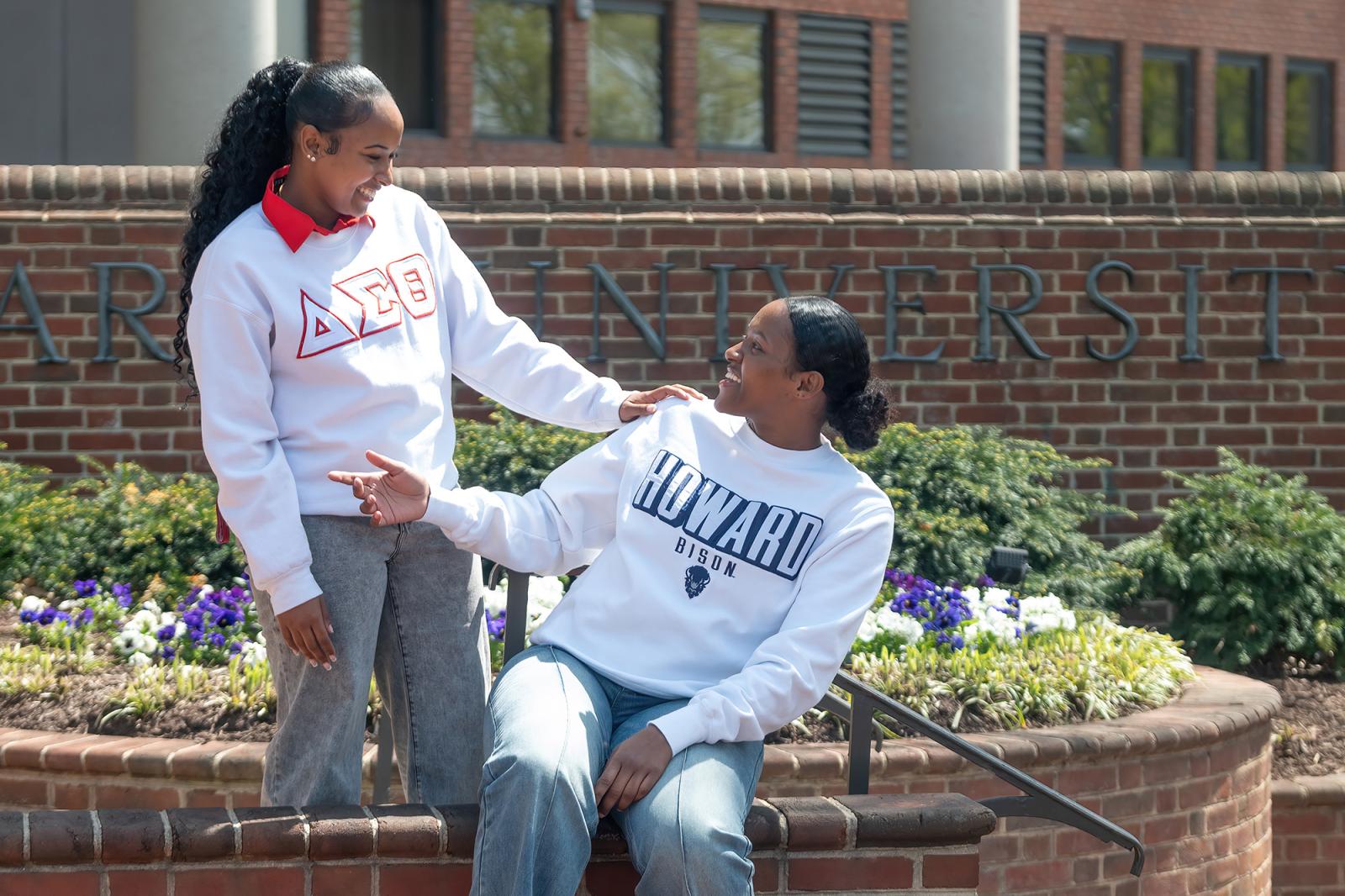
The twins have been extremely active members of the Howard community. Lulu is a member of the Air Force ROTC program, Collegiate 100, and Delta Sigma Theta’s Alpha Chapter. Safiya is also deeply connected with the Collegiate 100 program, a mentoring program associated with 100 Black Men of America, where she counts mentoring younger students among her most fulfilling moments. Their peers know and respect them as Bison, but their success as students belies a real truth — life hasn’t always been easy for them, but they have embraced excellence nonetheless.
“From the outside, it might have looked like any other family trying to get by,” Safiya said. “But behind closed doors, Lulu and I were learning what survival meant far earlier than most children ever should. Our childhood was filled with instability and fear. We endured emotional and physical abuse that forced us to grow up quickly. There were days we went to school carrying more than just backpacks—sometimes it was bruises, sometimes it was silence, sometimes it was the quiet understanding between us that we had to protect each other. When I was eight years old, everything shifted again. Our mom lost her job, and soon after we received an eviction notice. At that age, I didn’t fully understand what it meant to lose a home, but I remember the fear. It felt like something alive in the room, pressing down on us and reminding us that everything we had could disappear overnight. For over six months, Lulu and I slept in a homeless shelter.”
Throughout their childhood, the twins moved from place to place — Atlanta, Minneapolis, and Virginia — and their feelings of instability grew. A brush with the foster care system provoked even more uncertainty. Eventually, however, they realized they always had the most important things close to them — each other.
"What I remember most from that time were the nights in the shelter and the constant uncertainty of where we would end up sleeping from one night to the next,” said Safiya. “The unfamiliar beds. The quiet tension in the room. The uncertainty about what the next day would bring. And every night before we fell asleep, I would reach for Lulu’s hand. I would squeeze it, and she would squeeze back. That small moment of reassurance became our lifeline. For a long time, we didn’t know what to call home. But somewhere in the middle of all that instability, Lulu and I realized something important: home was never really a place for us. It was never the apartment, the shelter, or any place we happened to be staying in at the time. Home was us.”
“In a world that kept shifting beneath our feet, we became each other’s stability. Where she faltered, I tried to be strong. Where I faltered, she carried us both. We learned how to fight for each other, how to survive together, and how to keep believing in a future that once felt impossible.”
An unfair world might leave many demoralized and defeated, but not the Mohamed twins. They used education as their lifeline and focused on the future. It was a way to define themselves on their own terms, and take control of the trajectory of their lives.
“Through it all, we held onto one dream: college—a future and a life we could build on our own terms,” said Safiya. “A chance to create our own legacy, one not defined by the mistakes of those before us, by loss, or by the instability that shaped our childhood. We dreamed of something different—a life built with intention, resilience, and the freedom to finally decide who we would become. Howard University became that dream.”
The killing of George Floyd by police officers took place two blocks from where the twins lived in Minneapolis. Daunte Wright, who went to their high school, was shot by another police officer during a traffic stop. The two want to help communities learn about their law and their rights. Lulu is joining the U.S. Air Force after college with plans to become a JAG officer it its legal branch before eventually focusing on juvenile justice. Safiya will focus intensively on studying for the LSAT.
“I wanted to figure out how to change gun laws and create real reform,” said Lulu, who noted that her brother was a victim of gun violence during her freshman year. “It’s what drew me to social action. I just like making sure that people have the right to know what they can do and make sure there are laws that can help our community. I feel like political science helps you see how laws are made and actually write laws and help the government change them.”
Safiya describes Lulu simply as “fire.” She notes that her sister is fierce, relentless, and unapologetically herself, moving through the world with a strength that refuses to be dimmed. It is an energy that has allowed Lulu to embrace every opportunity at Howard, including Delta Sigma Theta, which she said helped her see the light within herself, and ROTC, through which she learned to begin her day while everyone else was still dreaming.
“You’re up at 4 a.m., while others are still sleeping in their beds, you’re going to be up the rest of the day doing your work and getting the job done,” said Lulu, describing her ROTC experience. “It just made me see that there’s no time to rest. You can sleep when you’re dead. You have to continue to push yourself if you want better for yourself.”
A scholar who has made Howard’s Dean’s List, Lulu has given back to her community in numerous ways. She’s chaired various committees as part of Delta Sigma Theta’s community outreach and works with the broader Washington DC community by volunteering with young people in Washington’s Youth Services Center, a detention center where youth are given a second chance at education by earning their GED, taking SAT prep classes, and developing academic skills. She is passionate about proving that people have value even if some have given up on them. She is using the life lessons she learned when she was younger to inspire others.
“Growing up, everyone would always say that I have this chip on my shoulder,” Lulu said. “But for me, it was always trying to accomplish the next thing and defy the odds based on how I grew up. So I was valedictorian and the first person to go to an HBCU from my school, but my ‘chip on my shoulder’ was seen as a bad thing. But when I got to Howard, it allowed me to just keep on growing as a person and the community that I found made me see that that chip on my shoulder was a good thing. It's good to be the person that always tries to accomplish the next thing for themselves. It allowed me to push myself beyond the limits that I thought I had. I never thought I could juggle so many things at once. It allowed me to grow my determination and who I am as a person and to allow people in.”
Safiya is equally determined, but in different ways. She is quieter and more contemplative. She had to transition between colleges. Once at Howard, she had to find a community of her own even as she embraced her sister’s legacy here. She made the Dean’s list repeatedly as she racked up successive 4.0 semester grade point averages. She worked in the office of Florida Congresswoman Frederica Wilson. And when she found herself needing funding to continue her education, she doggedly pursued scholarships, eventually landing pivotal funding from UNCF. Even after her challenges during her first two years at another school, she refused to give up on her Bison dream.
Like her sister, Safiya hasn’t simply used college as a way to better herself; she has made it her mission to give back. She served as a team lead for Howard’s Day of Service, through which new students learn how to live lives of “truth and service” by volunteering throughout Washington, DC. She planned service initiatives as a Collegiate 100 member, through which she is helping younger students build a pathway from high school to college by mentoring and performing community service projects, including outreach to children with cancer. As she prepares to leave Howard, she and her sister know that they have shared a truly transformative experience.
“Walking onto Howard’s campus means more than attending classes or earning a degree,” said Safiya. “Every step across that yard represents every night spent wondering where we would sleep, every moment of fear we learned to push through, and every time we chose resilience over defeat. It is the culmination of everything we endured and the promise we made to each other long ago: that no matter what life placed in our path, we would rise above it together.”
“Our story is not perfect. It is messy, painful, and filled with moments that tested us in ways most children should never experience. But it is also a story of resilience, sisterhood, and the unbreakable bond that carried us through the darkest chapters of our lives. Because through everything—every loss, every challenge, every moment of uncertainty—one truth has never changed. Lulu and I will never face life alone.”
Keep Reading
-
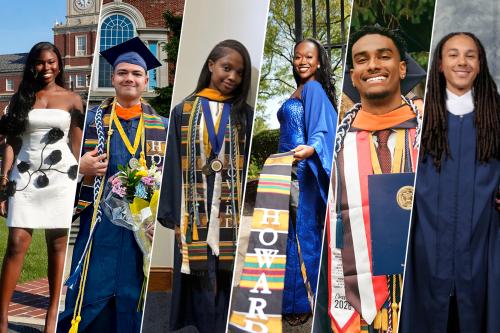 Legacy and Lineage
Perfect Performance: Nearly 200 Howard University Class of 2026 Graduates Earned a 4.0 Grade Point Average
Jun 22, 2026 11 minutes -
 News
NewsHoward University Alum Jayson Johnson Named to 2026 Cohort of Knight-Hennessy Scholars
May 19, 2026 2 minutes