

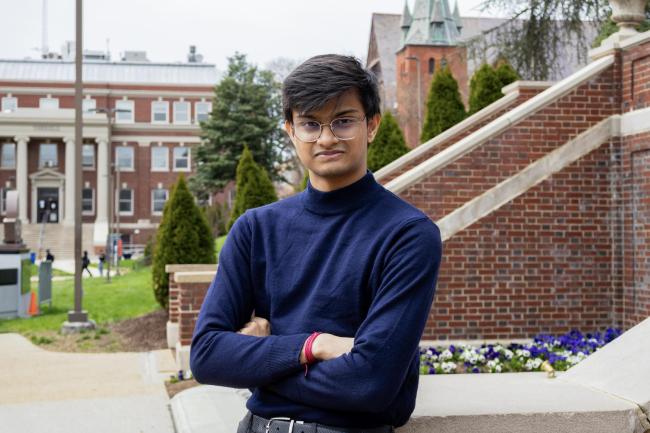
Two years ago, sophmore Risav Ganguly landed in the United States from Jharkhand, in eastern India, carrying the weight of his parents’ expectations and his own hope that he’d picked the right place for college.
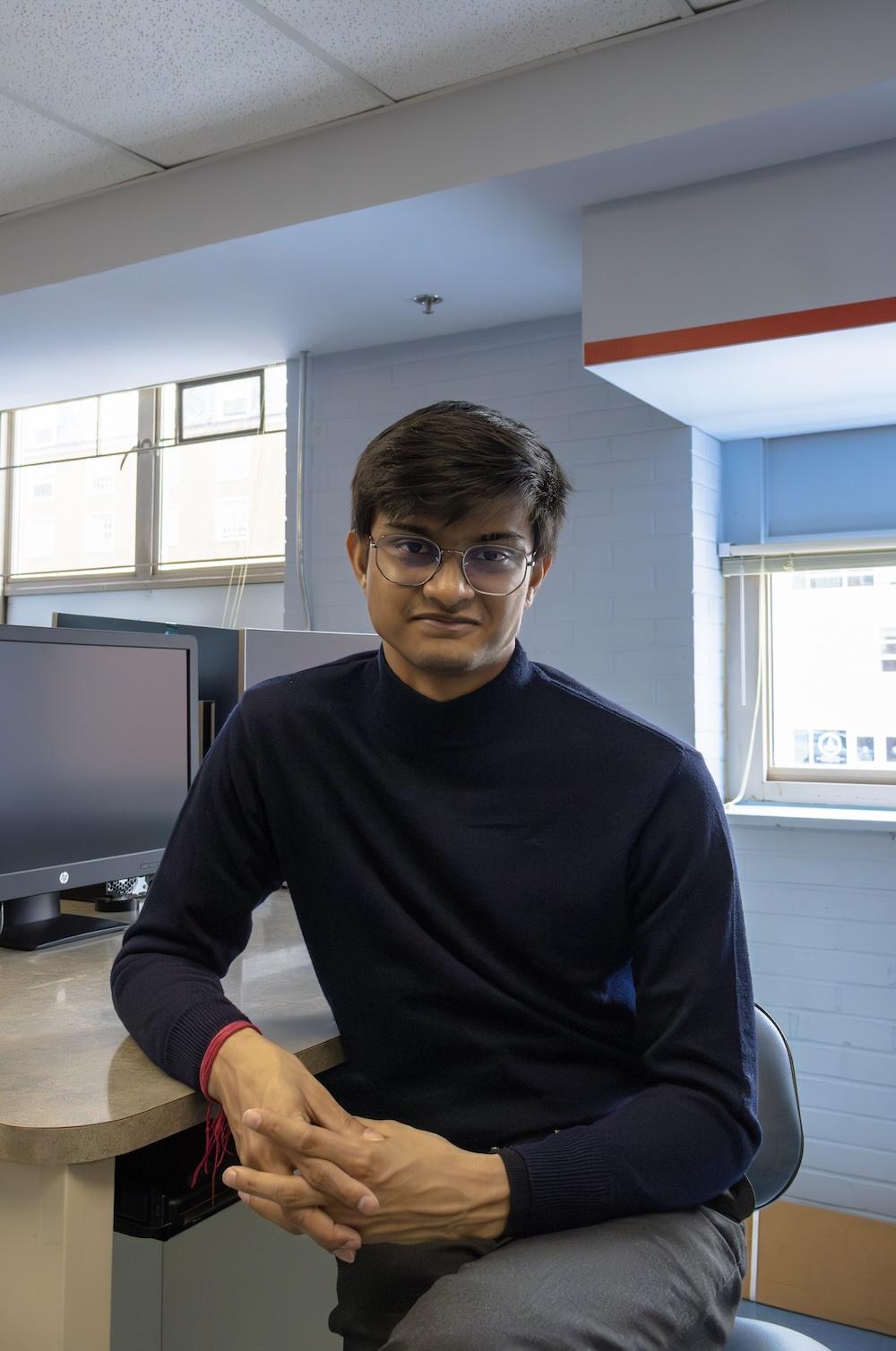
“When I arrived, I started my life in the United States from scratch,” said Ganguly, now an economics sophomore at Howard University. “I had only a few hundred dollars and a phone without a working SIM card. I didn’t even know if I would reach the right place when I got into an Uber.”
A year later, Howard turned out to be the right place for the international student. He has already been invited to the White House, joined a research lab on campus as an undergraduate, writes for the university’s student newspaper The Hilltop, and won one of the most prestigious undergraduate awards in economics with a research essay on W. E. B. Du Bois.
Ganguly’s essay, “The Suppressed Counter-Narrative: From Du Bois’s 1901 Economic Indictment to Modern Reparations,” earned the 2025 Andrew Brimmer Undergraduate Essay Prize from the American Economic Association, the first time a Howard student has received the honor.
Ganguly’s award-winning research essay on Du Bois examines the suppression of the scholar’s early economic work, particularly his 1901 study of sharecropping, and connects it to modern discussions of reparations and racial economic inequality.
“Economics programs at other universities are not usually taught from a social justice, historical, or contextual standpoint,” Ganguly said. “I could not have written the paper I wrote if I had gone somewhere else.”
Howard Offers What Other Economics Programs Couldn’t
Like many international students, Ganguly sought out a place where he'd get life experience he couldn't easily get at colleges back home. He found that and more at Howard, which currently enrolls students from 61 countries and positions itself not just as a historically Black institution, but as a global one.
“Even though the transition was difficult, no other place could have treated me better than Howard University,” Ganguly said.
Ganguly was born in West Bengal and was later raised in Jamshedpur — also known as Tata Nagar, a mid-sized industrial city. He grew up as an only child. His father is an engineer. His mother, a longtime educator who taught privately. Both now live in Lagos, Nigeria.
Although Ganguly was raised outside of the United States, he started learning about Black history at an early age. At his school in India, he read authors like Maya Angelou from a very young age.
"We learned world history broadly,” Ganguly noted. “I knew about the Civil Rights Movement. We learned about Martin Luther King Jr. and the 'I Have a Dream' speech as early as second or third grade. The curriculum was designed to expose us to different people and learn from historical events.”
That exposure stayed with him. When it came time to choose a university, he wanted something different.
“I wanted to go to a place where I wouldn’t blend in and be lost,” said Ganguly, adding also that Howard University was first college to accept him.
“I came here respecting that decision,” he said.
His first year was anything but easy. Ganguly arrived alone, with limited resources and no support system in the country. He lived on campus, in Drew Hall, where he began building a new life from scratch.
“I found my best friends there — people I never imagined I would meet 8,000 miles away from home,” he said. “Some of them have traveled with me to major opportunities, including another White House visit and study abroad in Switzerland.”
“My parents had put their life savings into sending me,” he said. “They were like, you’re going to go there and you’re going to figure it out.”
With support from faculty and administrators, Ganguly secured additional funding through grants and scholarships. His academic trajectory moved quickly.
Prize-Winning Research Essay
Ganguly arrived on campus as a political science major but switched to economics. His interest in economics deepened when Assistant Professor of Economics Jevay Grooms, Ph.D., invited him to join the Center for an Equitable Economy and Sustainable Society, a Howard economics research lab, as a freshman.
Ganguly explained that this Du Bois essay first took shape as a class assignment for the History of Economic Thought course taught by assistant economics professor Ana Paula Melo, Ph.D.
Ganguly said his goal was to bring together scattered research on Du Bois’s 1901 work on understanding the effects of sharecropping into a single, accessible narrative.
"There wasn’t a single work that brought together these strands in a coherent way," he said. "A lot of research exists, but it wasn't easily accessible, which can be a barrier to further scholarship."
Opportunities beyond the classroom have followed. In October 2024, Ganguly was among the 35 graduates and fellows of Dexterity Global invited to the White House, where he was hosted by then-President Joe Biden and First Lady Jill Biden.
“That experience opened doors for me to enter spaces and have conversations I never imagined,” he said. “It allowed me to represent both my country and Howard academically.”
He also had the opportunity to meet and have conversations with four Nobel Prize-winning economists since then.
Ganguly’s rise also coincides with a broader moment at Howard. The university attained its Research One, known as R1, classification status in 2025, marking the highest level of research activity.
“When I came in, Howard was not an R1 university,” he said. “Now it is and I feel like I am growing with the institution. When you grow with the institution, it feels very different. Every single person you meet is on the same journey as you are.”
*Photos by Skyla Jeremiah, Office of University Communications.
###
Keep Reading
-
 Legacy and Lineage
Howard University Honors Retirees, Inaugurates Academic Year at 159th Opening Convocation
Sep 25, 2026 6 minutes -
 Culture Creators: Arts and Entertainment
‘A Different World’ Stars Come Home to Howard Ahead of Netflix Sequel Premiere
Sep 25, 2026 4 minutes -
 *Research and Discovery
Howard University Study Links Medicaid Expansion to Lower Breast Cancer Deaths
Oct 6, 2026 5 minutes