Jazz is one of the musical genres widely seen as Black America’s gift to the world. Like the experience of Blacks in this country, it is characterized by its complexity and its beauty. It blends rhythms, harmonies, and melodies that showcase the fun of swing, the sorrow and heartbreak of the blues, and the hopefulness of gospel using a variety of syncopated rhythms that often make the offbeats more prominent, as opposed to emphasizing the expected downbeat. Though all jazz music incorporates improvisation, Golson’s music exemplifies “bebop and hard bop,” forms of jazz which feature fast and often improvised changes in tempo, chords, key, scales, and harmonic structure. In contrast to some other jazz forms, bebop and hard bop music was specifically designed to allow musicians greater control over their compositions and require more intense listening, making the artform less about entertainment and more about storytelling.
Paul Carr (B.A. ’85) is an assistant professor of saxophone, director of Howard University’s Jazz Ensemble, and a Howard alumnus. He is also executive director and artistic director of the Mid-Atlantic Jazz Festival and introduced Golson when he played at the festival in 2014. He said that even in a genre defined by innovation and creativity, Golson stood out.
“Benny Golson was unique because he came along during a time when most jazz artists had their own voice and they wanted to sound different from one another,” said Carr. “He grew up in Philadelphia and he and John Coltrane practiced together. Benny had that big beautiful dark sound and streamed a lot of ideas together, one after another. He always said a lot in a short amount of time. His compositions are the reason he had such a prolific effect on jazz. His compositions resonated with non-musicians as well as musicians, and that is very difficult to do. His compositions are fun and challenging to play for the musician, and the non-musician just loves the way they sound and the way his music makes them feel.”
Over almost seven decades, Golson has created more than 300 compositions and arranged music for the world’s most high-profile artists, including Diana Ross, Itzhak Perlman, Lou Rawls, Sammy Davis Jr., and Mel Torme. Golson played alongside legendary jazz artists, including John Coltrane, Dizzy Gillespie, Lionel Hampton, Earl Bostic, and Art Blakey. He has recorded more than 30 albums. Quincy Jones featured a star-studded rendition of “Killer Joe” on his “Q’s Juke Joint” album, featuring Grammy Award winners Queen Latifah and Nancy Wilson.
“Benny was composing during a very creative time on the jazz scene — the 1950s and 60s,” said Carr. “Unlike other musicians during the time, Benny also wrote lyrics to his tunes, so his music had a story associated with it, not just harmony and notes.”
Golson was one of the 57 legendary jazz musicians, including Count Basie, Gillespie, and Thelonious Monk, featured in Art Kane’s iconic photograph “A Great Day in Harlem,” a tribute to Harlem as the nucleus of jazz. Golson and the photograph are central to the plot of the Steven Spielberg movie “The Terminal” starring Oscar-winner Tom Hanks, Catherine Zeta-Jones, and Zoe Saldaña, in which the jazz-loving family of Hanks’ character Viktor is obsessed with the photo. Viktor comes to America from his fictional home country of Krakozhia for the sole purpose of collecting an autograph from the last person in the photo for which the family does not have an autograph — Golson. After getting trapped in a New York airport for months due to a diplomatic snafu, Viktor is finally permitted into the city, where he is able to hear Golson play his saxophone in accompaniment to “Killer Joe,” gets the autograph, and then promptly returns to his country. Golson plays himself in the movie.
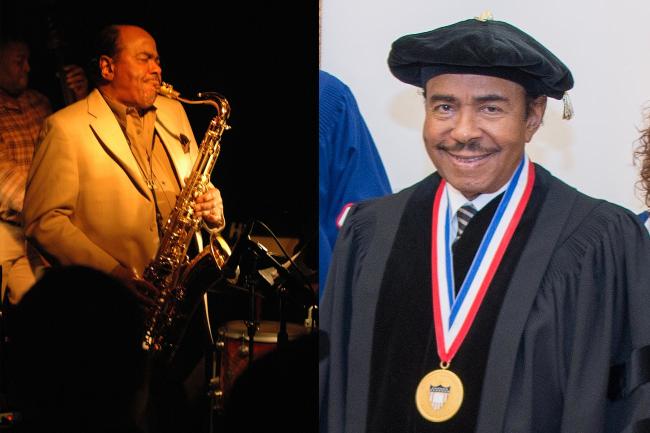
Golson enrolled at Howard in 1947 and began playing with jazz bands around the city and the Howard Swing Masters before leaving after three years to pursue his musical passion full time. He pushed boundaries and his professors at Howard, which did not have jazz band, in the truest spirit of jazz improvisation. In honor of his contributions to the arts and culture and his repeated demonstration of innovation and excellence, the Howard University Jazz Ensemble created the Benny Golson Jazz Master Award in 1996. In 2014, Howard University awarded him an honorary Doctor of Music degree.
Carr, who received the Benny Golson Jazz Master Award in 2014, saijd that Carr’s success helped Howard’s music department evolve.
“Benny attended Howard when jazz was not accepted in the music department,” said Carr. “In fact, he played clarinet and piano when he was there. He went back to Howard to finish his degree after he had received some success on the jazz scene. So absolutely, his success on the jazz scene spearheaded the change about jazz in the music department. Plus, people like Andrew White followed him a few years later to keep that momentum going.”
UNESCO and the organizations sponsoring International Jazz Day partnered with the Smithsonian Institution’s Jazz Oral History Program to record and document the perspectives on the lives and experiences of 100 authorities on jazz, including Golson. In 1996, the National Endowment for the Arts presented Golson with a Jazz Master Award, the highest musical artists for jazz in the United States. He received the Grammy Trustees award from The Recording Academy in 2021, alongside Ed Chereny and Kenny “Babyface” Edmonds. For Carr, receiving an award that placed him alongside greats like Golson was a milestone in his career.
“Being associated with Benny Golson and all of the other recipients of that award is an honor of the highest magnitude in jazz, and receiving the honor from my alma mater will always hold a very special place in my heart,” said Carr.


 Culture Creators: Arts and Entertainment
 Lineage: Howard Students and Alumni
 *Accolades