

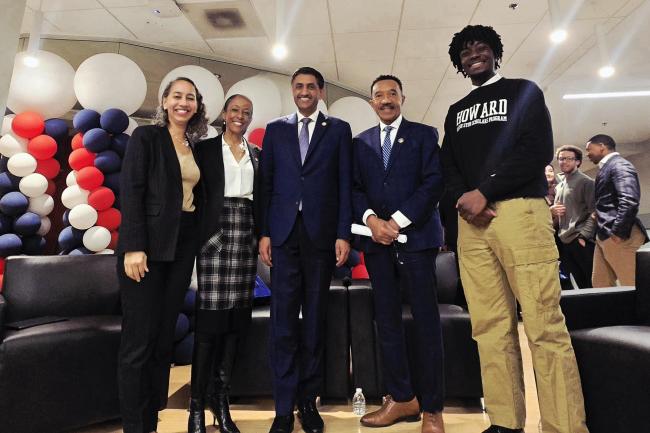
In November, the Howard University Office of External Affairs collaborated with the College of Engineering and Architecture (CEA) to facilitate a critical conversation, "Shaping the Future: AI, Tech Innovation, and the Next-Generation Workforce," to highlight national priorities and regional initiatives that are designed to expand opportunities for HBCU students to shape the future.
A conversation led by Talitha Washington, Ph.D., executive director for the Howard University Center for Applied Data Science and Analytics, and moderated by Nicholas Abram, CEA computer science junior and Karsh STEM scholar, featured U.S. Rep. Kweisi Mfume (D-MD), U.S. Rep. Ro Khanna (D-CA), and CEA Dean Kimberly L. Jones, Ph.D., (BSCE ‘90).
Washington opened with an emphasis on the urgency to prepare our students for an AI-driven future. She stressed the importance of the university's efforts to integrate AI education across disciplines, including new AI courses launching this spring, and an AI certificate program launching next fall, as well as its partnerships with tech companies and other HBCUs on academic initiatives to enhance AI literacy, such as Amazon Web Services’ Machine Learning University Educator Bootcamp.
AI is evolving faster than any other technology, with new tools emerging more quickly than can be properly understood. This new world technology is impacting every industry, and AI education and research must keep pace.
Through the president’s AI Advisory Council, we are actively aligning research, curriculum operations, and partnerships so that every Howard student gains meaningful AI literacy regardless of their discipline,” said Washington.
Howard University is committed to shaping a responsible AI future through interdisciplinary AI research across domains such as secure autonomy, human-machine teaming, trustworthy AI, language technologies, community-centered innovations, and digital health solutions.
Abram, a CEA undergraduate AI researcher who has contributed to projects at the Stanford Trustworthy AI Research Lab, the Inquisitive Robotics Lab at Yale University, and the Affective Biometrics Lab at Howard University, addressed the panel with a pressing question.
“It feels like new AI tools are coming out every single day, and in this time of rapid development, many of our students are worried. How are we supposed to adapt to this ever-changing workforce? How will you ensure that HBCU students are not left behind? And how will we have access to these new tools?”
Mfume responded with a quote from Martin Luther King, Jr.: “We stand today between two worlds — the dying old and the emerging new.” He noted that these remarkable words are just as profound and prolific today as they were in the late 1950s. This is a special period for humanity.
“I hope you all realize that the government has control to help create, stabilize and ensure that the opportunities are there,” Mfume assured students.
Mfume and Khanna have dedicated their careers to ensuring that digital access and technological progress are broadly shared across underrepresented communities through advocacy and activism. Their collective focus is now shifting to strengthening AI workforce pathways and creating opportunities for HBCU students.
Khanna called on tech companies to invest in and harness the talent at HBCUs, expressing his vision to bridge the gap between HBCUs and Silicon Valley. He introduced the TechWise program, which offers nine-month courses and job placements in the AI industry to HBCU students across 15 institutions.
“Those jobs are still going to exist. The key is to be trained and educated in the AI technology to be able to understand the use of that technology, and how to apply that technology,” said Khanna.
During the Q&A session, students expressed concerns about ethical and responsible AI use and the impact of AI on the future of the workforce.
Khanna emphasized the need to address ethics.
“We need an AI that is going to enhance human capability,” he said. “These are things that are not just for computer scientists to figure out, they’re for philosophers and ethicists and humanists to figure out, to deal with how we shape an AI world.”
Mfume affirmed to Howard students that they have the power to influence and shape the direction of AI and how it impacts the workforce.
“All of you have a sphere of influence. So many people believe you have the answer. Your opinion has real value,” he said.
In her closing remarks, CEA Dean Jones shared her experience as a Howard undergraduate student, noting that these years are a most inspiring time for students because there is so much that is being learned. During the conversation, she also encouraged students to take advantage of the connections they are making and to begin building their networks now for future career development.
“Please remember, as you go out into the workforce, and as you encounter people who may not believe you know enough or may not believe you are enough, that you are enough. You are a graduate of Howard University, and as an alumna myself, I know that we are fantastic,” said Jones.
Keep Reading
-
 *Accolades
Howard University CEA Professor Sonya Smith Elected to AIAA Class of 2026 Fellows
Sep 28, 2026 3 minutes -
 Artificial Intelligence
Howard University Launches Its First AI Certificate Program for Undergraduate Students
Aug 20, 2026 4 minutes -
 *Change Makers
Howard University Trustee Arne Duncan’s Anti-Gun Violence Organization Takes the Spotlight in Documentary
Oct 2, 2026 6 minutes