

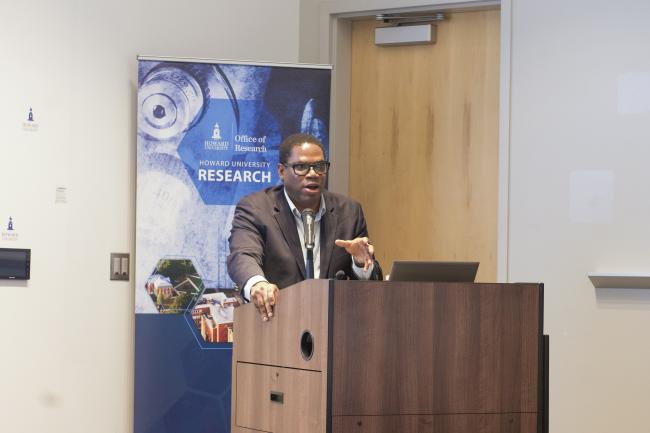
During Howard University’s Research Month 2026 initiative, faculty and student researchers across disciplines showcased the work they’re doing to advance the university’s impact in advancing artificial intelligence research with multidisciplinary collaborations, industry and community partnerships, AI training, and workforce development.
During the month-long series, facilitated by Howard’s Office of Research, faculty, staff, and student researchers led presentations, workshops, lectures, and discussions on new and ongoing projects driven by AI research. University researchers also addressed how the technology is impacting student learning and how they’re preparing students for an AI-driven workforce.
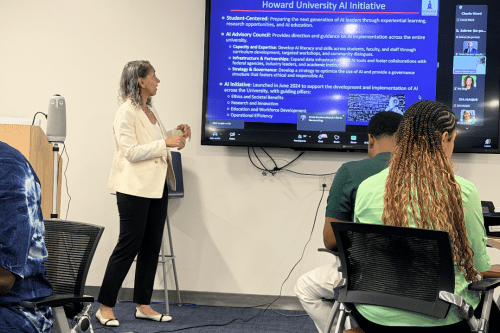
At the “Integrating Artificial Intelligence in Research” symposium April 16, Dr. Talitha Washington, executive director of Howard’s Center for Applied Data Science and Analytics, reiterated the work that’s currently taking place in support of Howard’s AI Initiative, sharing that advancing AI scholarship and innovation doesn’t happen in a bubble.
“We need good people at the table doing the work, doing the innovations in a way that shows we care, we do it with ethics in mind, and we all take some responsibility in how it’s going to be done,” said Washington.
Contributing to America’s AI Action Plan
Howard researchers are combining their efforts to expand the university’s contributions to the AI revolution.
Pamela Clarke, senior executive director of research development and college partnerships, noted in several Research Month events that the Office of Research is working with the university’s research community to contribute to a recent executive order to implement “America’s AI Action Plan” with the Genesis Mission.
The Genesis Mission’s goal is to accelerate scientific innovation by developing an “integrated platform that connects the world’s best supercomputers, experimental facilities, AI system, and unique datasets across every major scientific domain.” In March, the Department of Energy allocated $293 million in funding to advance the work of Genesis Mission by initiating Phase I of its Request For Application process.
“This is the largest investment of the federal government in AI research,” said Clarke. “The goal of this opportunity is to leverage the national labs, academia, and industry to use AI technology to transform the way we solve scientific problems. They’re looking to bridge partnerships, create high-skilled jobs, educate the community, and have the U.S. be leading in regard to AI technology and research.”
Clarke shared that the university is moving forward with submitting six proposals led by Howard researchers for Genesis Mission’s Phase I funding round. Clarke explained that there are several opportunities for university researchers to take part in future Genesis Mission funding rounds as the initiative outlines 26 science and technology challenges of national importance.
Howard’s AI and Healthcare Research
In addition to university’s participation in the national AI initiative, Research Month 2026 participants also shared the status of ongoing AI projects being conducted in Howard research labs and classrooms.
During one event, Dr. Tsang-Wei “William” Tu, associate professor of radiology in the College of Medicine, discussed the AI-powered system he helped to develop that can quickly analyze and classify brain images. Tu’s presentation, “StainAI: Deep Learning Based System for Automated Microglial Image Analysis,” outlined his latest collaboration with the Children’s National Hospital to study neonatal hypoxia, a type of brain damage.
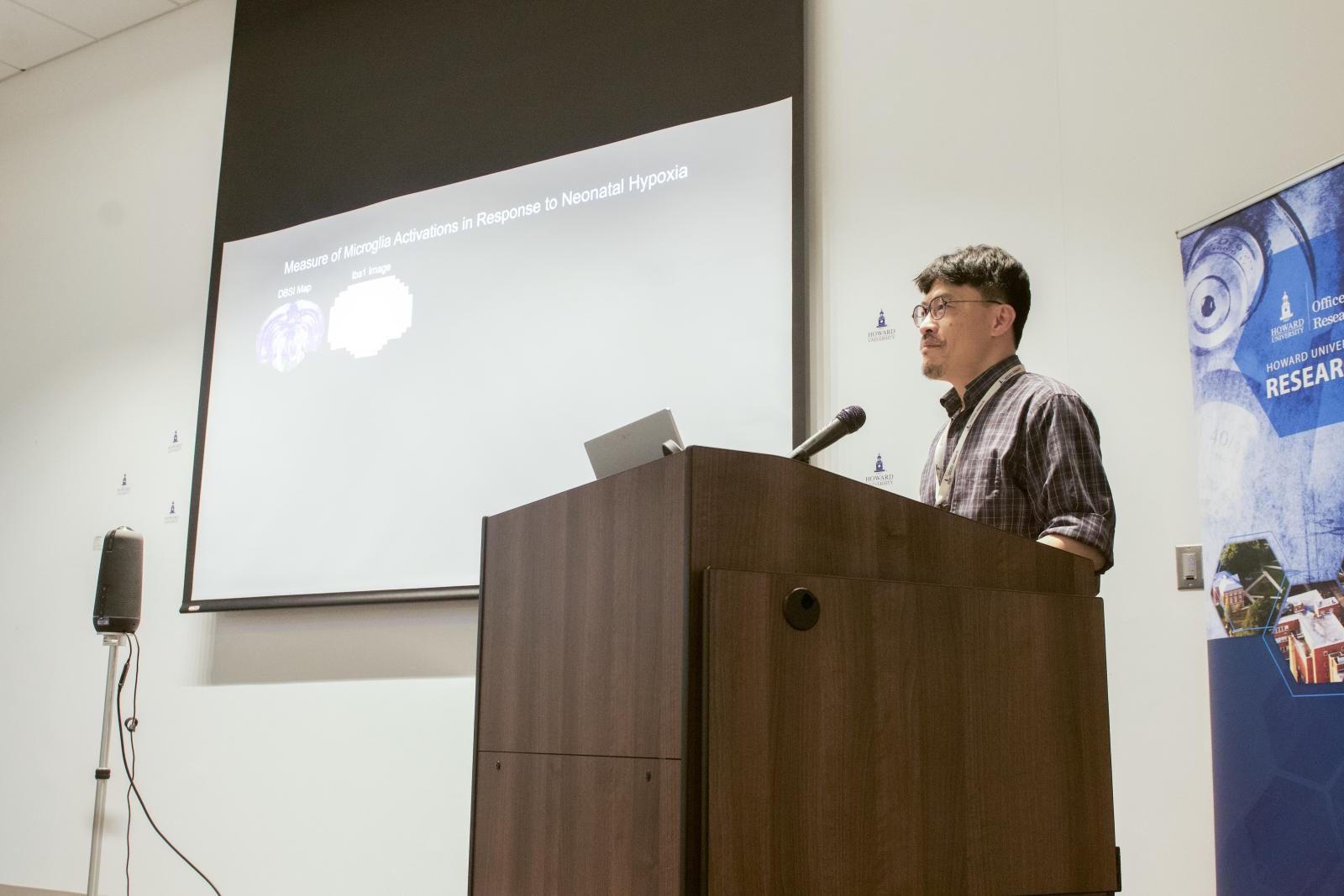
His team created a new system called StainAI, a deep learning software that can count and quantify morphological phenotypes of cells. Tu explained how StainAI works and discussed the results of a study he worked on mapping and analyzing microglia, the immune system of the brain. The study, published in Communications Biology, describes StainAI as a “scalable, high-throughput solution for microglial analysis from routine immunohistochemistry images, accelerating research in microglial biology and neuroinflammation.”
“There are numerous cells inside the brain which makes it very difficult for us to make a quantitative comparison with a radiology image,” said Tu. “My team uses AI models to classify the images and provide segmentation labels for each cell. We proved our principle that we can use AI models to analyze these very dynamic cells and it still gives us reliable results.”
Dr. Anietie Andy, assistant professor of electrical engineering and computer science, similarly discussed the studies he’s leading on AI use in healthcare with his work as a member of the Howard University AI in Healthcare consortium. Andy explained the projects he’s worked on investigating cardiovascular disease and his research in predicting the severity of traumatic brain injuries and traumatic diaphragmatic injuries.
The researcher highlighted his latest project in which his team used Generative Pre-trained Transformers (GPT) — a family of large language models (LLMs) developed by OpenAI — to predict the severity of traumatic brain injuries. The project is a collaborative effort between the university’s computer science department, the College of Medicine, and the Howard University Hospital.
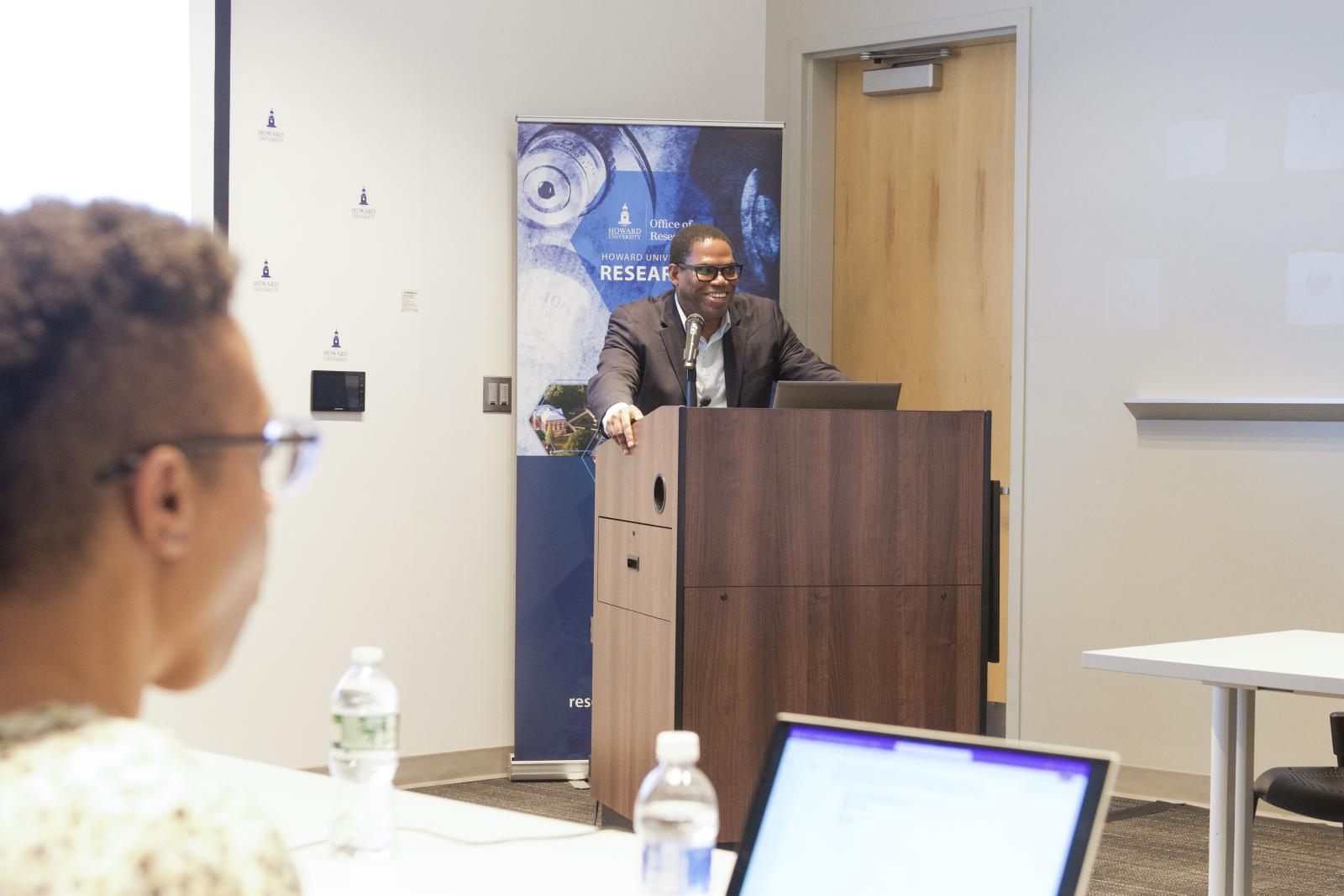
“By using LLMs, we get good enough results that are almost close to machine learning predictions,” said Andy. “Next steps include trying to fuse LLMs with machine learning to see if that fusion can give better predictions [while] coming up with fusion strategies.”
AI Innovation in Black Communities
Dr. Harry Keeling, associate professor of electrical engineering and computer science, explained the work he’s done educating students on engineering, AI, and robotics.
“Robots are a simple step forward in actionable AI output mechanism, so there’s a natural marriage between the two,” said Keeling.
Dr. Gloria Washington, associate professor of computer science, discussed the work happening at Howard’s Human-Centered AI Institute (HCAI). Washington shared how her team at HCAI created a framework for responsible AI, which they put into practice for Project Elevate Black Voices, a collaboration with Google that aims to improve automatic speech recognition technologies for African-American English speakers.
In terms of AI’s global impact, particularly as it pertains to Black diasporic communities, Research Month events such as the “AI, Data, and Africa: The Future of Global Innovation” discussion outlined how AI is affecting the African continent. The conversation featured Dr. Amy Yeboah Quarkume, associate professor of Africana Studies, and Dr. Uyi Stewart, vice president of inclusive innovation and analytics at the Mastercard Center for Inclusive Growth.
Stewart shared that beyond the “African digital colonialism” concerns happening on the continent of extracting key mineral resources used in AI production, “Africa is not playing catch up, especially when it comes to AI. What Africa is doing is inventing different defaults.”
He outlined three AI trends that’s emerging throughout Africa: expansion of AI ecosystems, digital entrepreneurship, and digitizing African languages. Stewart also discussed how African universities are “transitioning from training factories into ecosystem orchestrators, partnering with private sectors and different individuals in the community [to find] … the right problems to solve, bringing those problems into the incubator, and then engaging private sector organizations to think through how we productize these solutions.”
Keep Reading
-
 Artificial Intelligence
Howard University Launches Its First AI Certificate Program for Undergraduate Students
Aug 20, 2026 4 minutes -
 Artificial Intelligence
Howard University Hosts Agentic AI Bootcamp for Faculty to Explore the Future of AI in Academia
Aug 19, 2026 3 minutes -
 Epiphanies, Discovery, and Research
Howard University Doctoral Student Receives Competitive Dissertation Fellowship, Examines Faith in Educational Experiences of Black Students
Sep 4, 2026 5 minutes