

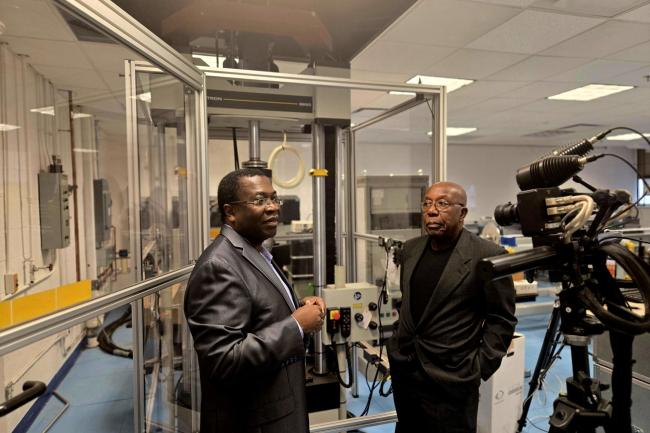
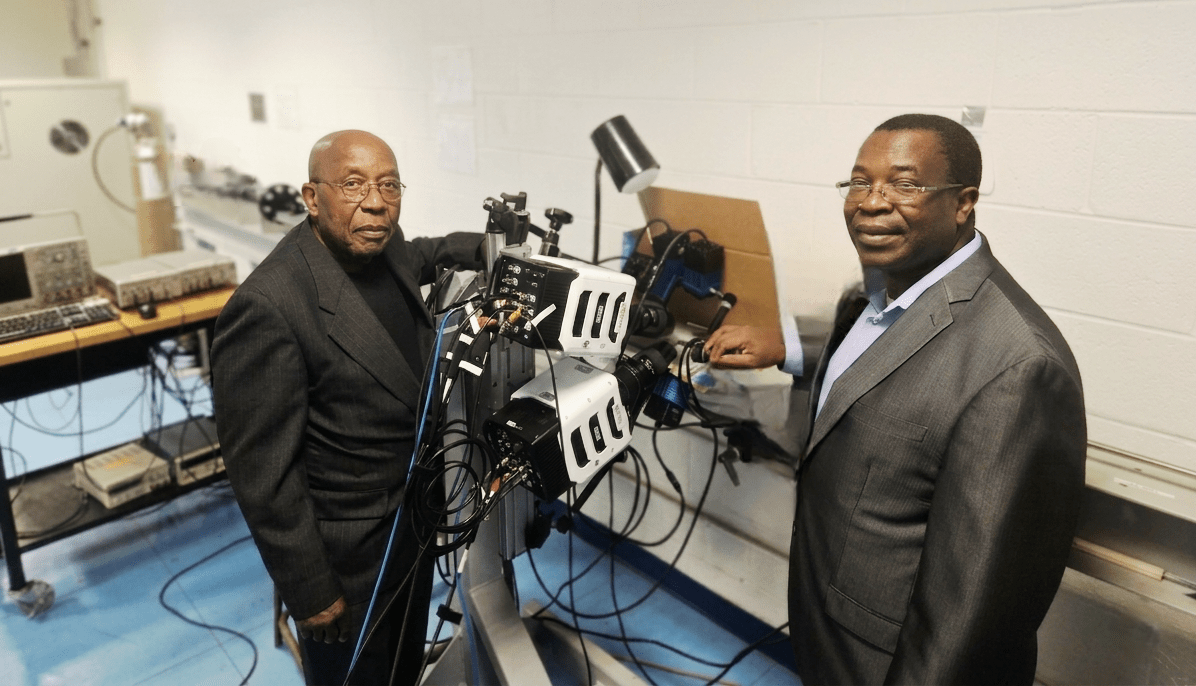
Howard University mechanical engineering professors Gbadebo Owolabi, Ph.D., and Emmanuel Glakpe, Ph.D., have been awarded a grant by the U.S. Department of Energy’s National Nuclear Security Administration (DOE-NNSA) to form the Consortium for Research and Education for Advanced Manufacturing of Alloys for Extreme Conditions (REAM).
Howard University joins consortium member institutions Texas Southern University and Texas A&M University in partnering with Los Alamo National Lab (LANL) and Idaho National Lab (INL) to help enhance national security.
The member institutions will receive $4.7M in total funding for the project with a $1.4M allocation for Howard University. Owolabi serves as the principal investigator for Howard University and Glakpe as co-principal investigator.
“We are excited about this new award. It will provide our research team the opportunity to engage in frontier research in an area that is of great importance to the energy sector. Additionally, our collaboration with the LANL and INL labs will give our students access to top-notch advanced manufacturing resources and expertise, enhancing their educational and research opportunities, and preparing them for leadership in nuclear science and engineering,” said Owolabi.
The project is dedicated to nurturing a new generation of students, preparing them to address the future challenges within nuclear science and engineering (NSE), specifically targeting advanced manufacturing, which includes 3D printing, AI and advanced robotics, nanotechnology and more. This will be achieved through a strategic expansion of the pool of students from minority serving institutions (MSIs) who are proficiently trained in disciplines vital to NSE aims to bridge academic and industry needs in NSE and advanced manufacturing. In partnership with the LANL and INL labs, the team of researchers will create internship programs for practical NSE experience and mentorship, preparing students for the NSE workforce and fostering connections with field experts.
The research component of this project focuses on the critical role of tungsten for the safety and efficiency of fusion reactors. Recognized for its unparalleled melting point, low vapor pressure, and considerable tensile strength, tungsten alloys are being engineered to withstand severe thermal and plasma stresses similar to those experienced during space shuttle reentry.
The researchers will work with students to develop additive manufacturing of high-performance tungsten alloys for nuclear applications using an open-source electron beam powder bed system. They will refine and optimize the manufacturing process by using a scientific machine learning digital twin for obtaining optimal microstructures and crack free mechanical parts.
At Howard University, new graduate courses will be introduced to address the lack of nuclear materials education. Students will also learn to perform detailed characterization of the mechanical properties and microstructures of both as built and irradiated tungsten alloy components to understand the behavior of these materials under the extreme conditions specific to nuclear applications. The consortium is designed to provide lasting benefits beyond the lifespan of the grant, ensuring that future generations can continue to access vital resources and expertise.
Keep Reading
-
 *Accolades
Howard University CEA Professor Sonya Smith Elected to AIAA Class of 2026 Fellows
Sep 28, 2026 3 minutes -
 Epiphanies, Discovery, and Research
Howard University Researchers Advance Decade-Long Study of HIV and Sickle Cell Disease
Sep 23, 2026 4 minutes -
 *Research and Discovery
Howard University Study Links Medicaid Expansion to Lower Breast Cancer Deaths
Oct 6, 2026 5 minutes