Do you think of climate change as a social justice issue?
This question was posed during a session held during Howard University’s Research Month event on April 22, titled, “Climate Change and Gender-Based Violence: An Overlooked Nexus.”
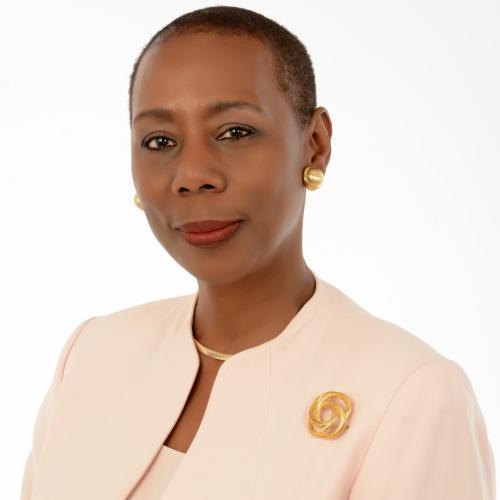
Moderated by Dr. Goulda Downer, associate professor in the College of Medicine, the session examined the connection between climate and elevated occurrences of violence against of women and girls as a consequence of “climate-driven disasters” like floods, droughts, heatwaves, and hurricanes.
“In the UN piece, it talked about how for every degree centigrade rise in temperature, there’s a 4.7 percent increase in gender-based violence,” said Downer.
The article that prompted the professor’s Research Month session idea, which was referenced throughout the day’s discussion, was based on a recent United Nations study. The study cites, among other data, growing evidence indicating that as temperatures rise, so do the number of intimate partner violence (IPV) and gender-based violence (GBV) cases.
“It just stuck with me,” said Downer in reference to the study. “I realized that it’s not something just [on] this side of the globe — it’s global. I decided to look at what this looks like for different parts of the globe.”
Investigating Climate Change Impacts, Violence, and Black Women
Presented by the university’s Office off Research, The Center for Women, Gender, and Global Leadership, and the College of Medicine, the panel included researchers from Asia, Africa, the Caribbean and the United States who spoke to how these issues impact women and girls, especially those who reside in “fragile” communities. According to the UN study, women and girls in fragile communities, where they already are facing inequalities that can make them more vulnerable to assault, are the most impacted by this kind of violence.
Keynote speaker Jacqueline Patterson, former senior director of the NACCP Environmental and Climate Justice Program, began by sharing more disturbing statistics as it relates to Black women.
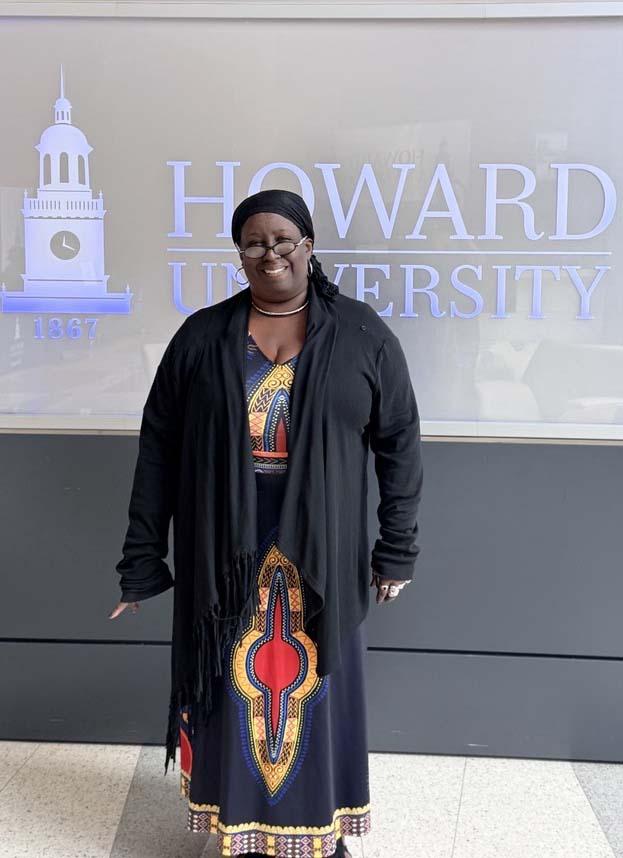
Calling the violence that often occurs as a result of climate change a “physical manifestation of environmental racism and anti-blackness,” Patterson shared that “80 percent of people displaced by climate change are women.” Within that statistic, “Black women and women in the global South face the sharpest edge of the compounded poverty and state violence.”
She asked how many people in the room had initially learned about the climate crisis as strictly an ecological issue, calling attention to the fact that many don’t draw a connection between social justice and climate.
“When I first started at the NAACP, the first thing I did was try to get folks to think about climate change as a social justice issue,” Patterson said, noting that most of her students thought her ‘Climate Justice 101’ class was about the climate of injustice in the world, or workplace discrimination. “Climate justice didn’t even compute.”
A main objective of the session, and of the work she does, is to bring awareness to evidential links between increased levels of GBV cases to climate change, and its eventual impact.
Patterson, who is also the founder and executive director of The Chisholm Legacy Project — a nonprofit that connects Black communities on the frontlines of climate justice with resources — went on to point out what climate change as a civil rights issue encompasses.
“Most of us were taught to compartmentalize around climate change; we know we can’t engineer our way out of the climate crisis,” explained Patterson. “We have to acknowledge the racial and gender structures that have built the extractive economy in the first place. So, as we think about the intersection of gender-based violence, race, and climate change situated more broadly in the environmental justice, our first step is recognizing that the degradation of the earth and the violation of Black bodily autonomy are deeply intertwined, inexplicably so.”
She went on to emphasize how Black women have historically been viewed and treated in America.
“We can’t resolve the climate crisis without dismantling the anti-Black social structure that fuels it,” Patterson added. “Gender-based violence, whether domestic, state sanctioned, or industry driven, is a direct consequence on the extractive economy that has historically viewed both the land, and Black women’s bodies as disposable resources to be mined, exploited, and discarded.”
It’s reported that in the United States, 45 percent of Black women experience sexual violence, physical violence, or stalking by intimate partners in their lifetimes. In addition, Black women are murdered by men at nearly three times the rate of white women.
“This reality completely shatters the myth of a state harbor during climate disaster,” said Patterson. “We started thinking about these intersections. When extreme weather forces communities to ‘shelter in place,’ or when failing infrastructure traps people within their homes, Black women are frequently locked inside with their greatest threats.”
Agricultural Impacts
Panelists also discussed issues related to farming and agriculture. According to Patterson, globally, 95 percent of African smallholder farmers depend on rain fed agriculture, but with climate models projecting extreme heat, crops will be impacted, resulting in food scarcity. In the United States, a 2024 study found that one in four Black households experienced food insecurity due, in part, to environmental racism (a legacy of discriminatory agricultural policies the uniquely impact Black communities). These facts can put women in danger.
“We also know [that] food insecurity globally actually doubles the odds of a woman experiencing gender-based violence,” said Patterson, noting that in many countries, women are responsible for the harvesting of food. “When crops fail, and food systems collapse, Black women are frequently trapped in abusive relationships due to the reliance on an abuser for basic sustenance, and they’re forced into transactional survival sets to feed their families, drastically increasing their exposure to sexual violence.”
Organizations like Patterson’s Chisholm Legacy Project are working to bring awareness to these issues, as well as resources to Black communities who are systematically under resourced in the aftermath of extreme climate-driven events. Sessions like this one further the discussion and engagement around ways to combat GBV and IPV.
Awareness and a Path Forward: A Howard Student’s Study
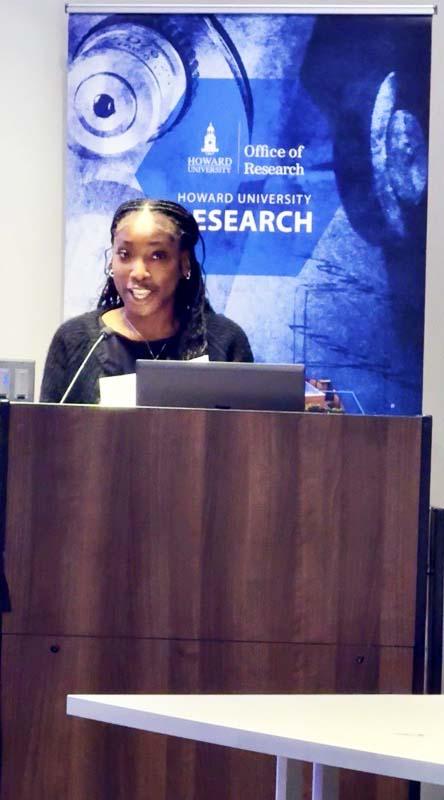
In addition to Patterson, Howard students are also bringing awareness to and identifying system-level failures in emergency response that often leave women and girls unprotected. Sophomore Laura Tisoit, a biology and chemistry major and maternal and child health double minor, presented her research examining the connection between climate change and instances of GBV. Her study included a sample of 76 participants across the United States, Jamaica, and Haiti, particularly students attending HBCUs. Tisoit found that respondents were generally unaware of the connection between climate change and GBV.
“While people understand these issues separately, many do not realize that climate-related events such as natural disasters, displacements, and economic instability can increase vulnerability to violence,” explained Tisoit. “Participants reported learning about these topics through social media, school, and personal experience.”
The majority of Tisoit’s respondents were female (approx. 74 percent) which she called significant, due to women being disproportionately affected by both climate change and gender-based violence. She concluded that while awareness of the issues separately is strong, there is a need “to better educate people on how they intersect.”
“We must integrate gender perspectives into comment policies, strengthen education in this generation and beyond, and prioritize the protection of vulnerable populations,” Tisoit added. “Climate change is not gender neutral, and our solution should not be either.”
A Global Crisis
Following the keynote and student presentation, there was a panel discussion featuring humane rights advocate Daniele Magloire, vice president of the Board of FOKAL in Haiti; Carolyn Kitione, of Shifting the Power Coalition in Fiji; and Mabel A. Ade, founder and executive director of the Adinya Arise Foundation (AAF) in Nigeria.
“Climate change affects the different regions of the world differently, which is the picture I wanted to show,” said Downer when asked about the makeup of the panel. “I decided to look at what this looks like for different parts of the globe.”
The panelist shared specifics from their regions, including Ade whose work is considered to be at the “forefront of the climate, gender-development nexus, with a strong focus on climate-induced displacement, loss of livelihoods, and how environmental shocks exacerbate gender-based violence,” in Nigeria. Kitione’s Shifting Power Coalition organization is a Pacific network of 15 women’s organizations advancing locally led humanitarian action in Fiji. Magloire shared her experience navigating various devastating climate changes and actions in Haiti over the past decade.
Climate change is not gender neutral, and our solution should not be either.” —Sophomore Laura Tisoit
People from all over the world joined the virtual discussion and were able to listen in and engage with these women who are on the ground doing the work to bring awareness to how climate issues intersect with IPV and GBV, and learn about how they’re providing resources and elevated access to the impacted women and girls. “They were able to really talk about the interconnectedness between the climate stressors, the displacement, and escalation of gender-based violence,” shared Downer.
When asked about solutions or practical strategies to combat GBV and IPV, as well as how communities can work together and perhaps implement emergency response frameworks, Downer pointed to the work panelist Kitione is doing in Fuji as an example.
“Carolyn had 15 different organizations. They’re already doing it — identifying what we have not done at all and [what we’ve] done well,” Downer explained, noting how Kitione’s team is collecting the data.
“We know what’s happening, but this is where the research becomes important,” she added. “When we have the objective data, then we can begin to harness that information and make the solutions not just geographically relevant, but relevant to the communities that we are expecting to serve.”
One of the things we also need to do is empower the women, empower them to tell their story.” — Dr. Downer.
Downer noted the importance of being on the ground and listening to those impacted, stressing that women need to be allowed to show up as their authentic selves and encouraged to share their stories in their own way.
“Honor the person who comes to share. That’s something that the women talked about, [having] a safe space for the community to actually come in and share their stories, which they have been able to do, but also link them to the resources they need, not what we think they need,” said Downer.
With all of this in mind, there are still many people who are not aware of the correlation between climate change and gender-based or intimate partner violence. It stands to reason then, that some of the women and girls impacted may also be unaware of this connection. This reinforces the need to increase awareness and continue compiling data and research in order to provide access to region-specific resources, in addition to truly listening to the women and girls who are at risk or who have been hurt.
“One of the things we also need to do is empower the women, empower them to tell their story,” said Downer. “Give them a safe space to land, with no judgment.”
Keep Reading
-
 *Accolades
Howard University CEA Professor Sonya Smith Elected to AIAA Class of 2026 Fellows
Sep 28, 2026 3 minutes -
 Epiphanies, Discovery, and Research
Howard University Researchers Advance Decade-Long Study of HIV and Sickle Cell Disease
Sep 23, 2026 4 minutes