

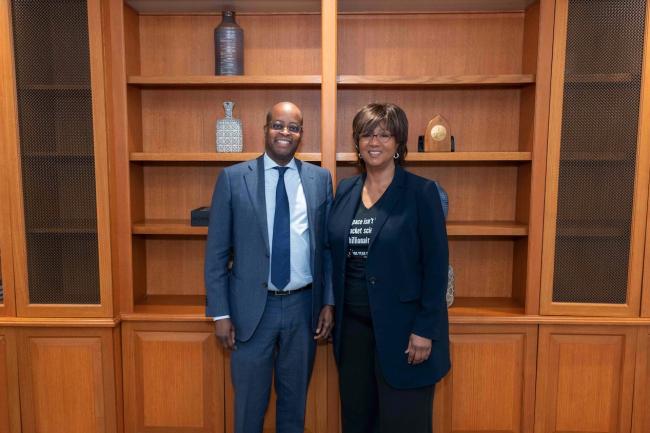
Dr. Mae Jemison, the first woman of color in the world to go into space and principal of the organization 100 Year Starship, spent two days at Howard University last week preparing students for the hardest engineering problem they will ever face: human interstellar travel.
"We have to push ourselves to think bigger," Jemison said. "The best way to learn is to try things you don't know how to do. That's where you develop confidence."
The 100 Year Starship workshops fell during Howard's Research Month on April 27-28, underscoring the university's R1 status, the nation’s top research classification. The event also aligned with Howard's Research Institute for Tactical Autonomy (RITA), a $90 million Air Force-funded center that develops autonomous systems for missions where human intervention isn't possible. Such systems could prove crucial to space travel in the future.
Howard University is the only historically Black university with R1 research status and the first HBCU to lead a University Affiliated Research Center.
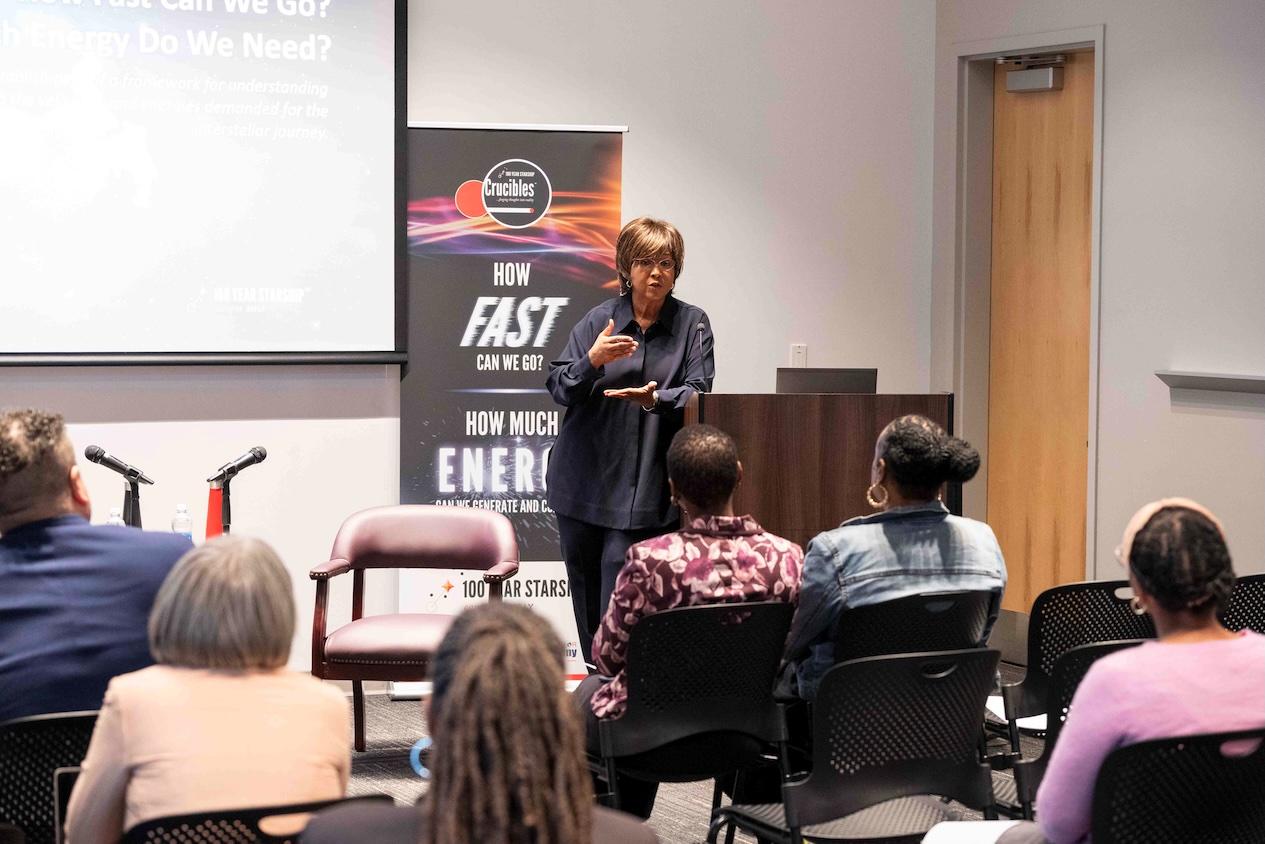
Jemison leads the 100 Year Starship project, which aims to make human travel to another star possible within a century. Getting there, she repeatedly stressed, requires moving beyond the "safe stepwise" approach that dominates most research.
“Interstellar travel is really about pushing for radical leaps, because we’re not going to get there by being safe,” Jemison said. “It took us 50 years to go back to the moon—we did it in 10 years when we didn’t know anything. So if we keep trying to take safe, stepwise approaches, we’re not going to get anywhere. It’s important to allow yourselves to think bigger than that.”
Jemison earned undergraduate degrees in chemical engineering and African and African American studies from Stanford University, and later an M.D. from Cornell University. She is best known as the first Black woman to travel to space, flying aboard the Space Shuttle Endeavour in 1992. Her presence, often marked by her natural hair and her refusal to conform to narrow expectations of who belongs in science, has long challenged boundaries.
"People know me in that orange flight suit," she said, referencing the iconic photos of her in space. "But it's not about the suit. It's about what we push forward."
Beyond incremental thinking
Over two days, panels and workshops brought together students and Howard researchers focused on understanding how to achieve the velocity and energy demands of interstellar travel, with or without humans. Discussions touched on propulsion, energy systems, and autonomy, led by researchers from Howard's Research Institute for Tactical Autonomy. The events included breakout sessions and long discussions that moved between physics, engineering, life sciences, and the ethics of planetary exploration.
“Howard is a comprehensive institution,” said Sonya Smith, director of Howard University’s Research Institute for Tactical Autonomy (RITA). “We have the medical school, engineering, life sciences—we have all of the disciplines that can contribute to what this work is about.”
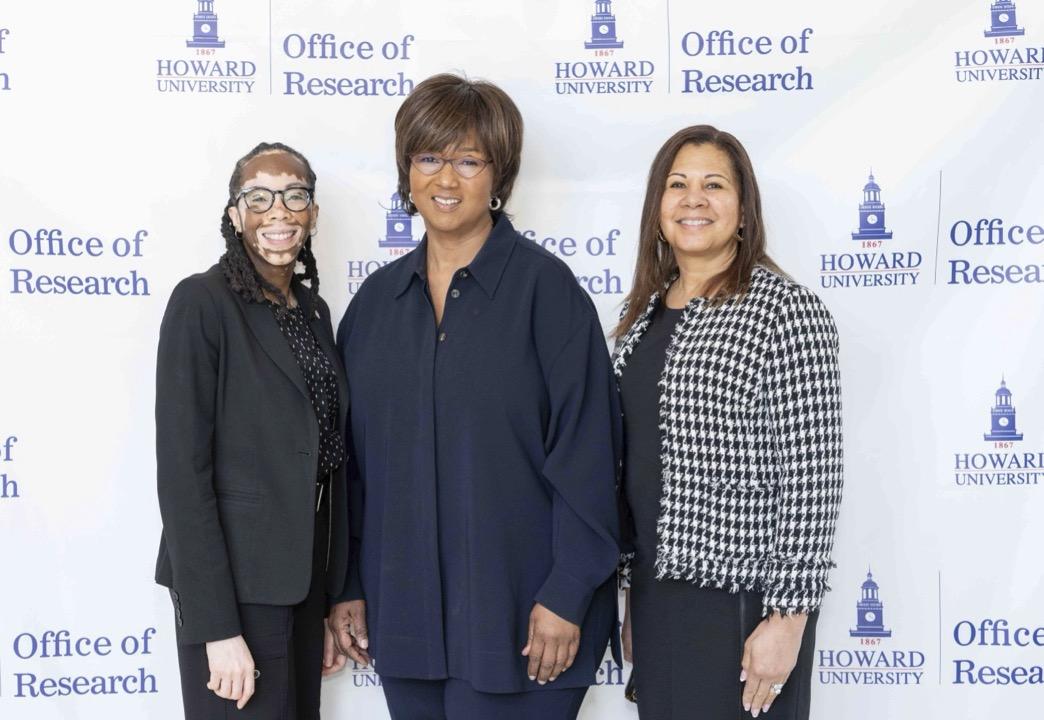
Jemison took a hands-on role in the research sessions. Working in groups, participants tackled mission designs: how to power spacecraft, navigate vast distances and sustain human life. Many approached the task cautiously, building outward from existing systems and grounding their ideas in what is currently feasible.
However, Jemison urged students to stop waiting for perfect knowledge.
"There is no perfect knowledge," she said. "There are not answers to these things until we start to try to apprehend them. I can't tell you the answers. I can tell you some of the process."
During the sessions, students also inserted personal questions. One student asked Jemison about seeing past barriers in science as it related to her own achievements. In one response, Jemison pointed to her childhood on the South Side of Chicago in the 1960s. "Would I be standing here," she responded, "if I did the things people thought were reasonable for me to aspire to?"
For Iman Stephenson, a Howard University first-year physics doctoral student who studied nuclear engineering at Oregon State, the 100YSS research workshops offered more than just technical knowledge.
"She's definitely an impressive person," Stevenson said of Jemison. "But seeing her working with us as a regular person, while still knowing that she's not, is inspiring."
Stevenson said she took away Jemison’s central message: scientific success doesn’t depend on perfection, and breakthroughs, especially in complex areas like interstellar travel, require crossing over into multiple disciplines.
"A lot of the time, people want to do more and think differently, but we get so closed in," Stevenson said. "We don't allow ourselves to go that extra distance into the unknown, where we don't know exactly how to do what we're attempting. That's where we learn a lot. That's where we build confidence."
###
Keep Reading
-
 Epiphanies, Discovery, and Research
Howard University Professor Lemir Teron Examines Environmental Justice
Jul 22, 2026 4 minutes -
 Epiphanies, Discovery, and Research
Howard University, NEON Bridge High School & Higher Education
Jul 15, 2026 6 minutes -
 Epiphanies, Discovery, and Research
Howard University Mental Health Advocates Discuss How Black Men Can Maintain their Mental Health Wellness with Resources Like Yoga
Jul 8, 2026 6 minutes