

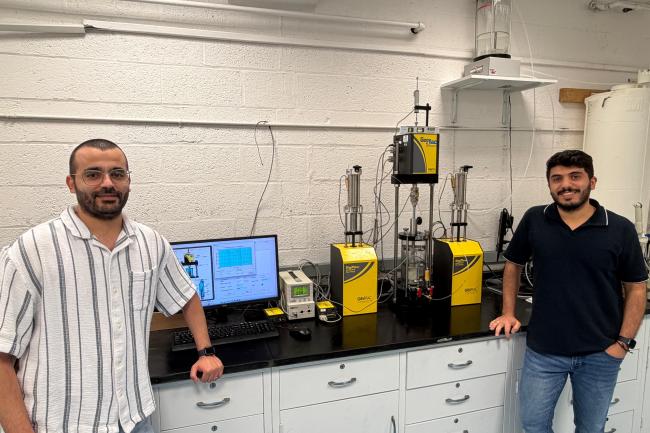
Howard university civil and environmental engineering assistant professor Karam Jaradat, Ph.D., was recently awarded a $780K grant from the United States Department of Defense to support his innovative work on the thermal behavior of soils in extreme environments.
The one-year grant will fund his research project Unraveling the Grain-Scale Mechanism of Soil Thermal Behavior and the acquisition of major advanced research instruments.
“Soils are particulate materials, and their response to extreme conditions, such as freezing, starts at the grain level. Acquiring these advanced research instruments will allow us to study this grain-scale response under such extremes and project it onto the large or macro-scale behavior,” said Jaradat.
In environments subjected to extreme conditions, particularly in arctic or permafrost regions, understanding the influence of thermal extremes on the stability of foundation soils becomes critical for ensuring structural safety and resilience of different infrastructures. These environments present unique challenges for infrastructure stability, military operations, and national security.
Jaradat will investigate how temperature fluctuations influence soil stability at the microscopic level. This area of research remains largely understudied due to limitations in current experiential methods.
The advanced research instruments, including a thermomechanical triaxial system, a temperature-controlled atomic force microscope, and a micro-computed tomography scanner, will enable the real-time high-resolution analysis of soil behavior under realistic heating and freezing conditions, bridging the gap between small-scale material responses and large-scale engineering applications.
National impact and strategic importance
The acquisition of these instruments will strategically position Howard University as the nation’s capital hub for advanced research in geomechanics and materials science, enhancing the university’s appeal to top-tier undergraduate and graduate students.
Access to state-of-the-art imaging and characterization tools demonstrates Howard’s commitment to providing students with hands-on experience using cutting-edge instrumentation.
The tomography scanner will be introduced to undergraduate civil engineering students through the CIEG-438 Soil Mechanics Laboratory course. During the particle size distribution module, students will prepare sand specimens and observe their internal grain and void arrangements via 3D tomographic scans. Students will then apply image-processing techniques to extract grain size distributions from the data and compare them with traditional mechanical sieve analysis results.
As part of a broader outreach initiative, Jaradat is engaging with local high schools, including a recent research presentation at Calvin Coolidge High School in Washington, D.C., during which students were invited to tour his Geomaterials Research Laboratory and participate in future research opportunities.
The goal of the outreach is to inspire students to pursue STEM degrees and potentially submit projects to prestigious national science competitions such as the Regeneron Science Talent Search to expand the university’s pipeline of STEM talent and strengthen its mission of inclusive excellence in science and engineering education.
Jaradat joined Howard University in Spring 2024 and established the Geomaterials Research Laboratory. His expertise spans from the multiscale laboratory testing of geomaterials to advanced multiscale multiphysics numerical modeling using both continuum and dis-continuum frameworks. He is a licensed professional engineer in Virginia, West Virginia, and Michigan. More information can be found on his research website.
Pictured above: Karam Jaradat with Ph.D. mentee Mohammad Almasaeid
Keep Reading
-
 Artificial Intelligence
Howard University Researcher Kamilah Woodson Develops A.I.-Powered Platform to Expand Mental Health Support for Students
Jul 31, 2026 6 minutes -
 Epiphanies, Discovery, and Research
Howard University Professor Lemir Teron Examines Environmental Justice
Jul 22, 2026 4 minutes -
 Lineage: Howard Students and Alumni
Howard Alumnus Chequan Lewis to Lead Crunch Fitness Through Its Next Chapter as New CEO
Aug 3, 2026 7 minutes