Howard University’s commitment to the legacy of Dr. Martin Luther King Jr. (LL.D. ’57) is not confined to a single holiday or annual program. It is a living practice renewed in classrooms and courtrooms, carried forward in student-led service, and sustained through spiritual life at the heart of campus.
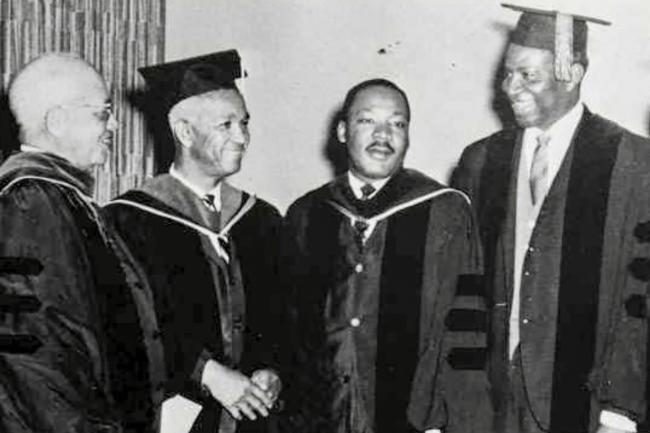
Long before the nation widely recognized Dr. King’s leadership, Howard served as an environment where his ideas were shared, tested, and amplified. He returned to campus multiple times during the 1950s and 1960s, including to earn an honorary doctorate in 1957. Today, Howard keeps that legacy alive through three interconnected channels: student participation rooted in service and civic responsibility; graduate and faculty leadership that turns scholarship into social impact; and the Chapel’s spiritual and interfaith ecosystem that nurtures moral courage and community care.
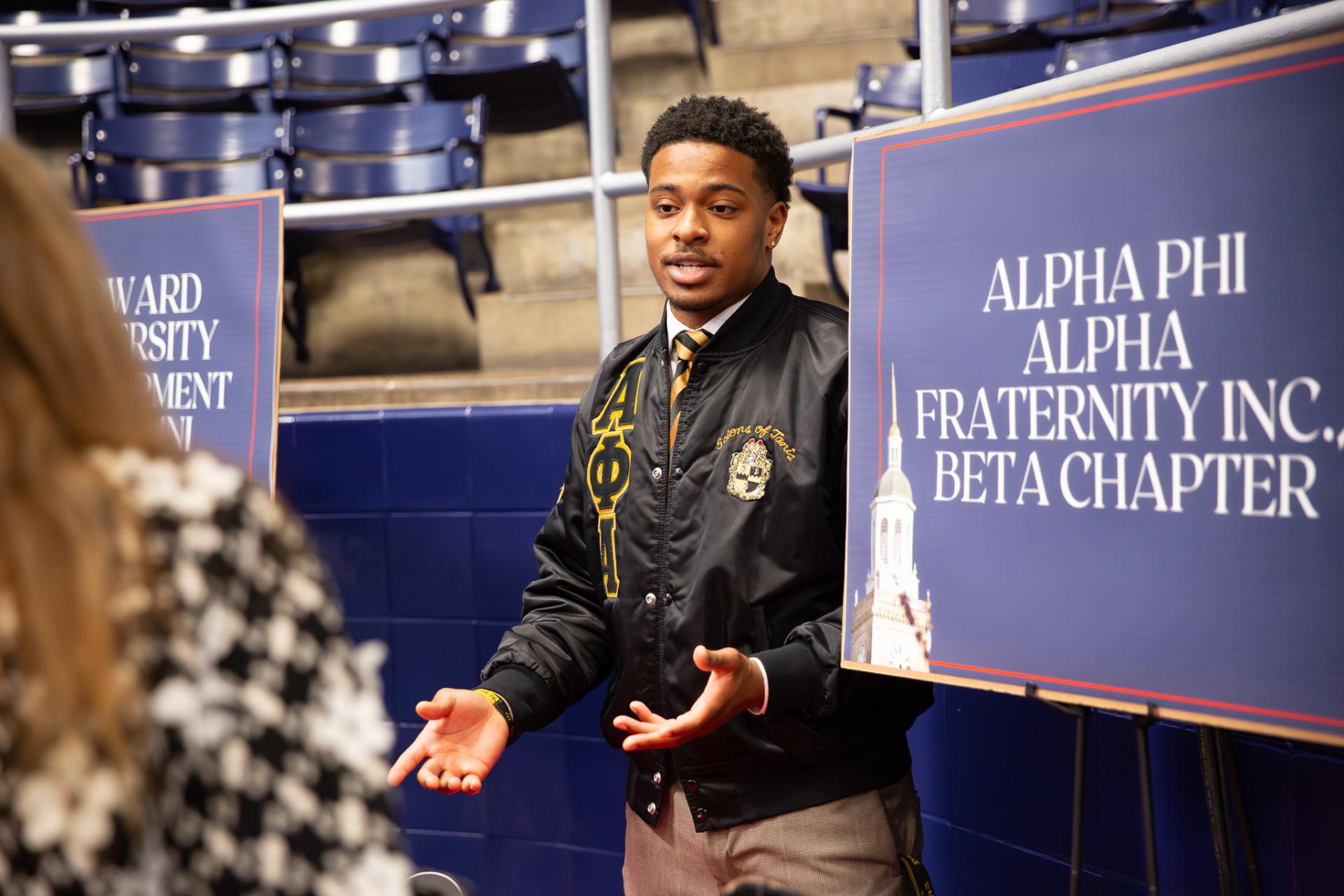
At Howard, Alpha Phi Alpha Fraternity Inc. reinforces a core lesson from Dr. King’s leadership: Progress is rarely abstract.
Student Participation: Alpha Phi Alpha and the Practice of Service
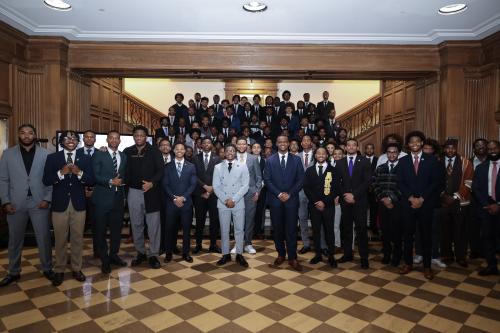
On a campus where leadership is learned experientially, student engagement remains one of Howard’s most visible throughlines to Dr. King’s example. Few organizations embody that ethic more consistently than the Beta Chapter of Alpha Phi Alpha Fraternity Inc., an organization and segment whose history is deeply intertwined with both Howard and the broader story of Black civic leadership in America.
Founded in 1907, Beta Chapter was the first Alpha Phi Alpha chapter established at a historically Black university, helping to shape Black student leadership on HBCU campuses for generations to come. Its mission — developing leaders, promoting brotherhood and academic excellence, and providing service and advocacy — reads like an action plan for the kind of community-minded leadership Dr. King urged young people to embrace.
That mission takes on added resonance at Howard; King himself was a member of Alpha Phi Alpha, and the fraternity continues to frame service as a central expression of his life’s work. At Howard, the Beta Chapter’s presence reinforces a core lesson from King’s leadership: Progress is rarely abstract. It is built through tangible, disciplined commitments: organizing, mentoring, volunteering, and showing up for community needs even when the work is not glamorous.
In practical terms, that means students applying the values of scholarship and service in ways that meet the moment. Whether supporting campus-wide initiatives, partnering with local organizations, or committing time to mentorship and civic engagement, Beta Chapter’s work reflects a broader Howard truth: The “dream” is sustained not only through speeches, but through structured, consistent acts of care and responsibility. When students lead with service, they keep Dr. King’s legacy from becoming a museum piece and instead make it a daily standard.
“Dr. King stood tall not because he sought recognition, but because he stood on principle,” Beta Chapter said. “As a proud member of Alpha Phi Alpha Fraternity, Incorporated, he embodied what it means to lead with intellect, integrity, and service. From the halls of academics to the front lines of justice, Dr. King carried Alpha’s ideals.”
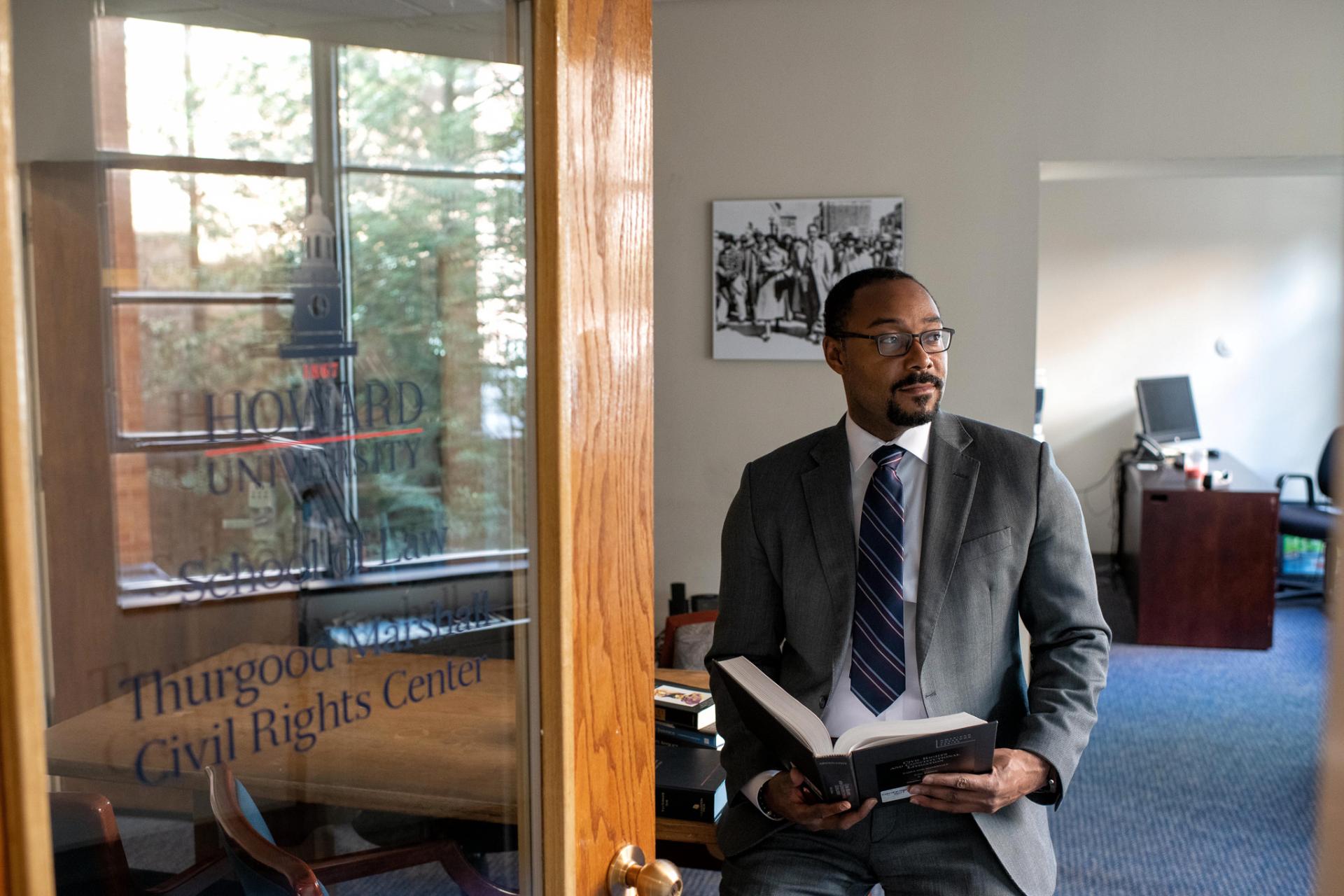
Professor Justin Hansford has been internationally recognized for scholarship and activism in fields that speak directly to the legal and moral questions that animated King’s public life.
Graduate and Faculty Work: Howard Law and the Arc of Justice
Howard’s role in preserving Dr. King’s legacy is also intellectual, anchored in the belief that ideas become transformative when paired with discipline, training, and moral clarity. Nowhere is that more evident than in Howard University School of Law, where scholarship and advocacy are not competing priorities but mutually reinforcing commitments.
A defining example is Justin Hansford (B.A. ’03), a Howard Law professor and executive director of the Thurgood Marshall Civil Rights Center. The center is Howard's flagship institutional setting for the study and practice of civil rights, human rights, and racial justice law and advocacy. Hansford’s work sits at the intersection of theory and action, and he is internationally recognized for scholarship and activism in those very fields that speak directly to the legal and moral questions that animated Dr. King’s public life.
“We know Dr. King was a Ph.D. level scholar, and an on-the-ground organizer who served as a drum major for justice in Congress, in the pulpit, and on the streets,” Hansford said. “Although he never passed the bar, he spent a good time in court as a defendant, responding to attempts to use the law to stifle our people’s strides toward freedom.”
Importantly, this impact is not limited to his work inside academia. Hansford’s biography reflects a pattern that is central to King’s legacy: stepping into real communities and real crises with tools for repair and accountability. Following the killing of Michael Brown in Ferguson, Missouri, Hansford engaged in community-based legal advocacy, helped co-author a human rights shadow report, and accompanied community members to testify at the United Nations, an approach that treats local struggle and global human-rights frameworks as deeply connected. Hansford, too, is a member of Alpha Phi Alpha Fraternity Inc., earning initiation into their Mu Lambda chapter during spring 2021.
This is what it can mean, in the modern era, to “keep King’s legacy alive” through graduate education and faculty leadership: to teach students that law is not merely a profession, but a public trust. Through centers, projects, and experiential learning, Howard Law helps prepare graduates to move beyond analysis toward solutions — work that seeks not only to interpret injustice, but to confront it with strategy, credibility, and courage. In that sense, the legacy is not just remembered; it is trained, sharpened, and deployed.
“Ultimately, the greatest way that [the Center's] work continues Dr. King’s legacy is training our students to engage in integrated advocacy on behalf of social justice movements for our people,” Hansford said. “Whether by engaging in legal strategizing, translating the language of the law and power into terms our people can understand, or simply by telling the story of our communities, our work follows in the traditions Dr. King emerged from.”
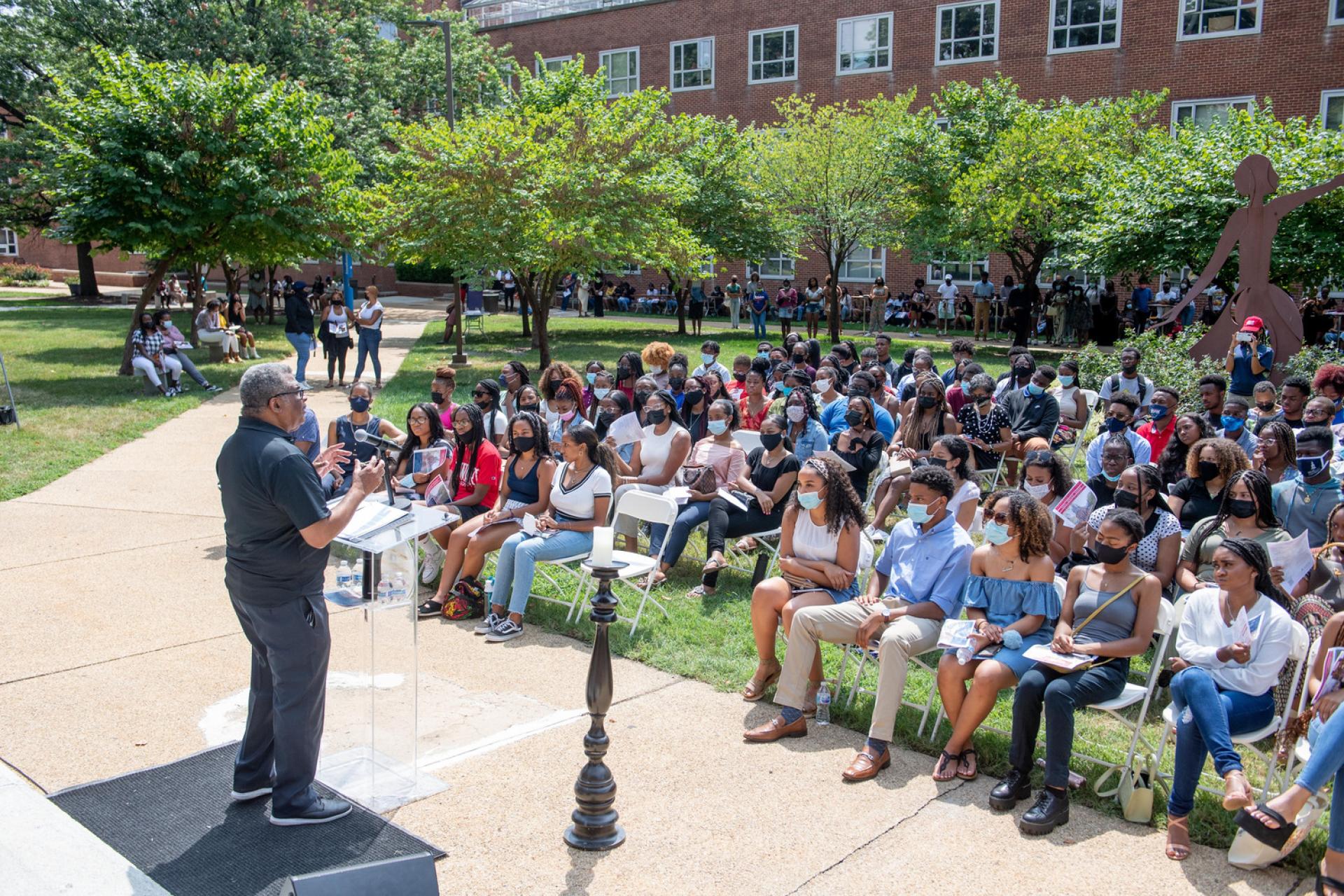
Under the leadership of Dean Bernard Richardson, the Chapel’s work has extended into structured opportunities for service and formation, helping students live out Dr. King’s conviction that faith without works is incomplete.
The Chapel and Spiritual Life: Rankin Chapel as Community Anchor
Dr. King’s leadership was inseparable from spiritual grounding. Howard’s spiritual life continues to nurture that same grounding, supporting students and community members as they pursue justice while also tending to wellbeing, belonging, and purpose. At the center of that ecosystem stands Andrew Rankin Memorial Chapel, described across the university as a hub for spiritual life and wellness and a haven for diverse faith traditions and spiritual communities.
The Chapel’s guiding principles of faith, service, and justice offer a direct bridge between spiritual formation and public responsibility. Its history reinforces how deeply these themes are rooted at Howard: Rankin Chapel is designated as a National Historic Landmark and has long served as the University’s spiritual heart. Under the leadership of Dean Bernard L. Richardson, Ph.D. (B.S. ’75), the Chapel’s work has also extended into structured opportunities for service and formation, initiatives such as Howard University Day of Service and Howard University Alternative Spring Break (HUASB), helping students live out Dr. King’s conviction that faith without works is incomplete.
The Chapel is also significant because it was a setting for Dr. King himself. Over the years, Dr. King delivered a number of sermons from the Chapel pulpit that served as both a moral challenge and practical discipline in difficult times. In moments of national uncertainty, and in the everyday pressures of student life, the Chapel functions as more than a landmark. It is a living space where the community can grieve, hope, reflect, and recommit. In that sense, Rankin Chapel helps keep Dr. King’s legacy alive by nurturing the moral stamina required to pursue justice over the long haul.
“Dr. King embodied faith as an essential force for justice,” Richardson said. “The Andrew Rankin Chapel continues that tradition today in our pursuit of faith, service, and justice.”
Keep Reading
-
DiasporaHoward University Hosts Fourth HBCU Internationalization Symposium, Centered on 'Black Internationalization'
Nov 14, 2025 3 minutes -
Homecoming 2025Tradition, Precision, and Style Take Center Stage at Howard Homecoming Greek Step Show
Nov 5, 2025 5 minutes -
Are You a Member of the Media?
Our public relations team can connect you with faculty experts and answer questions about Howard University news and events.
Submit a Media Inquiry