


At a time when artificial intelligence is rapidly reshaping how we learn, work, and communicate, the Howard University College of Engineering and Architecture (CEA) is advancing a campus-wide effort to ensure students, faculty, and staff are not only aware of these technologies, but are also empowered to use them thoughtfully and effectively.
Through the CEA AI Tinkery workshop series, Ph.D. candidate and AIM-AHEAD instructor Howard Prioleau is leading a hands-on initiative designed to build AI literacy from the ground up—bridging technical depth with practical application.
“At Howard, we are committed to ensuring that artificial intelligence is engaged across our entire campus in ways that are responsible, informed, and purposeful,” said Talitha Washington, Ph.D., executive director of Howard’s Center for Applied Data Science and Analytics and co-chair of the Howard University President’s AI Advisory Council. “I am grateful to CEA for bringing the AI Tinkery series to the Howard community and for making AI more accessible, practical, and impactful for our students, faculty, and staff.”
As he works to earn his doctorate in computer science with a specialty in artificial intelligence, machine learning, and natural language processing, Prioleau brings both research expertise and a passion for teaching to the series. His research work focuses on large language models, including their interpretability, reliability, and design — research that aims to make AI systems more trustworthy and aligned with human needs. This same philosophy underpins the AI Tinkery series: an emphasis on clarity, engagement, and responsible use of emerging technologies.
The idea for the series originated with computer science professor and member of the Howard University President’s AI Advisory Council Legand L. Burge, Ph.D., with a goal of strengthening AI understanding across campus. Recognizing that conversations around artificial intelligence often outpace foundational knowledge, Prioleau proposed beginning the series with a critical first step: demystification. Before diving into advanced tools and applications, the series opens by addressing a fundamental question: "What is generative AI, and how does it work?"
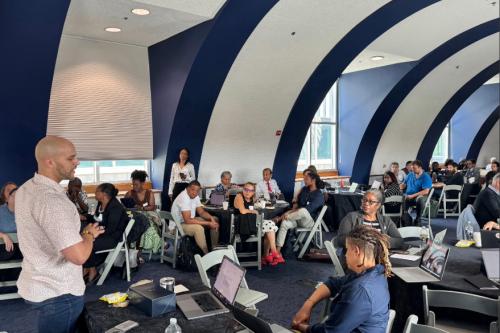
Each semester this past academic year, Prioleau and Burge, in collaboration with Washington, hosted a workshop. The inaugural fall 2025 workshop, AI Tinkery: Demystifying Generative AI, situated generative AI within the broader landscape of artificial intelligence, data science, machine learning, and deep learning.
Participants gained a clear understanding of how generative AI systems are trained on large datasets to recognize patterns and produce outputs such as text, images, and audio. Just as importantly, the session clarified what these systems are not. They are neither sentient nor capable of true understanding. By distinguishing capability from misconception, the workshop provided attendees the knowledge needed to engage AI tools critically, recognizing both their strengths and limitations.
Beyond theory, the session introduced practical strategies for effective AI use. Participants were guided through a structured prompting framework that emphasized clarity of task, context, audience, constraints, and desired output. This foundation reinforced a key message: generative AI is most powerful when used intentionally.
Building on this foundation, the spring 2026 workshop, AI Tinkery: Prompt Engineering 101, shifted the focus to interaction and how users communicate with AI systems to achieve better results. Grounded in the idea that large language models do not think but rather respond directly to input, the workshop emphasized precision as the cornerstone of effective prompting. Participants learned to structure prompts using three essential components — task, context, and output — while incorporating guardrails such as tone, format, and scope to guide responses.
The session also introduced accessible yet powerful techniques, including zero-shot and few-shot prompting, as well as multi-persona approaches that allow users to simulate diverse perspectives within a single query. Through iterative refinement strategies, participants were encouraged to treat prompting as a skill, one that improves with practice and directly influences the quality of results. The workshop culminated in the concept of building reusable prompt libraries, helping users move from improvised experimentation to more strategic, efficient workflows.
Together, the AI Tinkery workshops reflect a broader shift in how institutions approach emerging technologies: not simply adopting tools but actively cultivating understanding.
The series, which will resume this fall, creates space for exploration, critical thinking, and skill-building, ensuring that members of the Howard community are informed participants in the evolution of AI.
As artificial intelligence continues to shape academic, professional, and societal landscapes, initiatives like the AI Tinkery series reinforce Howard University’s commitment to innovation, education, and accessibility. By making complex concepts approachable and actionable, the series equips participants with the knowledge and confidence to navigate — and help define — the future of AI.
Keep Reading
-
 *Accolades
Howard University CEA Professor Sonya Smith Elected to AIAA Class of 2026 Fellows
Sep 28, 2026 3 minutes -
 Artificial Intelligence
Howard University Launches Its First AI Certificate Program for Undergraduate Students
Aug 20, 2026 4 minutes -
 News
NewsHoward University Names Jasmine Gurley as Senior Director of Public Relations
Oct 14, 2026 3 minutes