

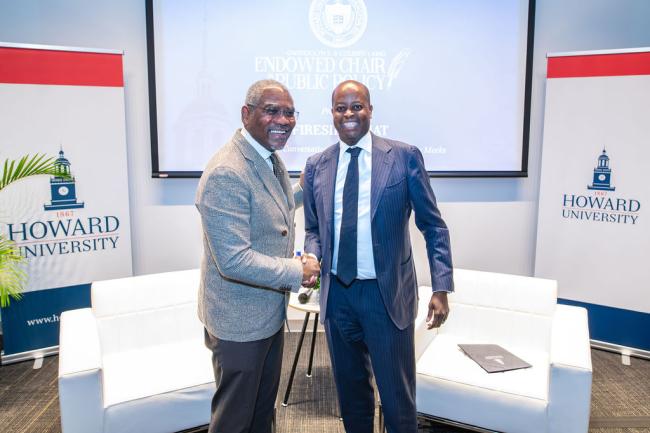
Top photo: U.S. Representative Gregory W. Meeks and Howard University Interim President and President Emeritus Dr. Wayne A. I. Frederick at a fireside chat Oct. 21, 2026, at Howard's Interdisciplinary Research Building. Photo by Alex Woodhouse/Howard University
U.S. Representative Gregory W. Meeks (J.D. ’78) returned to Howard University with a message for the next generation of leaders: Their voices, votes, and civic engagement have the power to shape the nation's future.
During a wide-ranging conversation with Howard University Interim President and President Emeritus Wayne A. I. Frederick (B.S. ’92, M.D. ’94, MBA ’11), Meeks encouraged students to remain engaged in the democratic process, emphasizing that young people have historically been at the forefront of movements that transformed American society.
The discussion, titled "Fireside Chat: A Pre-Election Conversation with Gregory Meeks," took place Oct. 21 at Howard's Interdisciplinary Research Building as part of the University's Gwendolyn S. and Colbert I. King Endowed Chair in Public Policy Lecture Series.
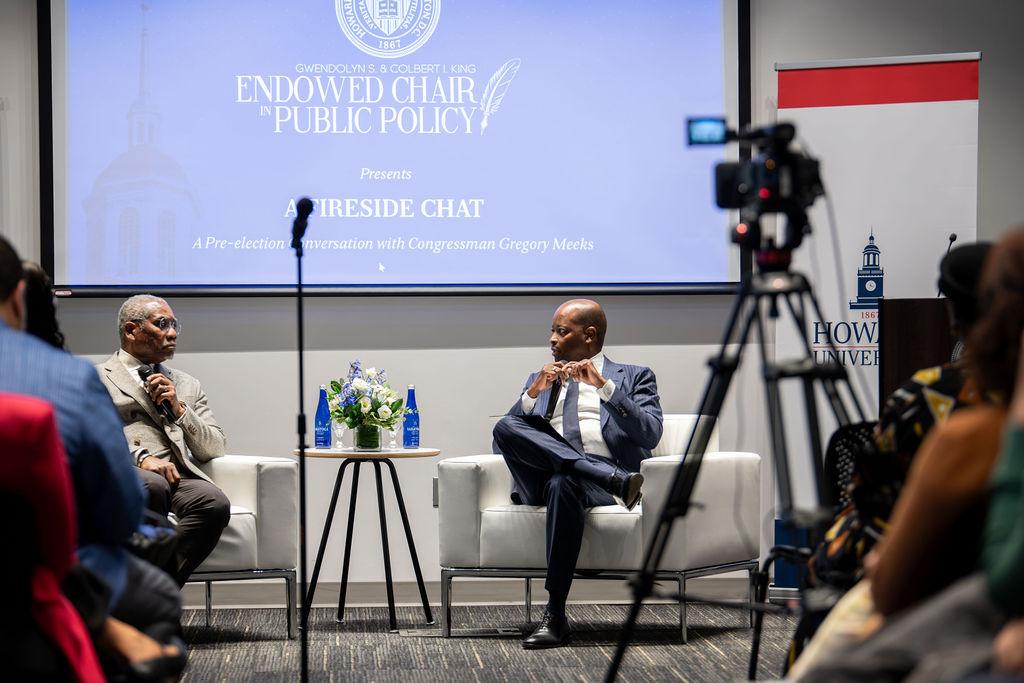
A graduate of the Howard University School of Law, Meeks has represented New York's 5th Congressional District since 2013, following his initial election to Congress in 1998. A prominent voice on foreign affairs and national policy, he became the first Black chair of the House Foreign Affairs Committee in 2021 and currently serves as its ranking member.
Before the conversation began, Taino Moreno, a third-year student from Los Angeles enrolled in Howard's joint B.A./J.D. program, introduced Meeks and Frederick to the audience, proudly describing himself as "a future Howard Law alum."
A Conversation on Policy, Leadership, and Civic Responsibility
Held ahead of the Nov. 3 midterm elections, the fireside chat offered students an opportunity to engage directly with a national policymaker on issues affecting their communities and the country.
The conversation explored a broad range of domestic and international challenges, including the federal deficit, foreign policy, immigration, student loan debt, the rising cost of living, the economic consequences of global conflicts, and the importance of compromise in effective governance.
Throughout the discussion, Meeks emphasized that civic leadership extends beyond holding elected office. It requires sustained participation, a willingness to engage with differing perspectives, and a commitment to advancing solutions that strengthen communities.
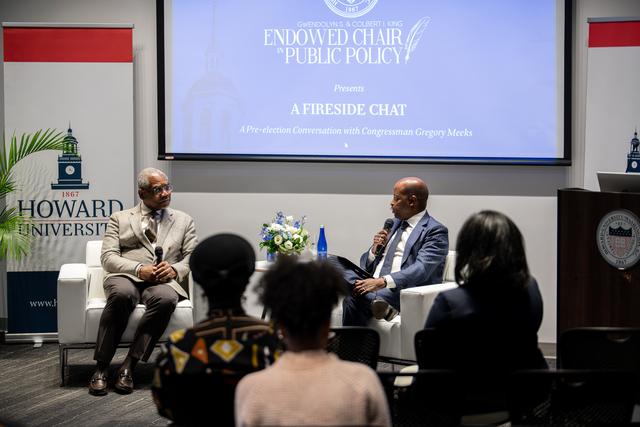
Central to his message was the significant role young people have played in shaping American democracy.
"It's young people that have always made a difference and changed the course of this country," Meeks said.
He pointed to the legacy of the late U.S. Representative John Lewis, who emerged as a student leader during the Civil Rights Movement. At just 19 years old, Lewis was already participating in nonviolent demonstrations challenging racial segregation. He later became a founding leader of the Student Nonviolent Coordinating Committee (SNCC), which was established in 1960 and helped organize sit-ins, voter registration initiatives, and other efforts to advance civil rights.
Lewis went on to serve more than three decades in Congress, becoming one of the nation's most respected advocates for voting rights and racial justice. His legacy continues through efforts such as the John R. Lewis Voting Rights Advancement Act of 2025, legislation intended to strengthen federal protections against discriminatory voting practices.
Central to his message was the significant role young people have played in shaping American democracy.
"It's young people that have always made a difference and changed the course of this country," Meeks said.
The Power of Young Voters to Shape History
Responding to an audience question about the power of the student vote and its potential to influence future generations, Meeks encouraged students not to become discouraged when progress seems slow or the results of their advocacy are not immediately visible.
"The key is, when you're living history, you don't see it," Meeks said. "You don't feel it. … It's history that looks back and says, 'Oh, you made such great progress.' But when you're in it, you think that things ain't changing, nothing is happening."
He reminded students that meaningful change often unfolds gradually, through the collective efforts of individuals who remain committed to their principles and communities.
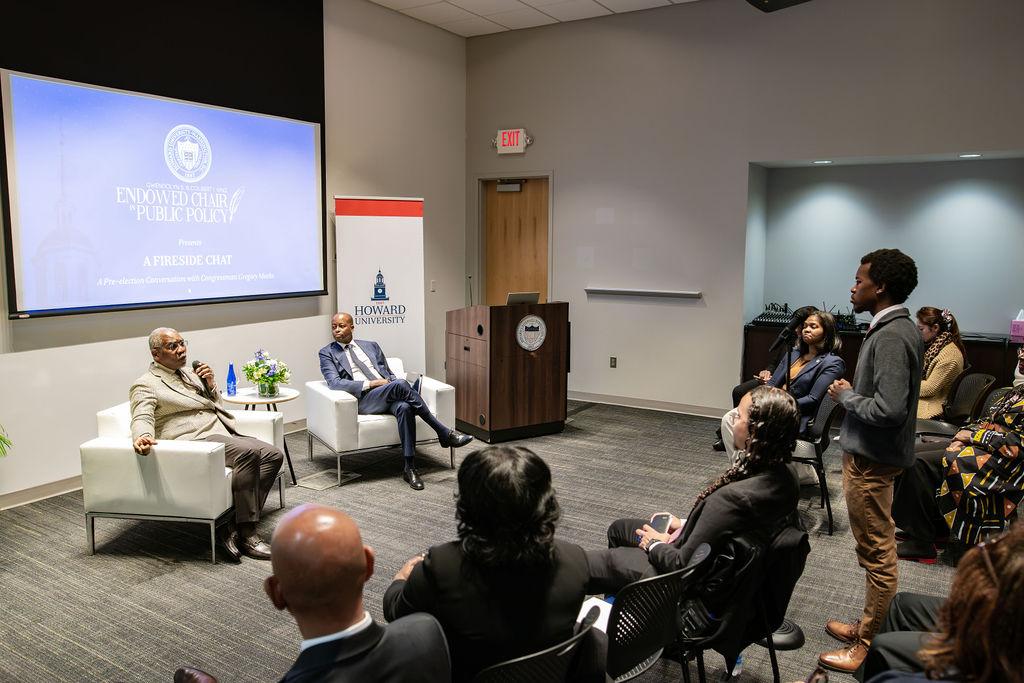
"You are making things happen, so stay doing what you're doing. Don't stop, don't give up, stay focused. Because you are making a difference now, pushing the country. And you ought to make the country a more perfect union."
His remarks reinforced the importance of sustained civic participation, particularly among younger generations whose engagement can influence election outcomes, shape public policy, and bring new perspectives to public service.
Early analysis of the November 3 elections by the Center for Information & Research on Civic Learning and Engagement (CIRCLE) at Tufts University underscored the continuing role of young voters in the electoral process. CIRCLE estimated that voters ages 18 to 29 accounted for approximately 10% to 11% of ballots cast nationwide, although final youth turnout figures will require additional analysis.
Continuing Howard's Legacy of Civic Engagement
Meeks' message reflects Howard University's longstanding commitment to developing leaders who advance social progress through scholarship, advocacy, and public service.
From organizing voter registration initiatives to covering national elections, Howard students have consistently demonstrated the power of civic participation and the importance of an informed electorate.
That tradition continued during the 2026 midterm elections through the Howard University News Service's HBCU Election Project, which brought together student journalists from six historically Black colleges and universities to provide 24-hour election coverage on Nov. 3. Operating from Howard's WHUT television studios, the collaboration offered students hands-on experience reporting on the democratic process and the issues shaping communities across the nation.
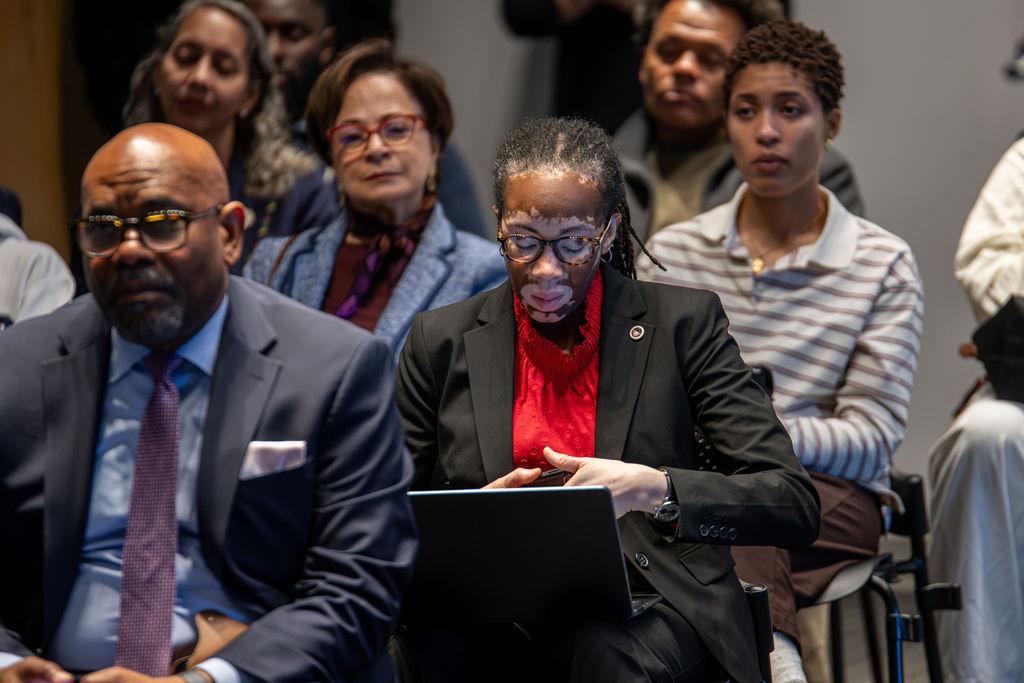
For Meeks, whose career in public service began long before his election to Congress, returning to his alma mater provided an opportunity to encourage the next generation of Howard leaders to recognize their own potential to influence the nation's future.
As a leader in the House and a distinguished Howard Law alumnus, Meeks exemplifies the University's legacy of preparing graduates to serve, lead, and shape public policy at the highest levels.
His message to students was both a challenge and an affirmation: The work of strengthening democracy is never finished, and young people have an essential role in moving the nation forward.
Keep Reading
-
 *Change Makers
Howard University Trustee Arne Duncan’s Anti-Gun Violence Organization Takes the Spotlight in Documentary
Oct 2, 2026 6 minutes -
 *Accolades
Howard University CEA Professor Sonya Smith Elected to AIAA Class of 2026 Fellows
Sep 28, 2026 3 minutes -
 Culture Creators: Arts and Entertainment
Stepping Back to Its Roots: Step Afrika! and How Howard University Helped Birth a Dance Movement
Oct 22, 2026 8 minutes