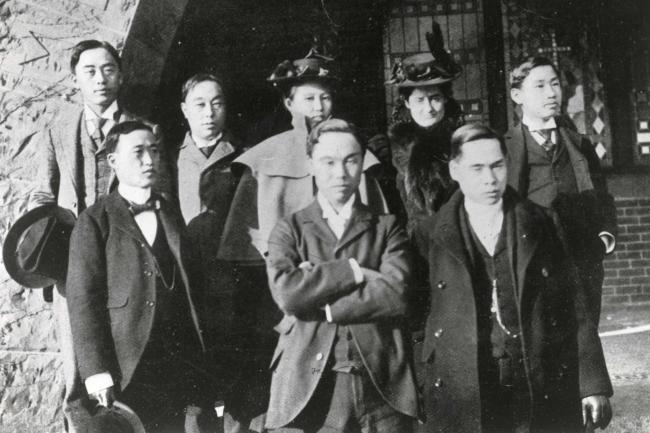
Above photo: Seven Howard University students from Korea in front of Howard's chapel in 1897. The students are pictured with Edith Rankin, daughter of former Howard president Jeremiah E. Rankin and niece of Andrew Rankin, for whom the chapel is named. Photo courtesy of the Howard University Moorland Spingarn Research Center.
If you ever needed proof that Howard is a global cultural mecca, you can look back as far as 1896. That year, Howard opened its doors to house and educate seven Korean students during a time of political upheaval in their country, as chronicled in a local newspaper. According to WETA, the students gained notoriety on their first night after stunning the Howard community with a melodious singing performance on campus, which was soon described in a story in the Washington Post. Three of the students were then invited by a prominent ethnologist to record songs on wax cylinders, including a version of “Arirang,” the unofficial national folk song of both South Korea and North Korea, which is the first known recording of a Korean voice in the United States and the first recording of the song anywhere in the world. The recording is now housed at the Library of Congress as a seminal piece of American and world history. The Library of Congress identified the students as Ahn Jeong-Sik, Lee Hee-Cheol, and Son Rong.
Today, South Korea’s most dynamic contribution to the global music scene is K-Pop, a genre personified by bands who use upbeat rhythms and high energy choreography to excite their fan base. Since debuting in 2013, the group BTS has used a fusion of R&B, hip hop, and pop to become the K-Pop standard bearer, surpassing 31 billion streams on Spotify by 2023 to set a Guiness World Record. The group’s music often focuses on themes such as mental health, love, and humanity. After stacking up No. 1 singles in more than 100 countries, including six in the United States, the group paused their performances in 2022 to engage in mandatory military service in Korea. The group is set to release their comeback album, also named “Arirang” today. As a teaser, the group released an animated video paying tribute to the seven Korean natives who came to Howard in 1896, including those who first recorded the song, and depicts the students singing in front of Founders Library before a group of onlookers. In the week since the video debuted, it has garnered over 5 million views on YouTube.
With millions of views, the animated trailer for the BTS album "Arirang" features Korean Howard University students singing in front of Founders Library.
“Arirang” has been sung for centuries and has hundreds, if not thousands, of versions. The song describes the agony of two Koreans who fall in love but are separated. It took on added significance as conflict and colonialism divided the people of the peninsula in the 19th and 20th centuries, separating loved ones in wartime and leading to the eventual division of the Korean peninsula after World War II. After Japan took over Korea in the 1900s and the Korean national anthem was banned, Koreans sang Arirang as a form of defiance. As demonstrated by BTS’s reverence for the song, it continues to be an important expression of the importance of connection.
Lyrics of a popular version of the song (translated into English) include:
Arirang, arirang, arariyo. You are going over Arirang Hill. My love, if you abandon me Your feet will be sore before you go ten ri*. Just as there are many stars in the clear sky, There are also many dreams in our heart. There, over there, that mountain is Baekdu Mountain, Where, even in the middle of winter days, flowers bloom.
* A ri is an Asian unit of measure equal to about 3.93 kilometers.
BTS’s teaser video brings to light some important issues as the world navigates growing cultural intersections. The video properly acknowledges Howard's role in educating the students who would make history. However, there are some inaccuracies. The video prominently features the iconic Founders Library, the first site at an HBCU to be named a national treasure, which had yet to be constructed. In addition, most of the people depicted in the audience on The Yard are not Black, which belies the institution’s history as one of the country’s foremost colleges with a predominantly Black student body. Though much of the faculty at the time was not Black, the video does elucidate the need for cultural sensitivity and historical accuracy even when intentions are positive.
HBCUs have always been bastions of academic opportunity for everyone, debunkingthe myth that only Black students attend. Great colleges prepare students for global leadership, and that preparation includes exposure to peers from diverse backgrounds who attend HBCUs because of world-class academic programs and their respect for Black traditions and culture. There is no contradiction in the fact that these Korean students were enrolled at Howard — well known as a leading, historically Black university. Unlike most prominent colleges at the time, Howard was explicitly founded to provide academic opportunity to talented scholars regardless of racial background, and many exclusively white colleges refused to welcome Asian and other international students at the time. During the 1896-1897 academic year, Howard’s student body included students from Honduras, Japan, the West Indies, and various African countries, in addition to Korea. Like Howard, HBCUs across the country have historically welcomed students from diverse cultural backgrounds even as they have celebrated the richness of Black academic and cultural traditions. Like all cultures, Black culture is influenced by others, and Howard’s international students have always added to the university’s distinctiveness as a center of global culture.
"Howard's legacy has always been one ofopenarms, welcoming people from every corner of the globe," said Benjamin Talton, Ph.D., executive director of the Moorland-Spingarn Research Center and professor in the Department of History. "Its spirit of internationalism is reflected in moments like 1896, when seven Korean students found a home here. This enduring tradition affirms that both Howard and black America stand as among the world's most inclusive, accommodating, and accepting communities."
It’s not hard to recognize the influence of Black culture on K-Pop. The groups borrow heavily on the performance model of 80s and 90s American singing groups, originating with New Edition and extending to the Backstreet Boys and N-Sync. New Edition, in turn, was heavily influenced by Motown-era groups such as the Jackson Five and the Temptations. K-Pop stars also often replicate hip hop fashion and dance, another cultural contribution by Black Americans which has taken on global popularity. The K-Pop phenomenon has also triggered a legitimate conversation about cultural appropriation, in which artistry, expression, and traditions which originated in Black communities are usurped by people from other communities without an understanding of the related history, sensitivities, and contexts. When meaningful cultural expression is contorted into superficial entertainment, it can become a disrespectful form of mimicry and perpetuate negative stereotypes, especially when used for commercial purposes without attribution or royalties.
Cultural appropriation has been a byproduct of Black genius throughout American history. Al Jolson infamously used blackface to parrot Black culture and became one of the most successful performers of the early 1900s. During the 1950s and 1960s, songs by Motown artists were quickly recorded by more widely known white artists, who passed the recordings off as originals and garnered huge hits. At the same time, Chuck Berry was pioneering rock and roll music, even as the credit for the creation of the genre was incredulously given to white artists like Elvis Presley. Countless Black fine artists, dancers, writers, and comedians have had their signature work stolen and presented as new and inventive by performers from other racial groups, leading to understandable sensitivity about the derivation of artforms like K-Pop.
Howard continues to celebrate its international connections and cultural dexterity, proving that even at an institution where Blacks make up the majority of the student body, those students are not monolithic and have diverse interests. While many students demand recognition of Black creativity and attribution to the artists and everyday people in the Black community who shape trends, they appreciate the intersection between all cultures. That’s especially evident for students who study in Howard’s Department of World Languages and Cultures, one of the university’s largest academic units. Twelve Howard students are studying abroad in South Korea this semester. In addition, Howard has an award-winning K-Pop dance team, which performs at various events throughout the year.
Founded in 2022, by Kristen McDaniels (B.S. ’25), Howard University’s One of a Kind (1OAK) is the first K-pop dance team at an HBCU, created by members of Howard’s Korean Culture Club to build a space for creativity, positivity, and cross-cultural engagement. Since its founding, the team has earned national recognition — winning the Washington D.C. Korean Culture Center K-Pop Dance and Singing Competition in both 2023 and 2024, performing at institutions including George Washington University, University of Maryland, Georgetown University, and more, and being scouted to perform at The Art of Living’s World Culture Festival alongside Dtrix. Guided by its mission to “enlighten and empower Howard University students as they perfect Korean pop choreography,” 1OAK works to bridge Black and Korean cultural influences while fostering a welcoming environment centered on expression, creativity, and community.
Howard's 1OAK K-Pop group performs a routine to "Oh!" by South Korean girl group Girls' Generation.
“1OAK has become a community where I can be authentically me and grow into the best version of myself,” shared founding member Reinah McNeil, who served as head photographer, editor, dancer, videographer, and creative director from fall 2023 to spring 2025.
Though its members respect the ways that K-Pop reflects Korean culture, 1OAK believes that its performances reclaim the Black cultural influences that underlie the genre. While they are careful not to be cultural appropriators themselves, they celebrate the infusion of dance, style, and attitude which is synonymous with Black communities. Nikki Prather, a member of the group last year, told The Hilltop that the line between cultural appropriation and appreciation is thin, and the group is helping to bring the genre full circle.
It becomes kind of a loop when it reaches us again because we’re taking our culture that they changed and made something brand new, an amalgamation of things.
1OAK performs in front of the Lincoln Memorial.
1OAK performs at Union Station.
Howard's original 1OAK K-Pop dance group.
Howard's 1OAK wins the Washington D.C. Korean Culture Center's K-Pop dance competition in 2023.
1OAK performs at Georgetown University.
“It becomes kind of a loop when it reaches us again because we’re taking our culture that they changed and made something brand new, an amalgamation of things,” she said.
As Howard students expand their awareness of world cultures, many have embraced the Korean language and traditions, which are taught by Howard instructor Kukjin Cheon. She believes that there are commonalities between the Korean experience and the Black experience in America. For instance, she helps her students draw historical parallels between the Korean independence movement and the fight by Blacks for the full rights of citizenship in the United States. She thinks that there is power when members of different minority communities understand each other better.
“When you learn about the language, you can learn about the culture more deeply and then we can connect more,” Cheon said.
Cheon and her students have had frank conversations about the influence of Black culture on K-Pop, and notes that many of her students feel it is unfair that the Black community is not given proper credit. She agrees that many K-Pop artists have leaned heavily on jazz, hip-hop, and R&B music and style. Nevertheless, she says that many of her students chose to study Korean because of their love of K-Pop, and she often plays the music to jump start her classes. In addition, she and her students explore many other aspects of Korean culture together through Korean culture presentations, and she encourages constructive dialogue.
“Everyone introduces what they like, so it can be K-Pop or K-Drama, or Korean social issues or food,” she said. “If they like traditional games, we can play the games together or sing songs together or dance together. I love my students because they are so bright, and they are thinking critically about what is fair in the world, so we are happy to share our opinions in a free and safe environment.”
Alexander McSwain, associate professor and coordinator of electronic studio arts at Howard, agrees that intercultural engagement can be a bridge to greater connections and understanding. He believes that the animated BTS trailer video can expose more audiences both to K-Pop and to Howard.
“As someone relatively new to the K-pop genre and its surrounding lore, my introduction has come largely through my students, many of whom are deeply immersed in K-pop culture," McSwain said. "Several of my Electronic Studio Arts majors are also members of the K-pop dance team 1OAK, and I credit them for opening that door for me. I was further drawn in after seeing a post by our alumna, Bryten Gant, whose excitement about Howard University being featured caught my attention. I found myself both intrigued and impressed by the shoutout to Howard and its historical references. At its core, both animation and music are forms of expression mediums that invite interpretation, critique, and conversation. One could argue that without the visibility created by the trailer and accompanying music video, I may have never discovered the Korean connections tied to the university at all. This experience serves as a reminder of the importance of doing your own research. Even when a starting point may seem historically imperfect, it can still act as a catalyst for deeper understanding, because, after all, it is art, and art at its core is a conversation.”
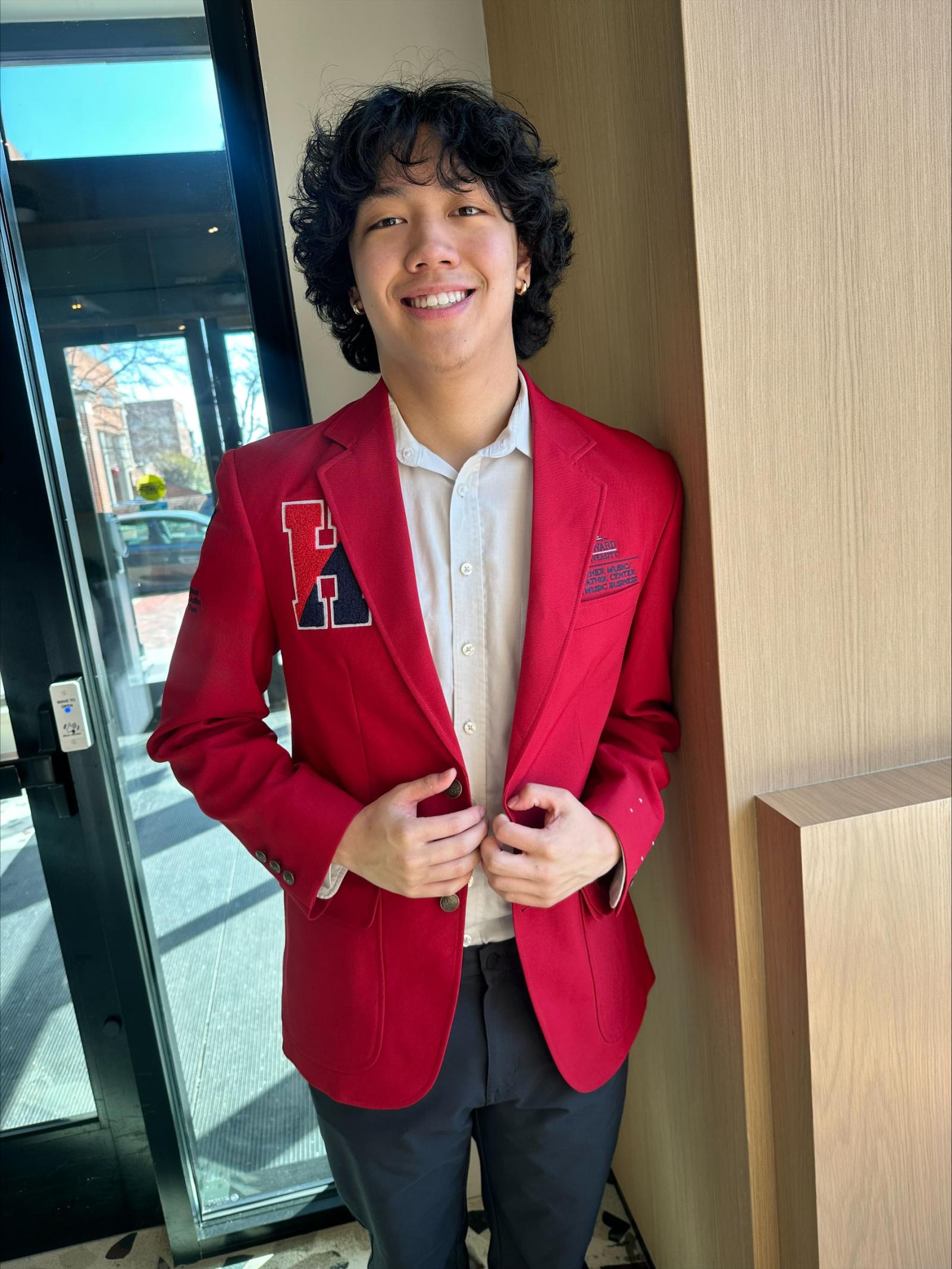
Alexander "Amen" Hong
That’s what Howard does. It opens the doors for people.
Cleveland, Ohio native and 2nd generation Korean-American Alexander “Amen” Hong is a Howard University finance major on a pre-med track. With 80,000 Instagram followers, he was a social media influencer before he enrolled at Howard but now uses it as his backdrop in many of his posts. His authentic voice is shaped by his personal upbringing that includes culture, community, and curiosity. He learned about the school during an episode of “Blackish” where alumnus Anthony Anderson’s character, also a Howard alum, talked about his experience. Hong was struck by the people, the energy, and the possibilities at Howard, and enrolled because he “just fell in love with the people” and felt called to be at the Mecca.
As a Korean-American student at Howard, Hong brings a perspective that stands at the intersection of Korean identity and deep respect for Black culture. While he grew up around Black people and feels that “Black culture has given me so much,” he is “first and foremost” Korean. That dual awareness shapes the way he sees BTS — not just as pop stars, but as part of a larger cultural exchange between Korean and Black communities.
He believes that BTS’s popularity cannot be separated from Black cultural influence.
“I’ve actually realized a lot of Black people really love K-pop, because I think a lot of K-pop derives from Black culture anyway, and Black music,” said Hong. “Just their style, the way they perform, whether it’s in their rap, or whether it’s in R&B. I know BTS came over here when they were younger in 2016, 2017, and they were eager to learn, and the Black community was eager to teach them.”
For Hong, BTS represents more than entertainment — they reflect a connection between cultures that he understands personally and speaks about with both pride and nuance.
Hong participated in Howard’s Alternative Spring Break, volunteering to help communities in Newark, New Jersey. The experience gave him one of the strongest feelings of home he has experienced since coming to Howard, helping him connect with different types of people, brought together through service.
“Howard opened doors for us, same way it was open for the Black community,” he said. “That’s what Howard does. It opens the doors for people.”
The connection between Korean culture and Howard resonates beyond the student body. Junhyuck Han is an international student advisor at Howard who is from Korea, and he is proud of his engagement with both societies.
As a Korean working at Howard University, this moment was incredibly exciting and meaningful to me," said Han. "I felt a deep sense of pride seeing my culture from my home country connected to the community where I now serve. It is especially important to recognize and appreciate institutions like Howard that opened their doors to international students as early as the 1890s with genuine openness. These historical connections are often overlooked, and I believe they deserve far more attention and recognition."
While everything in the BTS video isn't historically accurate, and there are certainly creative liberties taken, Han believes that the group's intentions are well placed, with a goal of acknowledging Howard's legacy.
"While I am not a music expert, I believe K-pop and Black culture intersect in significant and foundational ways," he said. "Many core elements of K-pop are rooted in Black culture, particularly through genres like hip-hop, R&B, and jazz. K-pop artists frequently incorporate rap, breakdancing, and other stylistic influences that originate from Black communities. I believe BTS’s intention in including Howard University was both symbolic and purposeful. By highlighting Howard, they are recognizing a historically significant connection between Korea and one of the most influential HBCUs in the United States. It reflects an effort to honor shared histories of resilience, education, and cross-cultural exchange. I also believe that BTS is using their global platform to elevate meaningful stories and amplify underrepresented narratives. Including Howard allows them to bridge Korean history with Black academic and cultural legacy, while encouraging audiences to reflect on how these communities have supported and influenced one another over time."