

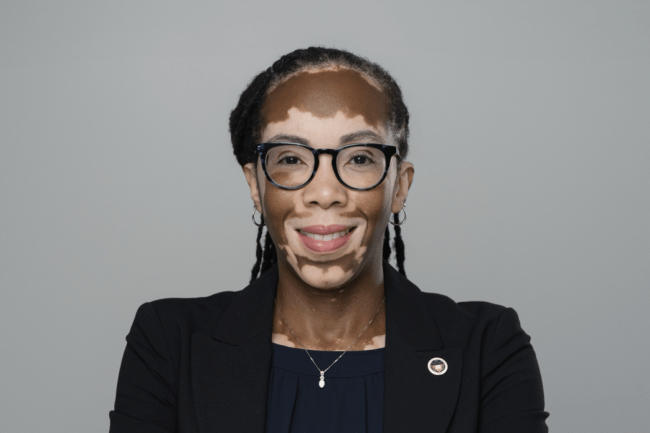
Kim Lewis once thought she would be an aeronautical engineer.
The Ph.D.-trained physicist was fascinated by the forces at work and the mechanics of systems engineering. As Howard University’s new vice president of research and chief research officer, a strong sense of design and optimization will be the key to unlocking the continued success as a R1 institution.
Howard University’s leadership is working to keep the university’s research agenda on track during a period of unprecedented upheaval across U.S. higher education amid federal budget cuts. Howard University President Wayne A. I. Frederick has described the challenge as a “balancing act,” one that involves maintaining an expansive R1 research environment, while simultaneously supporting student engagement in cutting-edge scientific activity, and growing a world-class research faculty.
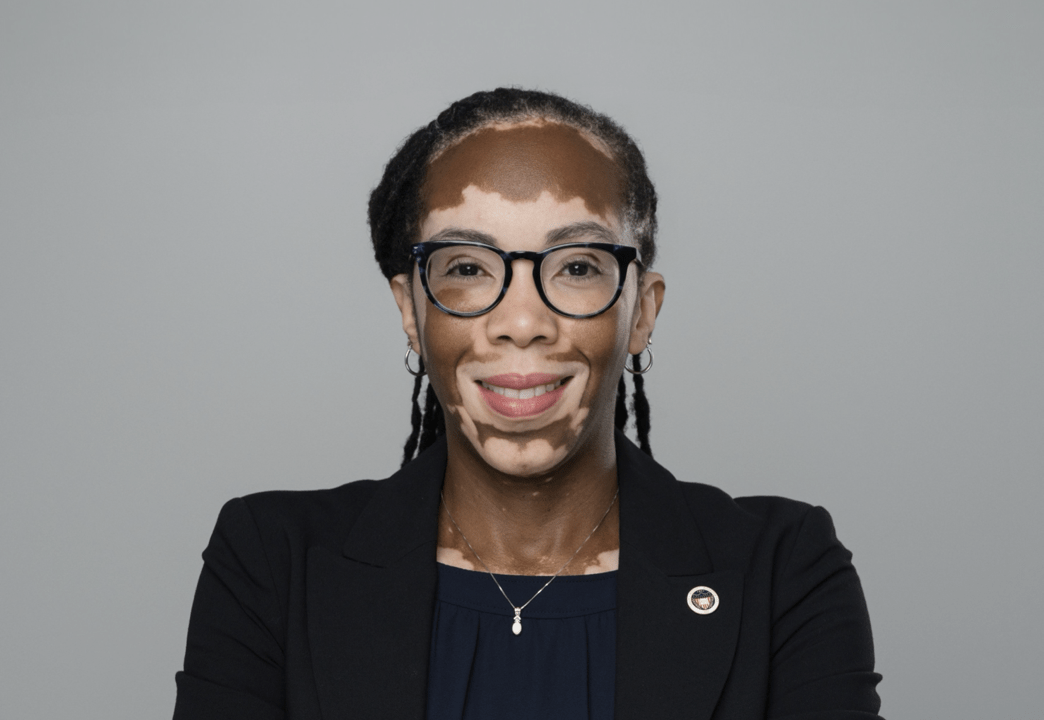
“This moment calls for precision, courage, and the ability to balance complexity while still accelerating discovery,” Lewis stated. “Our responsibility is not just to sustain excellence, but to keep expanding what is possible.”
The new leadership also comes as Howard prepares for its annual Research Month, a university-wide April initiative that highlights student and faculty scholarship through workshops, guest speakers, and a culminating research symposium. The month underscores the kind of research culture Lewis is now tasked with strengthening and expanding.
Lewis follows the university’s previous vice president for research, Bruce Jones, Ph.D., who helped drive record levels of research funding and positioned Howard as a key partner across government, industry, and academic collaborations.
A Sense of Purpose
Lewis’ academic path places her in an exceptionally small group of African American women physicists. She is one of just over 100 Black women physicists in the United States. Her educational journey began in New Orleans. It was “all-HBCU” in the sense of elementary, junior high school and high school, she said.
Her fascination within the realm of physics first developed in high school. She was engaged by one of her teachers that held a master’s degree in physics from Xaiver University, an HBCU. The teacher had tasked students with teaching a lesson in front of their peers for the day. Lewis recalls selecting a lesson on optics and the diffraction and scattering of light, an experience that left a lasting impression.
“I enjoyed it,” she said. “We never think about how light goes from the sun to our eyes and what happens in between that.”
Her dream job was to become a physics professor. She went on to earn an undergraduate degree in physics at Dillard University. Scholarships, including the David and Lucile Packard Scholarship, opened doors to early research opportunities and eventually led to graduate studies at the University of Michigan.
When Lewis graduated with a master’s in electrical engineering and a doctorate in applied physics, she recalls that there were no more than 60 Black women physicists in the country.
“It was clear to me was that we needed more of us. At Howard, I impress upon other women scientists how important it is for us to be here in academia.”
Finding Howard
Lewis’ first connection to Howard University came while she was presenting her research at a nanoscience conference during her time at Rensselaer Polytechnic Institute. In the audience was Gary L. Harris, Ph.D., the beloved Howard electrical engineering professor who was dean of the Graduate School and associate provost for research.
Harris invited Lewis to come to Howard for a sabbatical, an opportunity that brought her to campus for six months. During that time, Lewis worked in labs and collaborated across disciplines, but she said the one thing that really stood out was Howard’s involvement in community outreach.
“Once we went to Baltimore to a local university and we drove through the surrounding communities,” she said. “People would just come up to us just because of the Howard University name and brand.”
Several years later she decided to apply for the associate dean of research in the College of Arts and Sciences. Now, as vice president for research, she said her long-term strategic objective is to foster stronger faculty engagement.
Lewis is intent on building research infrastructure, which will involve aligning university offices, strengthening collaboration with the Office of the Provost, and ensuring faculty have the support they need to compete at the highest level.
“I want to ensure that we optimize our organizational capacity and make sure that we maintain our R1 classification,” she said.
Amid a turbulent federal funding environment, Lewis is also encouraging diversification, exploring private sector and industry partnerships alongside traditional sources. She also wants to continue strengthening Howard’s sense of community.
“That’s the energy I want to continue to bring to this community,” she said.
###
Keep Reading
-
 *Accolades
Howard University CEA Professor Sonya Smith Elected to AIAA Class of 2026 Fellows
Sep 28, 2026 3 minutes -
 Epiphanies, Discovery, and Research
Howard University Doctoral Student Receives Competitive Dissertation Fellowship, Examines Faith in Educational Experiences of Black Students
Sep 4, 2026 5 minutes -
 Epiphanies, Discovery, and Research
Howard University Researchers Advance Decade-Long Study of HIV and Sickle Cell Disease
Sep 23, 2026 4 minutes