

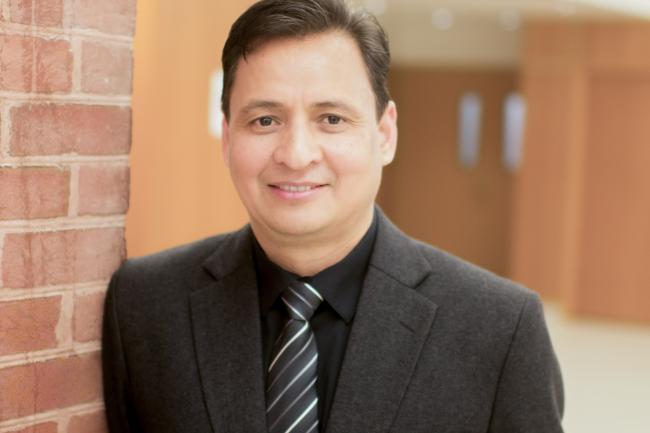
Danda B. Rawat, Ph.D., a professor of computer science in Howard University’s College of Engineering and Architecture, and the director of the AI Center of Excellence (AICoE), has received a $700,000 award from the National Science Foundation (NSF) to conduct research focused on one of the most pressing challenges in artificial intelligence: how to build AI systems that people can trust.
Artificial intelligence is increasingly being used to support decision-making in areas critical to public infrastructure, such as transportation, emergency response, and national security. While today's AI technologies can analyze vast amounts of data, many produce results without clearly explaining how decisions are made. The three-year project, led by Rawat, will develop innovative technologies for artificial general intelligence (AGI) capabilities. Rawat also serves as associate dean of research and graduate studies and director of Howard University’s AI Center of Excellence.
Rawat's research team aims to address that challenge through the development of a hybrid neuro-symbolic AI framework, an emerging approach that blends advanced neural networks with symbolic AI reasoning techniques.
“As AI advances towards AGI and becomes increasingly integral to our lives, workplaces, and national defense, developing AI systems that people can trust, whether as teammates, leaders, or assistants, is more important than ever. We will leverage neuro-symbolic AI for advanced scene understanding in critical applications, enabling AI to reason, adapt, and collaborate safely and effectively with humans,” Rawat said.
The project will focus on developing technologies that can continuously learn from new experiences while providing transparent and verifiable explanations for their actions. By combining learning, perception, reasoning, and decision-making, the resulting AI systems are expected to be more resilient and reliable in complex, real-world situations.
A key goal of the project is to improve collaboration between people and AI systems in environments where trust, explainability, accountability, accuracy and reliability are paramount.
The researchers will explore new methods for AI-powered scene understanding in dynamic, unstructured environments and develop advanced Neuro-Symbolic Reinforcement Learning algorithms. These approaches will allow intelligent systems to better interpret their surroundings, make informed decisions, and learn from interactions over time. Potential applications include disaster response operations, autonomous technologies, defense systems, and other mission-critical settings where human operators need confidence in AI-generated recommendations.
By making AI systems more explainable and dependable, Howard researchers could potentially help increase user trust and improve operational effectiveness across a range of mission critical applications.
Expanding Opportunities for Howard Students
Beyond technological advancement, the NSF award will create new opportunities for Howard students to participate in high-impact research and workforce development activities in artificial intelligence. Rawat has successfully supervised and graduated 45 doctoral students and over 30 master’s students and mentored over 200 undergraduate students.
In this project, undergraduate and graduate students will engage directly with top researchers on research projects, gaining invaluable experience in AI, machine learning, data science, and cybersecurity. The initiative aligns with Howard's commitment to preparing the next generation of innovators and technology leaders while broadening participation in fields that are shaping the future economy.
The project also strengthens Howard's position in artificial intelligence and machine learning research and its role in addressing national priorities through innovation, discovery, and interdisciplinary collaboration.
Through this NSF-supported effort, Howard University will continue to help shape a future where people and AI systems can work together more effectively, safely and confidently.
The award will support the three-year project, while expanding opportunities for Howard students to engage in cutting-edge AI research.
About Danda B. Rawat
Rawat has secured over $110 million as a PI and over $18 million as a Co-PI in research funding from several federal agencies, industries and private foundations. He also leads the Quantum Research Lab at Howard University where he conducts research on quantum machine learning, quantum computing and post quantum security.
Rawat successfully led the establishment of the Research Institute for Tactical Autonomy (RITA), one of only 15 U.S. Department of Defense University Affiliated Research Centers (UARC). He served as principal investigator and founding executive director. As the founding director of RITA and multiple high‑impact research centers and labs, including the Data Science & Cybersecurity Center, and the Department of War Center of Excellence in Artificial Intelligence and Machine Learning, Rawat has played a transformative role in advancing interdisciplinary research at Howard University.
Keep Reading
-
 *Accolades
Howard University CEA Professor Sonya Smith Elected to AIAA Class of 2026 Fellows
Sep 28, 2026 3 minutes -
 Epiphanies, Discovery, and Research
Howard University Doctoral Student Receives Competitive Dissertation Fellowship, Examines Faith in Educational Experiences of Black Students
Sep 4, 2026 5 minutes -
 News
Howard University Names Jasmine Gurley as Senior Director of Public Relations
Oct 14, 2026 3 minutes