

Howard University has launched the Office of Business Optimization (OBO), a new effort focused on improving the processes and systems that support the University’s students, faculty, researchers, staff, centers, and institutes.
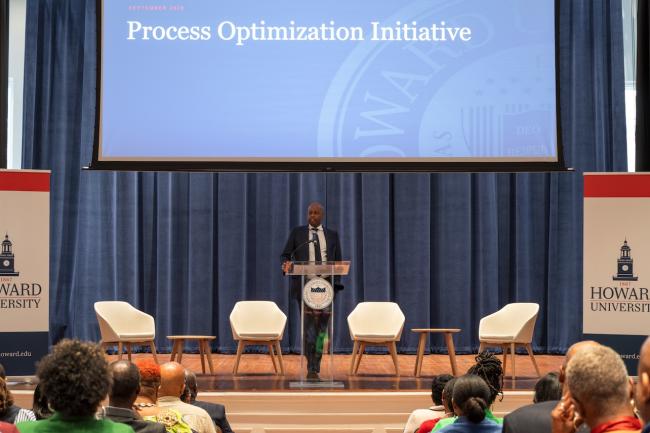
The office was formally introduced during the related kickoff of the President’s Process Optimization Initiative, which is bringing together partners from across Howard University to examine how work gets done across the institution and identify opportunities to make processes more efficient, transparent, consistent, and sustainable.

“The Office of Business Optimization is not meant to live alone. It is meant to work collaboratively with all of you,” said Allison Bryant, vice president of Corporate Relations and a co-sponsor of the Process Optimization Initiative. “Our faculty and staff know where the pain points are and our students experience the impact of our processes every day.”
Led by Christina Jimbah, assistant vice president for the Office of Business Optimization, the goal of OBO is to bring people together to identify unnecessary burdens and turn their ideas and expertise into lasting improvements.
“As universities continue to grow, their size and complexity grow, their ambitions grow, and the way that they operate has to continue to grow with the enterprise,” Jimbah said.
At a kickoff event on Sept. 17, Howard University Interim and Emeritus President Wayne A.I. Frederick, MBA, MD, said process improvements must be understood in the context of the technology environment in which today’s students live.
“We are now living in an era of technology where our primary customer gets everything done at the snap of a finger,” Frederick said. “We have this intelligence among our customers and amongst us. Every time we attempt to get something done, our expectation now is that it would be done immediately.”
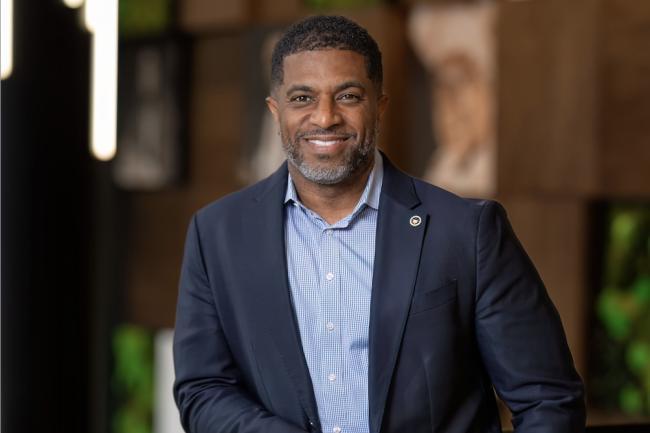
Christopher J. Tyson (B.Arch. ’98), a member of the Howard University Board of Trustees since 2022, said improving operational efficiency has been a priority for Board Chair Leslie D. Hale (BBA ’94) and the Board. Hale established an ad hoc committee focused on operational excellence, and Frederick subsequently convened the Process Optimization Initiative this spring.
Tyson said that while the Board of Trustees provides oversight, faculty and staff are on the front lines of university operations, giving them firsthand knowledge of how processes affect students, alumni and colleagues.
“You are on the front lines of engaging with our students and other constituents,” Tyson said. “And therefore, what they experience at Howard is part of what you deliver, based on the resources and capabilities that you have at your disposal.”
He encouraged faculty and staff to actively participate in the initiative, saying their knowledge and experience will be critical to identifying opportunities for improvement and ensuring that every Howard interaction is “one of quality, one of results, and one of follow-through.”
Starting with Three Work Streams
Bryant and Jimbah said the Process Optimization Initiative will work directly with individual Howard units to identify and address administrative challenges. Rather than operating separately from the University community, OBO will partner with faculty, staff, students and others who experience these processes firsthand.
The initiative’s initial work has focused on three areas: Workday shared governance, Development and Alumni Relations (DAR) account establishment, and shared services for the many Howard centers and institutes.
The Workday shared governance work stream focuses on creating a clearer process for requesting, prioritizing, managing and tracking changes to the University’s Workday environment. The work includes a proposed five-step release process and a governance framework designed to clarify ownership, decision-making, visibility, documentation and the impact of changes across departments.
The Development and Alumni Relations (DAR) account establishment work stream examines how gifts and other funds move into the University and become available for their intended purposes. The review identified challenges involving disconnected systems, inconsistent handoffs and unclear approval processes for complex or large gifts.
The team has mapped the gift life cycle and is developing a shared decision model, tiered thresholds and service expectations, a redesigned account establishment form, and greater automation. The work also calls for reestablishing a gift acceptance committee to provide oversight of complex and large gifts.
The third work stream focuses on shared services for Howard centers and institutes, where leaders reported spending significant time navigating processes involving hiring, purchasing, appointments, financial management and access to funds. The initiative is developing a service model with clearer processes, timelines, ownership, points of contact, and onboarding pathways. A five-center pilot will test the model, establish success metrics and inform broader implementation.
Johnny Graham, executive director of the Howard University Entrepreneurship and Innovation National Center for Entrepreneurship, said improving administrative processes can strengthen a given center’s ability to fulfill its missions.
“Our operational support is not separate from our mission,” Graham said. “It’s what makes our mission truly tangible and possible.”
A Focus on Progress
Jimbah emphasized that the work streams are a starting point, providing a foundation from which lessons can be applied across the University. So far, the streams have generated 12 prioritized recommendations.
Bryant said successful optimization will require participation across the University, including transparency about what is being changed, clear ownership, measurable outcomes and accountability for sustaining improvements.
“Tell us what’s working, and tell us what isn’t,” Bryant said, encouraging members of the Howard community to contribute ideas and identify areas where processes can be improved.
Frederick noted that the work should not begin with the assumption that every process at Howard is broken. Howard, he said, has made significant progress while continuing to identify areas for improvement.
He pointed to the physical transformation of the campus as one example of the progress Howard has made, recalling that the area where the ceremony was held, now home to the Myrtilla Miner Building and the School of Education, was once “empty and lifeless” when he first came to Howard in 1988. Today, he said, the area is one of Howard’s vital “energy centers.”
“All of us have to contribute to making Howard better,” Frederick said.
Howard University has established optimization.howard.edu as a starting point for members of the community to share feedback and ideas about process improvement.
Keep Reading
-
 *Upgrade
Howard University’s Campus Store Reopens in Grand Fashion with Its Biggest Renovation Ever
Sep 18, 2026 5 minutes -
 Epiphanies, Discovery, and Research
Howard University Medical Simulation Center Expands Accreditation in Human Simulation
May 18, 2026 2 minutes -
 Commencement 2026
Going Viral: Howard College of Medicine Graduate Shay Taylor's Journey From Hospital Janitor to Doctor Becomes Global Inspiration
May 5, 2026 3 minutes