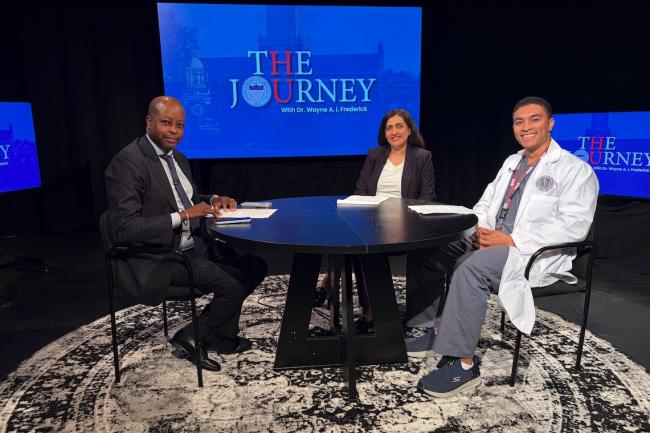
What does it take to become a physician? And what kind of physicians will medicine need in the future? A new episode of WHUT-TV’s The Journey, hosted by Dr. Wayne A. I. Frederick, explores those questions through a conversation about becoming a doctor and preparing the next generation of physicians.
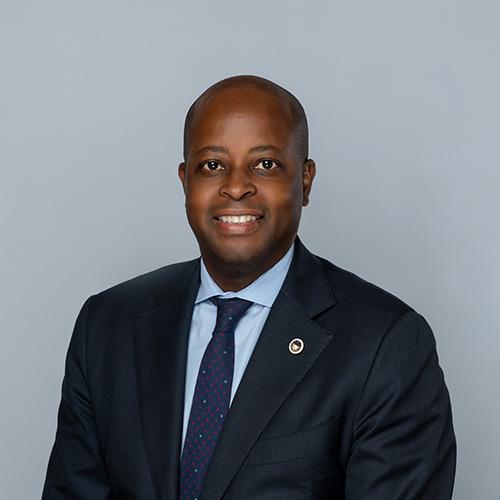
The episode features Noor Malik, M.D., clinical assistant professor of neurosurgery at Howard University Hospital and the Howard University College of Medicine, and Chris McGinley, an M.D./Ph.D. student at the Howard University College of Medicine. Frederick (B.S. ’92, M.D. ’94, MBA ’11) serves as interim president and president emeritus of Howard University and as the Charles R. Drew Professor of Surgery in the College of Medicine.
Together, they discuss what it takes to prepare the next generation of physicians for a profession increasingly shaped by advances in technology, research and clinical care. The physician shortage is particularly acute among Black and Hispanic communities. Black Americans make up about 14% of the U.S. population but only 5.7% of physicians, while Hispanic Americans represent about 20% of the population but just 7% of physicians.
Frederick, Malik and McGinley also examine the human qualities future physicians need, including empathy, communication, adaptability and a commitment to the communities they serve. Other topics include the importance of mentorship and hands-on clinical training, and how students can prepare for the demands of a medical career.
Malik said her journey to neurosurgery was shaped by curiosity, mentorship and a fascination with the brain. In the episode, she reflects on entering a historically male-dominated specialty, what continues to draw her to the field, as well as the role of technology in neurosurgery. After beginning her medical education in Pakistan, Malik pursued neurosurgical training and fellowships in pediatric neurosurgery and neurosurgical oncology, gaining experience with emerging techniques such as intraoperative neuromonitoring and laser interstitial thermal therapy.
McGinley brings a different perspective: that of a physician-scientist still making his way through the training pipeline. An M.D./Ph.D. student at Howard, he is conducting research on how the brain repairs itself after stroke, including the potential of a molecule that could help promote brain repair. His interest in research was influenced in part by his grandmother’s experience with leukemia and a clinical trial that gave their family more time together.
The conversation repeatedly emphasizes the importance of understanding the person behind the diagnosis.
Malik emphasizes that becoming an excellent physician requires more than mastering science and clinical technique. Physicians must learn to listen, communicate with families and understand that every patient represents a person with a story beyond the medical chart or an MRI.
The new episode of The Journey will air on WHUT-TV on October 5 at 10:30 p.m., with additional broadcasts on October 10 at 2 p.m.; October 11 at noon, 7 p.m. and 10 p.m.; October 12 at noon; and October 13 at 8 p.m. Viewers can tune in to WHUT-TV and follow Howard University’s digital platforms for additional information.
Related Story