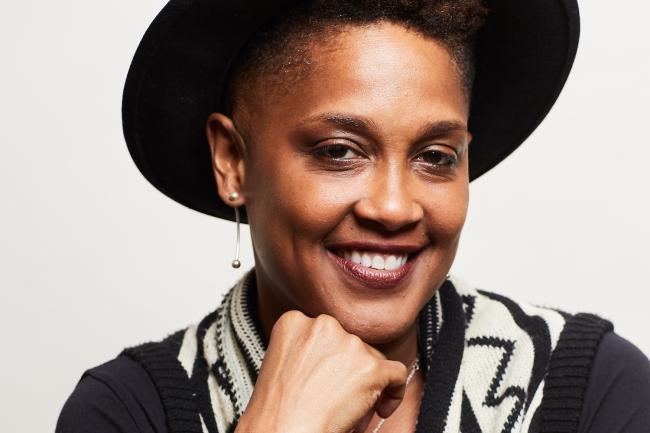
WASHINGTON, D.C. — Howard University will present “Necessary Means: Adreinne Waheed on Gathering & Power,” a major exhibition examining the beauty, dynamism and political force of collective Black life through the photography and archival practice of Howard alumna Adreinne Waheed.
Opening Wednesday, Oct. 14, 2026, during Howard University Homecoming week and remaining on view through May 28, 2027, at the Howard University Museum at the Moorland-Spingarn Research Center (MSRC) in Founders Library, “Necessary Means” brings Waheed’s documentary street photography into conversation with selections from the Waheed Photo Archive, her extensive collection of found photographs documenting African American life from the Civil War era to the present.
An artist talk with Waheed, followed by the opening reception for “Necessary Means: On Gathering & Power,” will take place on Wednesday, Oct. 14, from 2 p.m. to 5 p.m. Reserve a spot on Eventbrite.
Curated by Kathryn Coney-Ali, executive director of the Howard University Gallery of Art, and Dr. Melanee C. Harvey-Fryar, associate professor of art history in Howard’s Chadwick A. Boseman College of Fine Arts, the exhibition traces the profound influence of Howard University on Waheed’s development as an artist while exploring the ways Black communities create, sustain and exercise power through gathering.
For the first time, Waheed’s archival and contemporary bodies of work are presented together, revealing a throughline across her practice: photography as an instrument of memory, celebration, resistance and self-determination.
From Howard’s Archives to a Global Photographic Practice
Waheed’s relationship with Howard is central to the exhibition.
As an undergraduate in Howard’s School of Communications in the early 1990s, she interned at the Moorland-Spingarn Research Center, one of the world’s most significant repositories dedicated to the global Black experience. Her exposure to its collections helped shape what the curators describe as an “archival aesthetic practice”—connecting the preservation of historical Black images with her own documentation of Black communities around the world.
“Necessary Means” begins with “Archival Foundations,” featuring historic images from the Waheed Photo Archive, before moving into “Through a Howard Bison’s Viewfinder,” which examines the artists, intellectuals, professors and peers who influenced Waheed during her years at Howard.
Those influences include the legacy of the Black Arts Movement, the cinematic innovation of filmmaker and Howard professor Haile Gerima, and the emergence of hip-hop culture among Waheed’s generation.
Early photographs on view include images of the Rock Creek Drum Crew in 1994 and the 1995 Million Man March, establishing themes of public space, cultural expression and collective presence that would continue throughout Waheed’s career.
Gathering as a Source of Power
The exhibition expands beyond Howard through sections devoted to Black community, celebration, protest and cultural expression across the African Diaspora.
In “Power of Gathering,” Waheed’s photographs move between couples, families, festivals, demonstrations and communal celebrations, illuminating Black love, intergenerational connection, self-fashioned identity and contemporary expressions of “Black is Beautiful.”
“Diasporic Joy & Power” extends that exploration internationally, bringing together photographs from the Fees Must Fall student protests in South Africa in 2015, Carnival in Salvador, Bahia, Brazil, in 2014, and Black cultural gatherings including DanceAfrica at BAM, Soul Summit and Afropunk in Brooklyn, and Afropunk Johannesburg.
Together, the works advance a central premise of the exhibition: gathering can be a source of spiritual, cultural and political power.
Several of Waheed’s photographs make the relationship between joy, visibility and resistance especially vivid. “The Light Bearer” (2020), photographed during the Show Up for Black WomXn vigil in Brooklyn, centers an illuminated figure within a nighttime gathering. Another photograph, made during the 2020 HBCU March for the Generations in Washington, D.C., captures protest, personal expression and collective affirmation, while “Fleet on Fleek” (2017) portrays four Black sailors standing together in uniform.
The exhibition concludes with “Freedom of Form: Resist Conformity, Embrace Your Power,” examining the ways Black people move through, occupy and claim public space. Through images of protest, movement, celebration, and collective presence, the section invites viewers—particularly students—to consider the significance of their own bodies, movements and relationships to the spaces around them.
Building and Preserving a Black Visual Record
Waheed has been making photographs since age 13 and has built a career spanning photography, editorial work, archival research and publishing.
Her photography has appeared in publications including The New York Times, The Fader, The Crisis and Mfon: A Journal of Women Photographers of the African Diaspora. As a photo editor, she has produced and directed shoots for publications including Vibe, King and Essence.
In 2010, Waheed established the Waheed Photo Archive to preserve found photographs representing more than a century of African American life. The Smithsonian’s National Museum of African American History and Culture acquired the archive in 2015, with selections later appearing in the museum’s 2018 publication “Everyday Beauty.” That same year, Waheed published her photography book, “Black Joy and Resistance.”
By bringing those historic images together with Waheed’s contemporary photography, “Necessary Means” demonstrates how preserving the past and documenting the present can become interconnected acts of cultural stewardship.
For Howard students, the exhibition also offers a distinctly Howard story: what can emerge when an artist encounters an archive, mentors, a creative community and an intellectual tradition—and carries those influences forward into a lifetime of artistic practice.
Exhibition Details
“Necessary Means: Adreinne Waheed on Gathering & Power”
Oct. 14, 2026 – May 28, 2027
Location: Howard University Museum, Founders Library
Howard University
Washington, D.C.
Curators: Kathryn Coney-Ali, Executive Director, Howard University Gallery of Art, and Dr. Melanee C. Harvey-Fryar, Associate Professor of Art History, Chadwick A. Boseman College of Fine Arts
The exhibition is a collaboration between MSRC, the Howard University Gallery of Art, and Art Bridges.
###
About the Chadwick A. Boseman College of Fine Arts
The Howard University Chadwick A. Boseman College of Fine Arts is one of the nation’s premier institutions for visual arts, music, dance, and theatre. Rooted in the legacy of Howard—the top-ranked coeducational HBCU—its excellence is carried forward by the remarkable talent, training, and impact of its faculty, students, staff, and alumni, who are shaping culture, telling untold stories, and transforming communities through the arts. Learn more at https://finearts.howard.edu/.
About Howard University
Howard University, established in 1867, is a leading private research university based in Washington, D.C. Howard’s 14 schools and colleges offer 140 undergraduate, graduate, and professional degree programs and lead the nation in producing African Americans with professional doctoral degrees. Howard is the top-ranked historically Black college or university according to Forbes, the only HBCU with an R1 research institution designation, and the only HBCU ranked among U.S. News & World Report’s Top 100 National Universities. Renowned for its esteemed faculty, high-achieving students, and commitment to excellence, leadership, truth, and service, Howard produces distinguished alumni across all sectors, which have included the first Black U.S. Supreme Court justice and the first woman U.S. vice president; a Nobel Prize laureate; Schwarzman, Marshall, Rhodes and Truman Scholars; prestigious fellows; and over 170 Fulbright recipients. Learn more at www.howard.edu.
Keep Reading
-
 Media Release
Howard University Receives $1M Gift from Alumnus to Advance the Impact of Innovation in the College of Arts and Sciences
Oct 15, 2026 4 minutes -