

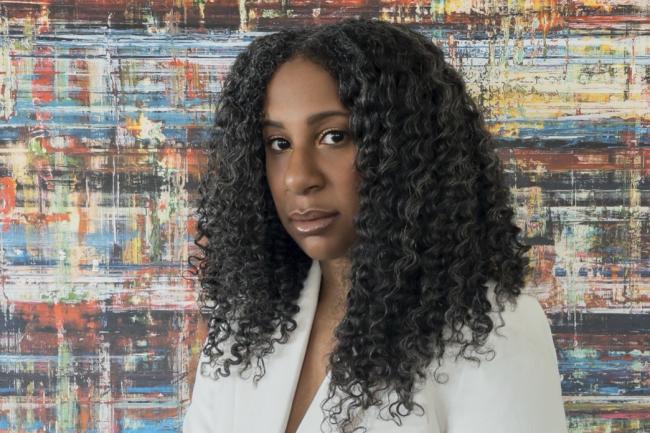
Howard University alumna Alison C. Rollins (B.S. ’09), whose writing voice was shaped by Washington’s Black cultural scene of the early 2000s and campus life, has won the prestigious Whiting Award for emerging writers. She was rewarded for her most recent poetry collection, “Black Bell” (Copper Canyon Press, 2024).
The title “Black Bell” comes from a 19th century image of an enslaved woman forced to wear a metal cage around her body, designed to make escape impossible. The contraption stood seven feet tall and six feet across; bells and horns clamped around the torso and shoulders and attached at the back of the neck. The book includes an epigraph from abolitionist Moses Roper, who described a captured woman forced to wear it after an escape attempt.
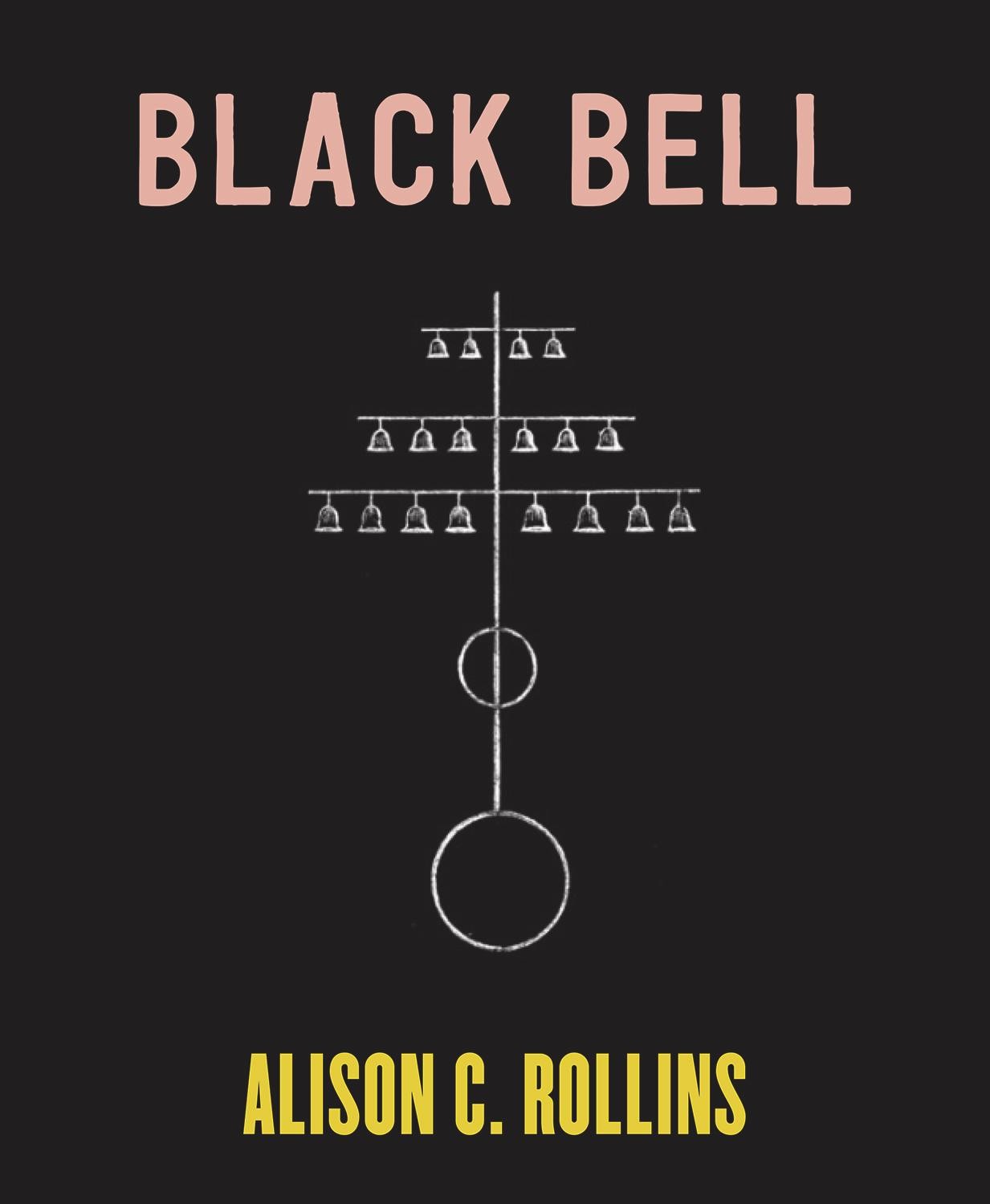
In its citation, the Whiting Foundation said Rollins’ poetry “possesses a familiarity across literary traditions that infuses it with depth and striking immediacy. Her painstaking research closes the gap between past and future, contributing to a new way of seeing. Every phrase carefully lends a rhythmic, physical intensity. Riveting on the page, it sings when given voice.”
The Los Angeles Review of Books called the collection “stunning and wildly expansive,” noting that its images and diagrams, alongside the poetry, resist neat description and compel readers to confront the limits of language. During public readings, including her 2024 Radcliffe Fellow lecture at Harvard University, Rollins actually dons a contraption with iron horns and bells which she welded at a steelyard herself. She said that this demonstration is meant to breakdown the “usual polite dynamic of poetry reading.” She also wears it to speak back to the enslaved woman described by Roper, whom Rollins imagines as “Black Bell.”
Rollins’ special recognition as a Whiting Award winner comes after her winding path as a writer, including moving back home to the Midwest after college and nearly giving up writing. She cites history and the Black Arts Movement as major influences.
“To be a poet, to me, means being experimental and liberatory with language, pushing words to their farthest potential through the power of imagination,” Rollins said in a recent interview. “Poetry has always been a sight of play and freedom for me to explore both the societal limitations and limitlessness of Black existence in the past, present, and future.”
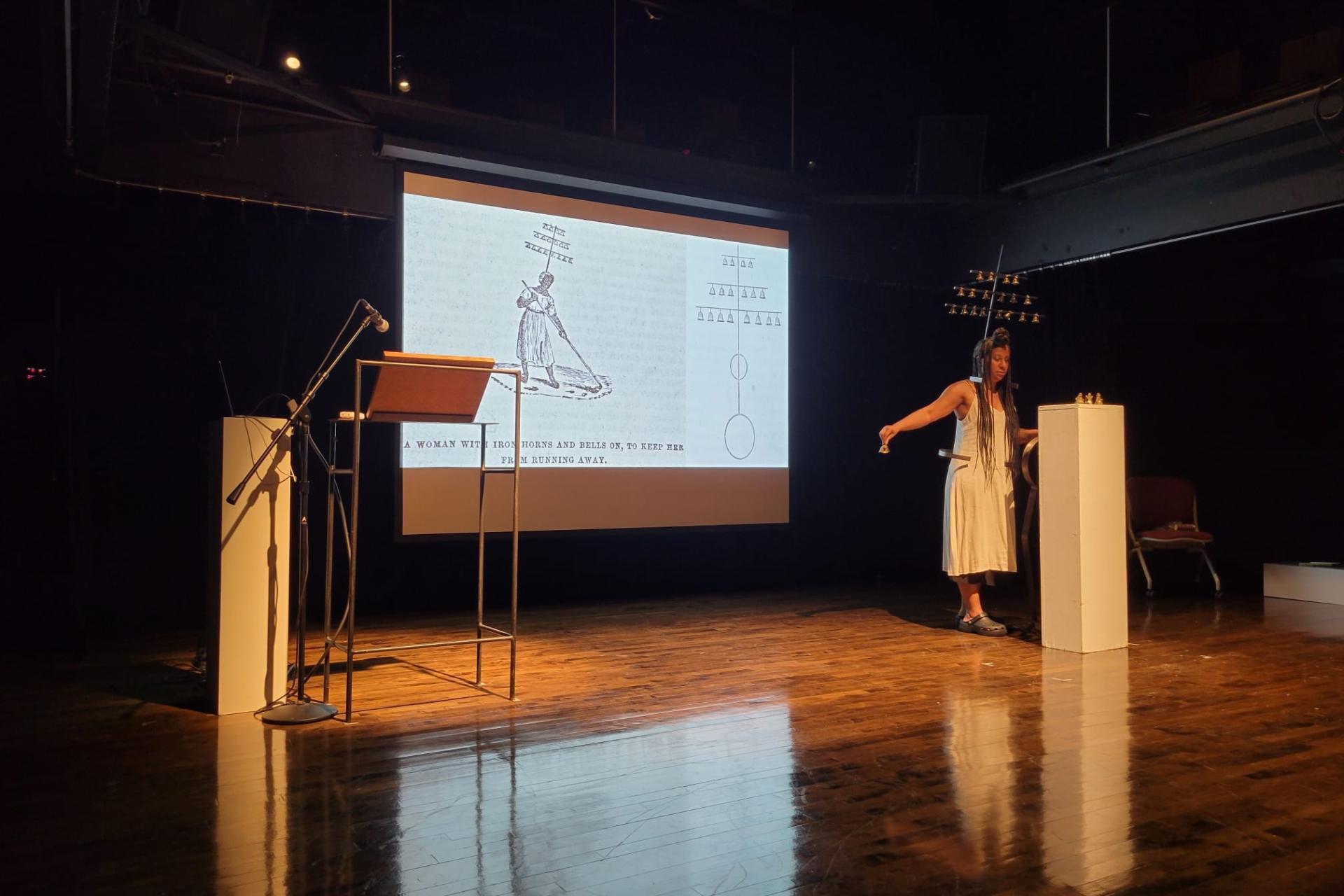
Howard University alumna Alison C. Rollins wears a metal sculpture she created during a performance of poems from her collection, "Black Bell." The image appeared in an interview with The Massachusetts Review.
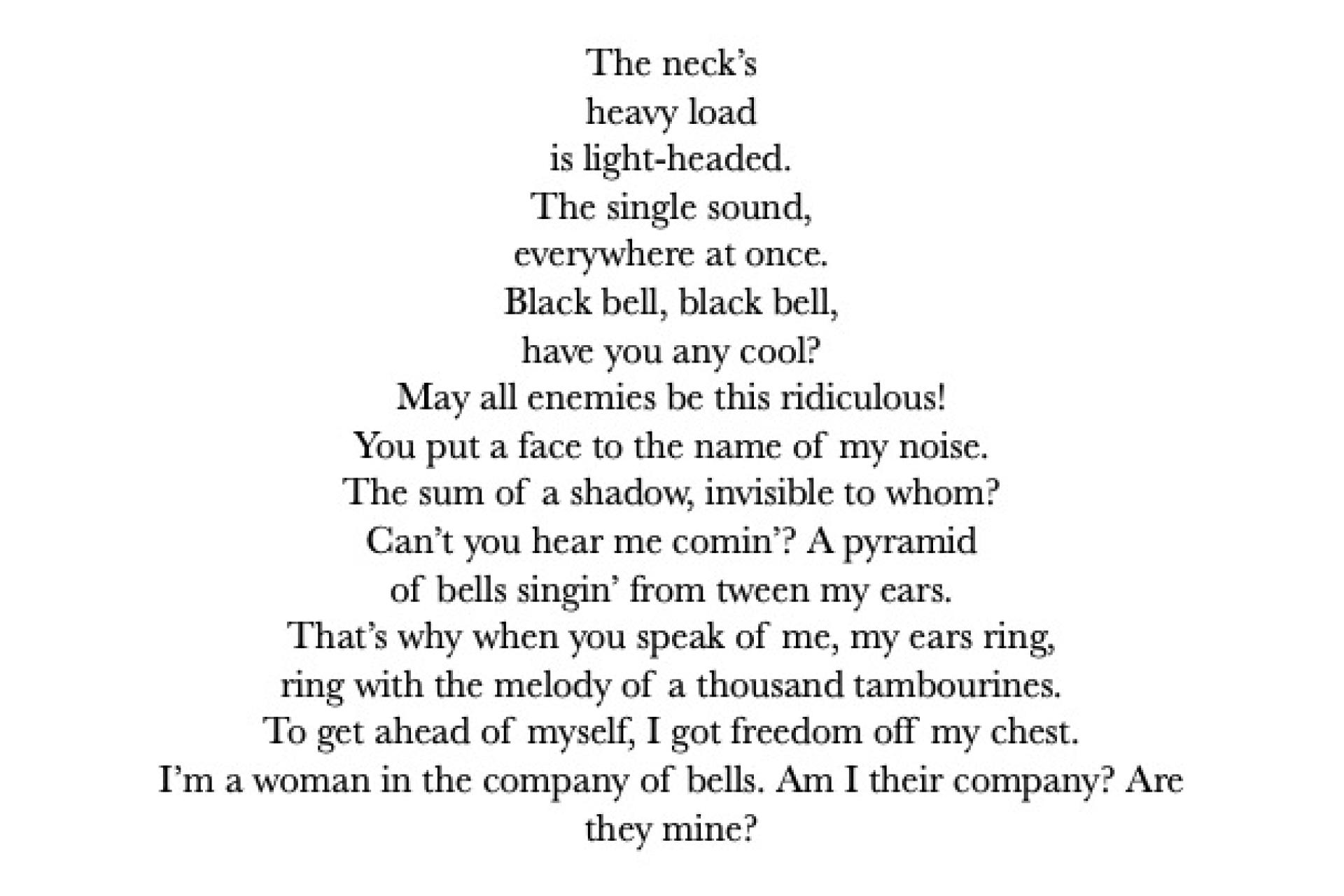
Opening lines of "A Bell Is a Messenger of Time," from Black Bell.
Finding Her Voice at Howard University
Rollins would discover her distinct poetic voice at Howard, where she began her studies in 2005, drawn by a love for Washington D.C. The St. Louis, Missouri, native enjoyed rides on the Metro, hearing different languages, and seeing upwardly mobile Black people throughout the city. Before making her college decision, she toured American University, George Washington University, and Georgetown University. Howard was the last stop on the list.
She noted that Howard, at the time, was not at the top in terms of college amenities, but she locked in on the “the vibrancy, the energy, and excellence” that surrounded the campus. Knowing that she would be the first of her sisters to go to college, Howard’s offer of a full-tuition legacy scholarship cleared any doubts.
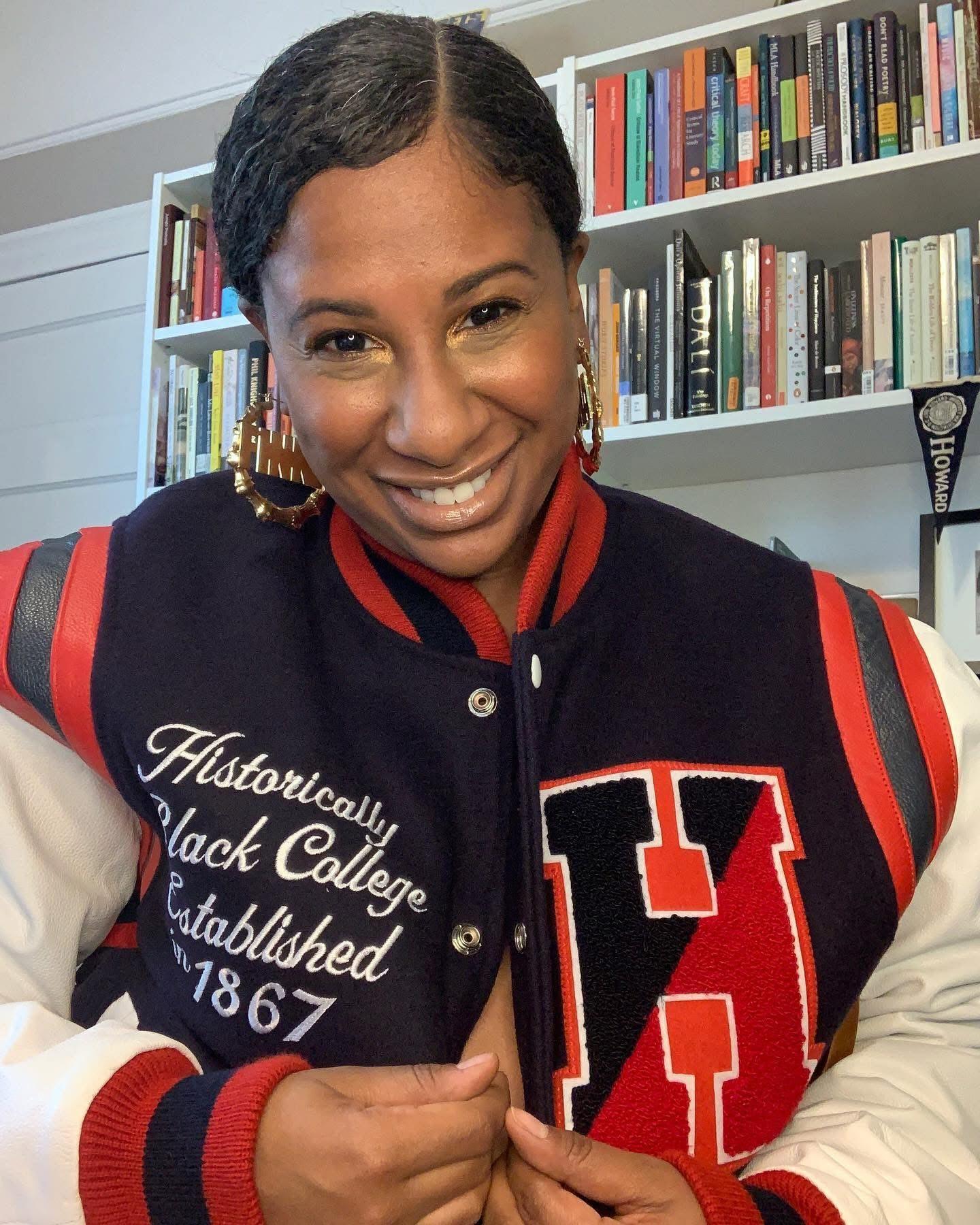
Rollins recalled having to navigate family pressure when it came time to choose a major. Both of her parents hold graduate degrees, and she felt pressure, particularly from her father, to pursue finance, law, science, or engineering.
"The pressure is real on people of color, Black Americans in this country, and immigrants,” Rollins said. “Survival takes a great toll on folks’ mental and physical wellbeing; there can be real concern and tangible impact in terms of what people choose to do to make a living. But I also feel that the skill sets it requires to thrive in this country as a Black person, a person of color, demand a certain level of imagination and creativity."
Rollins and her father compromised on psychology, and she graduated from Howard in 2009 with a Bachelor of Science in the field, minoring in English.
On campus, Rollins participated in creative writing workshops and performed at Howard’s annual Hearts Day celebration, where Black writers came to campus to be honored. Rollins said she loves and admires the work of contemporary writers Yona Harvey (B.A.’96) and Douglas Kearney (B.A.’96), who both attended Howard as undergraduates. She called Toni Morrison (B.A. ’53), who was also from the Midwest, her ultimate icon.
At one of these campus events, she met Amiri Baraka (B.A.’54) and asked him about the Black Arts Movement. She remembered that Baraka had a poem on HBO's “Def Poetry Jam” that repeated the phrase "why is we Americans." She later published her own poem with the same title in Poetry magazine and the piece was also published in the anthology “African American Poetry: 250 Years of Struggle & Song.”
Outside the classroom, Rollins found community in Poetre, a poetry club where students gathered for readings, spoken word events, and book talks. They met at Sankofa Books at the former Mocha Hut on U Street. She advises current Howard students to give themselves grace, find their people, and resist the belief that they must fit a prescribed version of what it means to be at an HBCU.
“Allow yourself time to find your people, find your tribe on campus,” Rollins said. “Who you are is unique and amazing.”
A Winding Road Yields Success
Rollins said after graduating from Howard, she knew she wanted to be a poet and writer but had no idea how to make that happen. She enrolled in a doctoral program in English at Temple University and moved to Philadelphia to start the program. But she said the surroundings were unfamiliar, and with only a minor in English, she felt a bit out of her depth. She left the program and moved back to the District, working a variety of odd jobs, including government consulting work.
Rollins said she really didn't know where she was headed and "kind of gave up writing" as she processed her future. Eventually, she moved back to St. Louis and started working as a library assistant. That job led to a library and information science degree from the University of Illinois Urbana-Champaign. Rollins then worked for years as a public librarian, high school librarian, and eventually a college librarian.
During the COVID-19 pandemic, Rollins's work started to be published more frequently. She also ramped up her reading and involvement in the poetry community and decided to pursue a Master of Fine Arts in creative writing at Brown University so she could teach alongside her work as an active writer. Her first book of poetry was the critically acclaimed collection “Library of Small Catastrophes,” (Copper Canyon Press, 2019).
Today, Rollins is in her third year as an assistant professor of English at the University of Wisconsin–Madison, where she teaches creative writing, nonfiction, and poetry. In her words, it's been a "Black Brandy Cinderella-like" career.
“The path toward success is not often a linear, clear path,” Rollins said. “I've had a lot of failures, a lot of challenges, a lot of departures, pivots career-wise, education-wise, et cetera.”
Asked how her father, a retired attorney, has fared along the way on her journey, Rollins laughed softly.
"He would appreciate that you asked that question,” she said. “I didn't really have parental approval. I think my dad especially thought, 'What are you? You can write poems wherever, but you need a real job. You need health insurance,' which is very real and accurate."
She added, “Only until fairly recently does he support and understand the vision in terms of what has transpired. Even his initial skepticism has only served to fuel my drive paired with the grit, perseverance, and refinement of character that only a place like ‘The Mecca’ can instill.”
Keep Reading
-
 Culture Creators: Arts and Entertainment
‘A Different World’ Stars Come Home to Howard Ahead of Netflix Sequel Premiere
Sep 25, 2026 4 minutes -
 Lineage: Howard Students and Alumni
20 Years in Motion: Models Inc. Celebrates Two Decades of Fashion, Mentorship and Black Creative Expression at Howard University
Sep 14, 2026 7 minutes -
 *Accolades
Howard University CEA Professor Sonya Smith Elected to AIAA Class of 2026 Fellows
Sep 28, 2026 3 minutes