

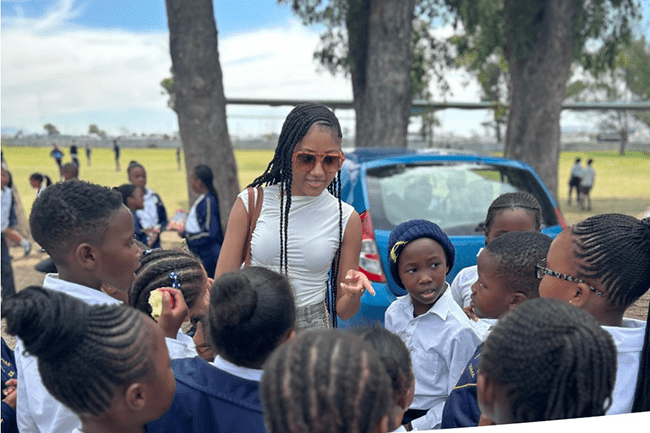
Second year graduate social work student and 2025–2026 Founders Fellow Aubrey Scott still remembers the connections he made in Cape Town, South Africa. Scott spent his trip working at The Ark City of Refuge shelter and specifically remembers being inspired by its sole, lead social worker..
“Seeing her operate The Ark and the way that she did was just profound to me,” he said. “It was definitely something that was eye opening, and I decided to really develop a relationship with her because my interest at that time was program development and program analytics as it relates to social work.”
Scott was in South Africa as part of the School of Social Work’s International Service Learning Program, during which Howard students travel to Cape Town and are assigned to one of many organizations throughout the city. For 10 days, students assist on-the-ground organizations, receive mentorship, learn more about the history and ongoing effects of Apartheid from those who’ve lived through it, and engage directly with the community.
Gaining a Fresh Perspective on Social Work
This year marks the 15th anniversary of the program, which began as an independent study course supported by Dr. Cudore Snell and Dr. Sandra Crewe and has since become a hallmark of the program. The course is currently taught by Dr. Sandra Jeter and involves faculty from across the School of Social Work. On March 7, 12 graduate students and four faculty members will depart for Cape Town, showing how the Howard mission of Truth and Service has no border.
Over the course of two weeks, the cohort will work independently at partner organizations across the city — from shelters like The Ark to child development initiatives like Project Playground — and join together for larger community service projects. Additionally, they will visit Robbens Island, where Nelson Mandela and other anti-Apartheid leaders were imprisoned, as well as the District Six Museum, to learn about the history of Apartheid and forced displacement within South Africa, before visiting a Cape Town township predominantly populated by Black Africans to engage in community work and directly learn about that community.
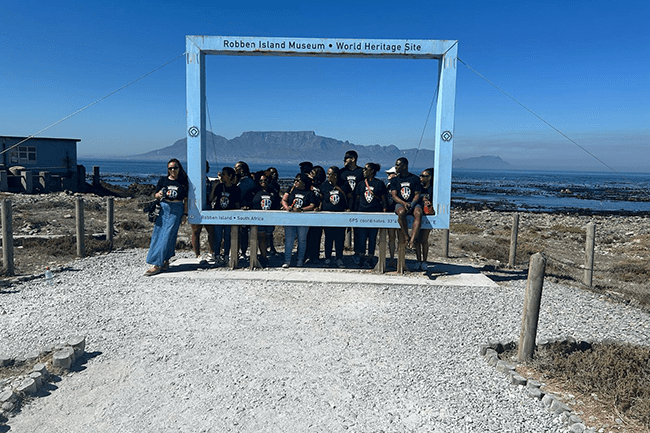
To Jeter, this trip gives the graduate students an opportunity to better appreciate the diversity of the Black experience, while also interrogating their own understanding of power, bias, and inequity, as well as their own privilege. Students are also expected to keep a journal during the experience.
“We have assigned journal reflections for them to do throughout the trip so that they are taking a moment to actually think, because every day is fast-paced while we’re over there,” she said. “We are very intentional about encouraging our students to take a moment to really think about what they're experiencing, what they’re seeing. How is this showing up in their bodies? Are they rejecting the culture? Are they accepting of it? Are they understanding their privilege or not? We want them to reflect on that.”
An Experience That Resonates
For first year Masters in Social Work student Jade Miller, the trip is a natural extension of her journey. Born in Massachusetts, Miller has been involved in childcare and community service since pre-school, when her class helped craft AIDS quilts for local hospital patients.
After moving to D.C., Miller originally looked for work as a nanny; however, after the loss of her brother to gun violence, she pivoted to social work, determined to provide the kinds of interventions that could have changed the trajectory of his life. She likens the international trip to her first visit to D.C., which helped set her on the path she’s on today.
“When they presented the idea of ‘We’re going to another country for this trip in South Africa, we’re going to be learning about what social work and advocacy looks like from their perspective,’ I was very excited,” Miller said. “I had done service learning domestically when I was in college. It's what brought me to D.C., the first time, and it really changed my perspective on homelessness and food insecurity. That’s what I was here to do. I already knew how impactful those trips can be.”
Miller intends to become a school social worker after earning her MSW and hopes to leave the trip with an even greater understanding of her clients’ needs.
“As someone who’s not from the country, I think will be really helpful to give me perspective of what my clients could be experiencing,” she added.
For second-year MSW student Jessica Bryant, the future isn’t so set in stone. Already holding a degree in sign language from the prestigious Gallaudet University, the D.C. native is open to any career that allows her to serve the community.
“I intentionally am trying to curate a career that I genuinely enjoy, whatever that looks like,” she said. “If that means I’m in the schools, sure. If that means I work with deaf and hard of hearing seniors, like I do currently, sure. If that means I work in hospice, sure. If that means I get rid of humans altogether and go work on somebody’s animal sanctuary, sure.”
I’ve always found myself holding that in the back of my head and remembering that there’s no experience in the world that’s unique or out of reach for me to empathize with and understand.
Beyond the experience of the trip itself, Bryant sees it as a chance to remember how important social work is.
“A lot of people want to diminish the profession these days,” she noted. “It’s grown because they need people to do social work, but I feel it doesn’t get the respect that it deserves. I hope to takeaway that what I'm doing, what I’ve chosen to do, is important. What I’ve chosen to do isn’t just something that women do — it’s important because people need help.”
Scott, reflecting on his own trip, emphasized a final value of the trip: the internationalization of care. The experience cemented in him a global perspective on social work, because “the oceans don't really separate us.”
“There was a saying that when I was younger, I used to read often, ‘Homo sum, humani nihil a me alienum puto,’ which means, roughly, ‘I’m human, therefore anything pertaining to human experience pertains to me,’” he said. “I’ve always found myself holding that in the back of my head and remembering that there’s no experience in the world that’s unique or out of reach for me to empathize with and understand.”
The International Service Learning Program is funded through a wide range of sources, including donations. If you have the means, consider donating to the School of Social Work today.
Keep Reading
-
 *Accolades
Howard University CEA Professor Sonya Smith Elected to AIAA Class of 2026 Fellows
Sep 28, 2026 3 minutes -
 Legacy and Lineage
Howard University Honors Retirees, Inaugurates Academic Year at 159th Opening Convocation
Sep 25, 2026 6 minutes -
 *Change Makers
Howard University Trustee Arne Duncan’s Anti-Gun Violence Organization Takes the Spotlight in Documentary
Oct 2, 2026 6 minutes