Contact: Lydia Sermons or Carol Wilkerson
Email: mediarelations@howard.edu
Phone: 202-288-7071
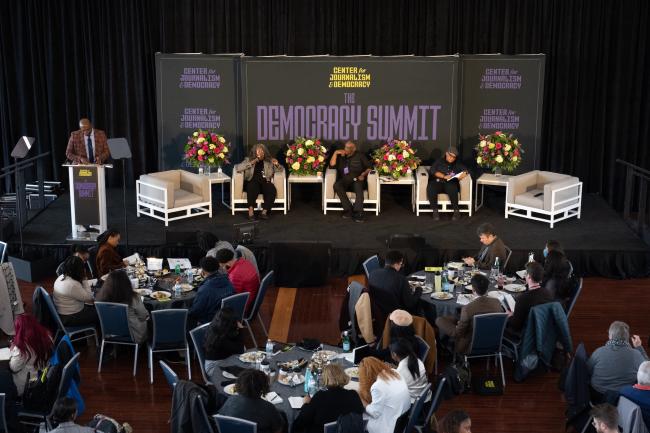
WASHINGTON — On Tues, Oct. 6 from 8:30 a.m. to 5 p.m., Nikole Hannah-Jones, founder of the Center for Journalism & Democracy at Howard University; Knight Chair in Race and Journalism; and a New York Times reporter, will host the 2026 Democracy Summit. The free, full-day convening will bring more than 200 journalists, newsroom executives, legal scholars and democracy advocates together to prepare for an unprecedented midterm election. The Democracy Summit will be livestreamed nationally for public viewing.
As the 2026 midterm elections approach on Nov. 3, the Democracy Summit will serve as a space for journalists to learn, strategize and plan for an election environment expected to challenge our democracy institutions and the strength of our democracy itself. The event will feature four, high-impact panels on how to cover threats to democracy in real-time and how newsrooms can prepare for what’s ahead. Participants will learn from newsroom leaders in some of the nation's most important news organizations and journalists who have covered eroding democracy abroad and legal and scholarly experts.
“The midterm elections will test American democracy and the journalists covering it in ways we have never seen before in our lifetime,” said Hannah-Jones. “The Center for Journalism & Democracy exists to serve as a resource for journalists and newsrooms to prepare for how to both cover and guard against threats to our democracy, one where ballots are being contested, courts are intervening just weeks before Election Day and where ICE may be standing at polling places. Our democracy depends on journalists and newsrooms who are ready in their role as the firewalls of democracy, and our goal is to make sure they are prepared."
Panelists will include leaders from some of this nation’s most important newsrooms, including Carolyn Ryan, managing editor of The New York Times and Leroy Chapman Jr., editor-in-chief of the Atlanta Journal-Constitution. Jodie Ginsberg, CEO of the Committee to Protect Journalists, will moderate the first panel: Press Attacks Amid an Eroding Democracy: Why We Must Defend Journalism. Panelists will examine the escalating threats facing journalists, news organizations and democratic institutions, while exploring strategies to strengthen press freedom and collective action. Jelani Cobb, dean of Columbia School of Journalism will moderate a session Are You Ready? Preparing Your Newsroom for High-Stakes Elections, focused on newsroom readiness, election reporting infrastructure, decision desks, and preparing journalists to navigate contested elections responsibly and accurately. The Summit will then turn toward international experts with a panel discussion Lessons From Abroad: Fighting Back Against Attacks on Democracy moderated by Hannah Allam, national security reporter for ProPublica. The conversation will bring together international journalists and democracy leaders, sharing lessons from countries confronting democratic backsliding, election interference and attacks on the free press.
A centerpiece of the program is What to Expect on Election Night: A Newsroom Simulation, an interactive, Fred Friendly-style session replicating the editorial and legal conditions journalists may face the night of the midterm elections. Moderated by Joe Davidson, journalist, former Washington Post columnist and co-founder of the National Association of Black Journalists, this exercise presents panelists with a scenario that could realistically confront a newsroom — a razor-thin local race, disputed results and an unverified claim involving ballots etc. As the session continues, the scenario escalates driving questions about politics, security and government intervention as the stakes continue to rise. Every participant will then get a chance to reflect and strategize on the scenario during a facilitated roundtable discussion.
Featured speakers include:
Press Attacks Amid an Eroding Democracy: Why We Must Defend Journalism
Jodie Ginsberg (Moderator), CEO, Committee to Protect Journalists; Georgia Fort, journalist and president of the Center for Broadcast Journalism; Nikole Hannah-Jones, Center for Journalism & Democracy Founder; Knight Chair in Race and Journalism; reporter, The New York Times; and Mary McCord, executive director, Institute for Constitutional Advocacy and Protection, Georgetown Law
Are You Ready? Preparing Your Newsroom for High-Stakes Elections
Jelani Cobb (Moderator), dean, Columbia Journalism School; Leroy Chapman Jr., editor-in-chief, Atlanta Journal-Constitution; and Carolyn Ryan, managing editor, The New York Times
Lessons From Abroad: Fighting Back Against Attacks on Democracy
Hannah Allam (Moderator), ProPublica National Security Reporter; Marianela Balbi, executive director, Instituto Prensa y Sociedad de Venezuela; Attila Mong, Europe representative, Committee to Protect Journalists; and Cristina Zahar, Latin America program coordinator, Committee to Protect Journalists
What to Expect on Election Night: A Newsroom Simulation
Joe Davidson (Moderator), journalist, former columnist, The Washington Post; co-founder, National Association of Black Journalists; Claire McNeill, managing editor for News; internship director, Tampa Bay Times; Janai Nelson, president and director-counsel, Legal Defense Fund; and Ron Nixon, journalist; former director, AP Local Investigative Reporting Program
In addition to these four sessions, the Democracy Summit will include a networking reception at the close of the event giving journalists the opportunity to connect and build relationships.
###
About the Center for Journalism and Democracy
The Center for Journalism & Democracy is a first-of-its-kind academic center committed to strengthening historically informed, pro-democracy journalism. Rooted in the history of journalism as activism, the Center for Journalism & Democracy seeks to honor and disseminate the traditions of the Black press by training journalists across the diaspora of HBCUs and focusing the profession toward journalism that defends democracy and claims justice as an ethos. The Center is led by founder Nikole Hannah-Jones, the Knight Chair in Race and Journalism and a reporter at The New York Times Magazine.
About Howard University
Founded in 1867, Howard University is a private, research university that is comprised of 14 schools and colleges. Students pursue more than 140 programs of study leading to undergraduate, graduate, and professional degrees. The University operates with a commitment to Excellence in Truth and Service and has produced one Schwarzman Scholar, four Marshall Scholars, four Rhodes Scholars, 12 Truman Scholars, 25 Pickering Fellows, and more than 165 Fulbright recipients. Howard also produces more on-campus African American Ph.D. recipients than any other university in the United States. For more information on Howard University, visit www.howard.edu.
Keep Reading
-
-
 Media Release
Howard University Swimming & Diving to Host Fifth Annual Battle at the Burr, Celebrating Championship Excellence and Community Through Aquatics
Oct 8, 2026 4 minutes