

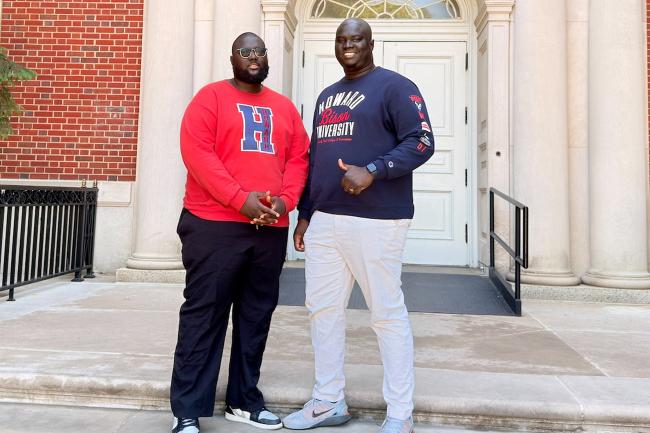
When brothers Moustapha and Papa Hoyeck immigrated to the United States from Senegal in 2014, they had to learn English, adjust to American culture, and restart their educational journey. When they started their journeys at Howard University in 2020, it was the middle of the COVID-19 pandemic.
“I think the first time I met my professors in real life was two years into the program,” said Papa. “I was the only student admitted in the Department of Microbiology in 2020 when I started, so it was quite a lonely journey at the beginning.”
After their mother’s passing in 2014, the brothers moved to the U.S. to live with their father, a sanitation manager in Florida. At the time, Moustapha was finishing his second year of law school in Senegal while Papa was just finishing up high school. The transition to the U.S. was more difficult than they anticipated. The differences in the education systems meant that Moustapha had to, essentially, restart his higher education. While the siblings were taught English in school in Senegal, their lessons focused mostly on reading British English, which, they discovered, was much different than American English.
“We were in the U.S. for six months before we started school and most of that time was spent at home,” said Moustapha. “When you come to a new country, not knowing the culture, not knowing anything, even going to Walmart is a pain because it is so difficult to communicate.”
Moustapha’s Journey
The pair began their educational journeys in America at Valencia College in Orlando, Florida, where they graduated with associate degrees in general studies in 2016. Their first year at Valenica focused heavily on learning English through EAP (English for Academic Purposes) courses. Their hard work paid off as they were consistently recognized as high performers amongst their classmates, an accomplishment they will always be proud of.
After Valencia, the Hoyeck brothers attended the University of Florida. Moustapha received his bachelor’s and master’s degrees in political science, while his brother received a bachelor’s in microbiology and cell science and a master’s in public health with a concentration in epidemiology. Although the University of Florida provided them with a good education, the isolation they experienced attending a predominately white institution left them wanting a change.
They were attracted to Howard for the diversity of the campus and the city of Washington D.C.
“Once we saw that we had time to apply to Howard, we started researching, and I have to say, the stats and a lot of the success stories that we read about Howard were very attractive,” said Moustapha. “Those are the kind of things that make you want to be part of the story. When we got in, we were committed to bringing something new and being part of the legacy of this university.”
They made good on their promise.
In 2020, Moustapha reached out to political science professor J. Jarpa Dawuni, Ph.D. and worked to help her open the Center for Women, Gender, and Global Leadership (CWGGL). His master’s thesis focused on social movements and resource mobilization in Africa and he wanted to expand his research to include topics concerning women. The CWGGL was created by a $1 million donation from Heather and Jim Murren in 2020.
“Since I had a law background and was focused on Africa, I reached out to Dr. Dawuni,” Moustapha explained. “I saw that her research focused on Africa and she’s a pioneer when it comes to African women in law.”
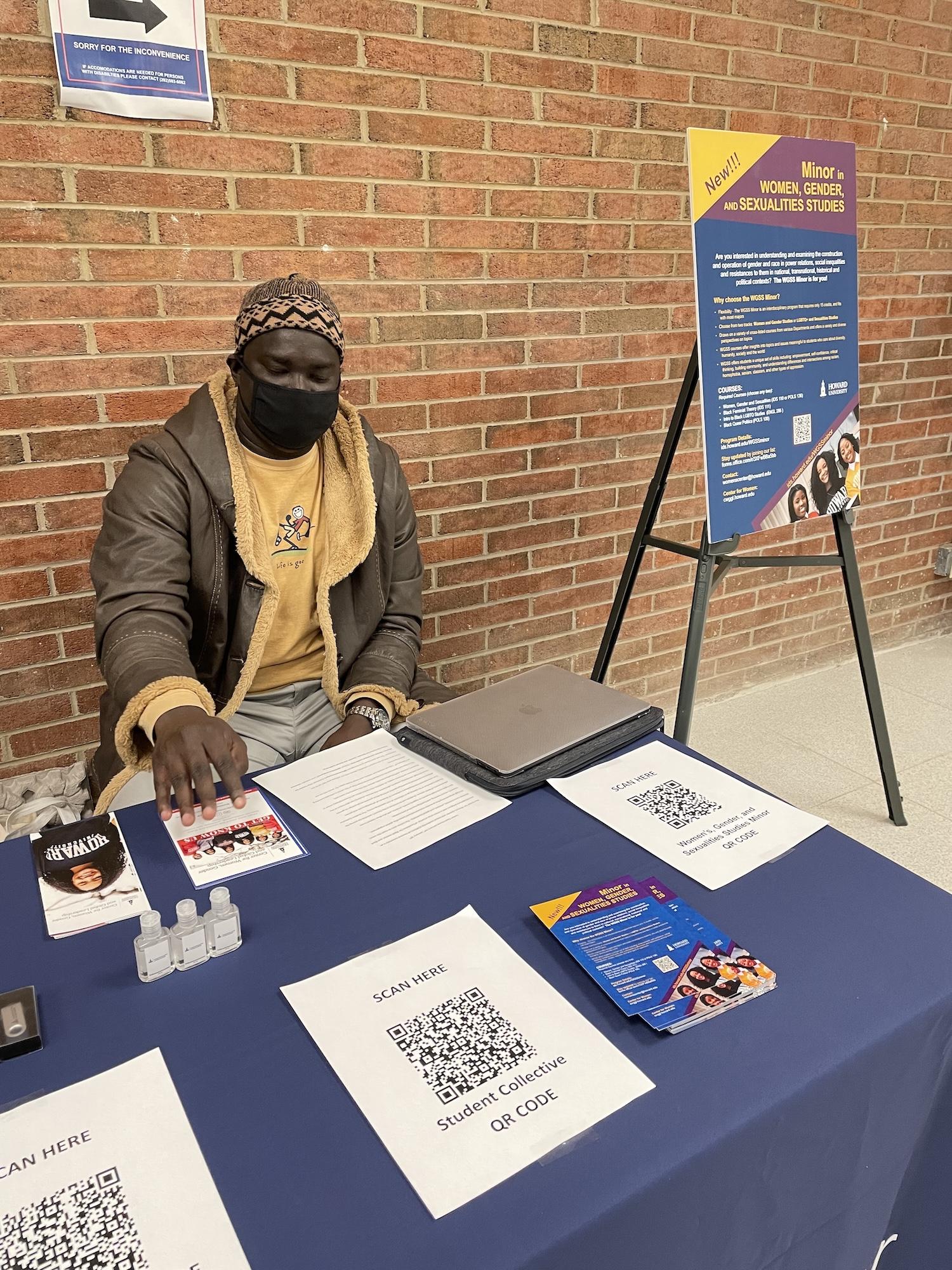
When he learned that Dawuni needed help launching the CWGGL, Moustapha immediately started working to help put some of her ideas into motion. In his years working with the Center, he helped to develop various student and faculty programs, publish research, and host events with distinguished speakers from around the world. He also contributed to the publication of a 20-chapter document chronicling the historical trajectory of women at Howard.
“Moustapha was a God-sent gift to me,” said Dawuni. “In 2020, I had $1 million in hand but no human capital to start building the Women’s Center. My department chair at the time, Dr. Ravi Perry, ‘loaned’ Moustapha to help me, and he was central to building the Women’s Center. He also developed excellent research skills and continued to work with me as a research assistant on my $725,000 National Science Foundation grant. I have no doubt he will excel in any career he chooses. He will be an asset to his employer.”
“Whenever I pass by the center, I feel a huge sense of pride because the center is there to highlight the intellectual contributions of Black women,” Moustapha added. “I owe Dr. Dawuni a lot for allowing me the opportunity to work on the center with her. When I got to Howard, I was an inexperienced graduate student coming from a different state, but she believed in me and I am so proud to have been a part of this important work.”
Papa’s Journey
Papa, on the other hand, experienced his greatest successes as a teaching assistant (TA) at the university. He started by teaching introductory biology courses and, after much success, was later promoted to teaching more advanced undergraduate courses. The class Papa was most proud to have taught was “Pathogenic Bacteriology,” a course he last taught in 2023.
“Not only was I selected as a TA, but the professor had so much trust in me, that he let me lead most of the teaching for that class,” said Papa. “Since teaching that course, I’ve had students reach out to me for letters of recommendation and have had students go on to medical school. My proudest moment was at a Commencement ceremony when a few students who I taught in their freshman year came up to me to introduce me to their parents and [told] me about the impact I had on them. It humbled me that even the smallest contribution to someone's education can reach horizons that you didn't even expect.”
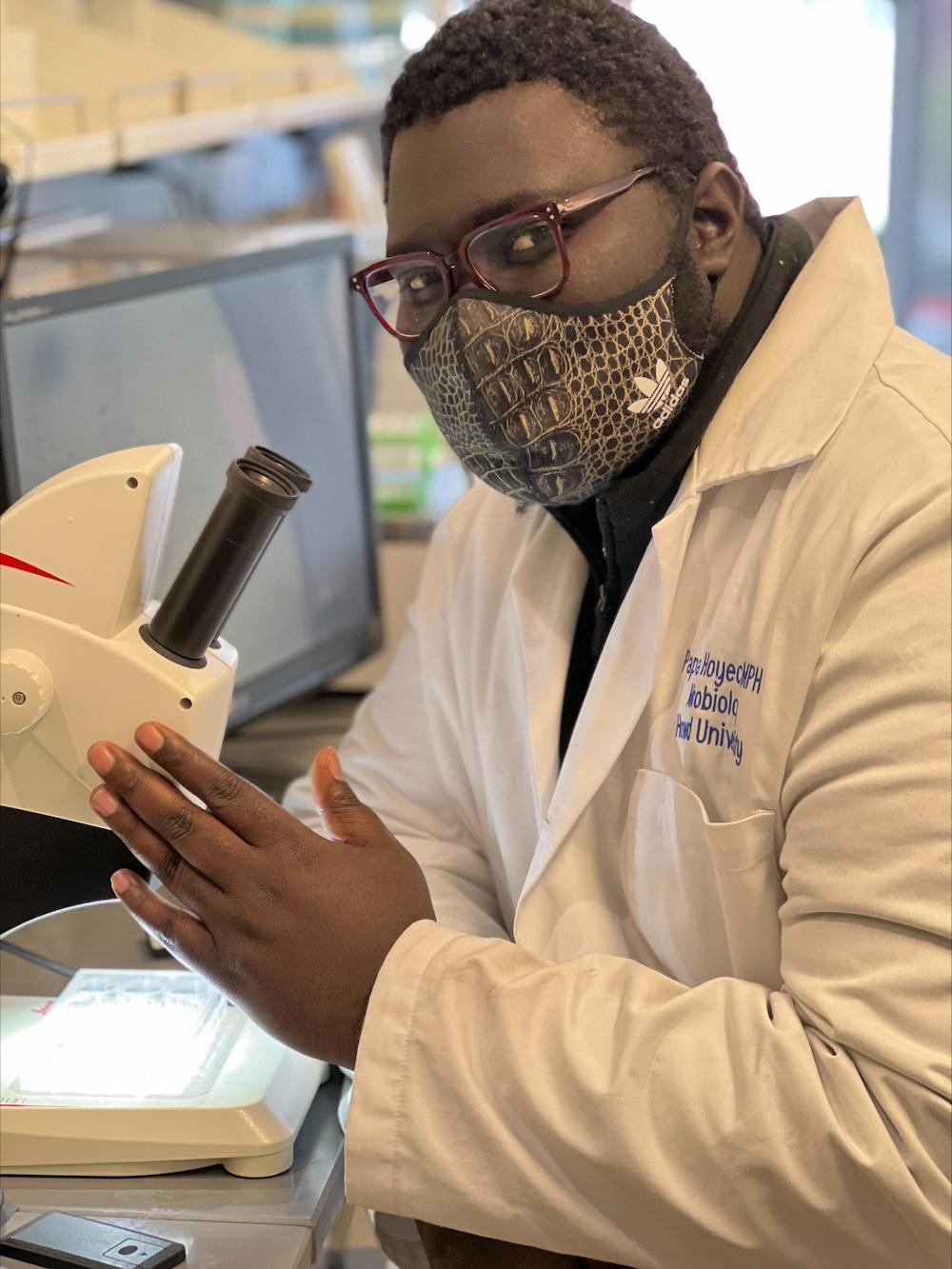
Papa also had the opportunity to be the medical microbiology instructor for the Summer Health Professions Education Program, a summer program designed to prepare undergraduate students from around the country to pursue professional medical degrees. It was the first time he was fully responsible for designing a course.
“I had the pleasure of teaching Papa as a sole student in several of our first-year classes in the microbiology Ph.D. program, during the first part of virtual learning at the start of the COVID-19 pandemic,” said Karl Thompson, tenured associate professor of microbiology. “Papa proved to be an astute learner, despite the challenges created by the newly established virtual learning modalities that we were both adjusting to. Over time, Papa demonstrated intellectual maturity and intellectual bravery as a developing scientist and graduate student. Most importantly, he proved to be a trusted role model for undergraduate and junior graduate students in the microbiology and biology departments. These achievements are all testaments to his perseverance against all odds and potential to impact society with his newly developed scientific investigational and teaching skills.”
This weekend, the Hoyeck brothers will graduate from Howard’s Graduate School with their doctorate degrees after a long 12-year educational journey. Moustapha will receive a Ph.D. in political science with a focus on International Relations and Comparative Politics. His dissertation research explored why the Economic Community of West African States (ECOWAS) is failing to prevent military coups in West Africa.
Papa will receive a Ph.D. in microbiology. His research investigated the effect of ferroportin FPN Q248H mutation, a mutation prevalent in African Americans and sub-Saharan Africans, on HIV-1 infections.
“I want to give a major shout out to my brother,” said Moustapha. “We did this together and I know that if I was alone on this journey, maybe this success would not have happened. I also want to say thank you to our wives and families. At the times when I wanted to give up, they gave me the motivation to keep going.”
Keep Reading
-
 Legacy and Lineage
Perfect Performance: Nearly 200 Howard University Class of 2026 Graduates Earned a 4.0 Grade Point Average
Jun 22, 2026 11 minutes -
 News
NewsHoward University Alum Jayson Johnson Named to 2026 Cohort of Knight-Hennessy Scholars
May 19, 2026 2 minutes -
 Commencement 2026
'We Thrived': Howard University’s Class of 2026 Steps Into a World That Needs Truth and Service
May 9, 2026 5 minutes