

Recognizing Howard’s Cultural and Academic Significance
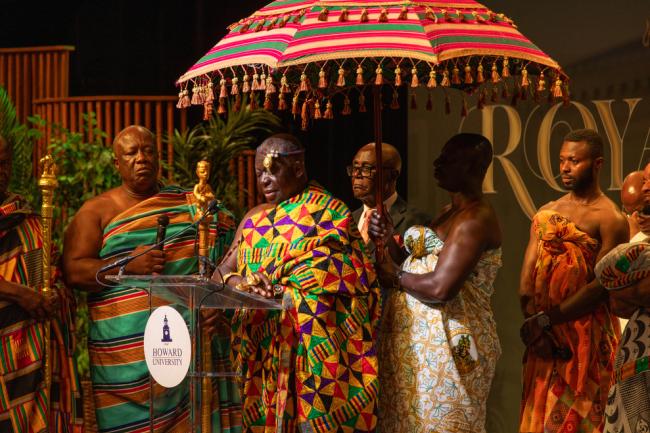
Tonija M. Hope (Ph.D. ’24), assistant provost for International Programs and executive director of the University’s Ralphe J. Bunche International Affairs Center, said during her 11 years at Howard, she could not recall a visit from a king. She referenced a famous visit from Emperor Haile Selassie of Ethiopia in 1956, when he received an honorary Doctor of Laws (LL.D.) degree.
Hope and the Bunche Center worked with the Millennium Excellence Foundation, an institution celebrating leadership, innovation, and nation-building across Africa and the global diaspora, to make the Asantehene’s Howard visit possible, in conjunction with the University’s Center for African Studies, Department of African Studies, Department of Afro American Studies, the Office of the Provost, and Ghanaian Student Union.
The visit materialized because Hope said the Asantehene recognized the cultural and academic significance of the University.

“It was important to him. They wanted to make sure the king was able to engage the Howard community,” said Hope. “The king deeply recognizes how important it is for him to speak at a place as iconic as Howard University if he is in Washington, D.C., so they reached out to me. They’re going to do the big ceremony at Bowie State University on Saturday, but it was clear that he also had to do something at Howard.”
She added that the visit is just as important to the Howard community as it is to the Asantehene, especially to the students but also faculty, staff, and alumni.
“A lot of people don’t know or don’t remember there are traditional rulers in Africa who are incredibly significant and influential. But just because we don’t hear about the King of the Ashante on the news like we hear about King Charles does not mean that he’s any less royal or less important,” said Hope. “I think it’s important for us to celebrate and recognize and honor our own.”
Reputation Transcends Borders
The Asantehene’s decision to deliver his lecture at Howard this week is unsurprising. Howard’s global impact, since its earliest years, has been as far reaching as it is transformative. The impact is seen in a myriad of ways, which includes royal visits to the campus, along with diplomats, scholars, and researchers from around the world.
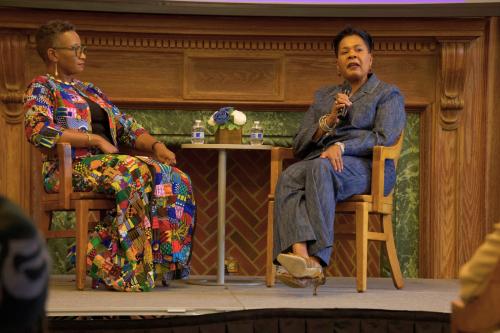
The same day Howard hosted the Asantehene, Her Excellency Paula-Mae Weekes, the former president of the Republic of Trinidad and Tobago and its first woman president, participated in a fireside chat at Founders Library in an event presented by the Center for Women, Gender and Global Leadership.

While those visits reflect Howard’s longstanding role as a global center for intellectual leadership and ties to Africa and the broader African diaspora, the reach also extends to other diverse locales. Earlier this year, King Charles III hosted Wayne A. I. Frederick (B.S. ’92, M.D. ’94, MBA ’11), Howard’s interim president, president emeritus, and Charles R. Drew Professor of Surgery, and Hope at an event at St. James’s Palace in London honoring the winners of the Queen Elizabeth Prizes for Higher and Further Education. Frederick and Hope were in place as special invited guests.
But it is not simply about lining up alongside royalty. The global impact is evidenced regularly by the University’s focus on providing opportunities for students to travel abroad, drawing international students to campus and housing several international student organizations; and hosting collaborative events and workshops with partners from foreign territories.
“For many of the same reasons that Howard is the iconic institution that it is in the United States, its reputation transcends borders,” said Hope.
Howard’s Study Abroad Opportunities
Study abroad programs at Howard are the most student-facing examples of the University’s global reach, allowing students to travel internationally for learning and engagement opportunities. The University’s study programs and opportunities are coordinated through the Ralphe J. Bunche International Affairs Center and through individual colleges and schools.
Howard’s study abroad opportunities for students includes the HU Bison Abroad program. The University-led HBCU Symposium on Internationalization has played a major role in global learning.

The annual symposium, organized by Hope around the framework of Black internationalization, focuses on sharing best practices, building equitable partnerships, and charting next steps to expand global learning across HBCUs. During the 2025 symposium, Frederick stressed the need for HBCUs to normalize access to international learning, and insisted campuses work on international learning. He insisted that campuses work to ensure that students’ zip code or family income never stop students’ potential participation in exchanges abroad, research, or internship opportunities.
“Global engagement is not a luxury; it is a necessity,” Frederick said, who added that durable funding, public-private partnerships, faculty champions, and sustained storytelling were among the things essential to why HBCU global education is vital to competitiveness and problem-solving.
The number of programs and symposiums help promote cross-cultural dialogue, facilitate deeper scholarship and engagement on global issues, and prepare students for careers in international leadership and service.
For some, the story of students’ participation in international programs starts with passports, which has hindered some students from studying abroad. To ensure students obtain passports, the College of Arts and Sciences has a Free Passport Drive that in 2025 assisted 250 students in applying for passports, allowing the students to further their global pursuits.
“We want to make sure our students have the keys to the world, and it starts with having a passport. It’s not just a Howard thing but the U.S. in general where people don’t have passports,” said Hope.
Students, passports in hand, have been able to benefit from the Howard University Alternative Spring Break (HUASB), coordinated through the Andrew Rankin Memorial Chapel. For over three decades, HUASB has empowered communities and dismantled disparities across the nation and worldwide with student-led service.
Providing students with opportunities to travel internationally has proven award winning. Howard’s success with global academic achievement was recognized in 2025 when six graduates were awarded the prestigious 2025-2026 Fulbright U.S. Student Program grants, allowing them to travel to six different countries for teaching, research and graduate study opportunities.
The University’s School of Education received the “Best Practice Award in Support of Global and International Perspectives” from the American Association of Colleges for Teacher Education (AACTE) in 2024 for its global initiative in which elementary education students worked in underserved communities in Colombia to engage with local officials, do community service work and more.
Rise in Study Abroad Interests
Hope said about 65 Howard students are studying abroad during the fall 2026 semester, such as junior Stanley Scott who’s currently spending the 2026-2027 academic year at the London School of Economics and Political Science. Scott was named as the 2026-2027 English-Speaking Union (ESU) Luard Morse Scholarship recipient, which provides selected recipients with a scholarship to study at a university in the United Kingdom.
The 65 study abroad students is a high number of students by Howard’s standards, though not nearly as high as Hope would like. That number tends to trend higher during the spring semester.

“A lot of students want to be here for homecoming, or they don’t want to go away if they’re pledging a fraternity or sorority,” said Hope, “so 65 [students] in the fall is a substantial number for us. There is an increase interest in it, but there’s always a lack of resources.”
Hope met an alum recently who told her he was slated to study abroad in Ghana but never went because he did not have airfare.
“We see that. Students think they don’t have the money to be able to go, but I would argue sometimes it’s less expensive to study abroad than it is to be at Howard in the first place. If the program is $9,000 to go to the Dominican Republic for the semester, Howard is not charging you whatever you were supposed to pay Howard for the semester. They’re only charging you the cost of the program. There is a program for everybody at every price point. I think a lot of students don’t know that,” said Hope.
Long History of International Student Enrollment
Howard’s history with educating and engaging with international students dates as far back as the institution’s earliest days not long after its 1867 founding, Wutoh said during his remarks at the Asantehene’s lecture Aug. 25.
“Within five years of the founding of the University, (in 1872) we graduated our first group of international students, which included one from Prussia, one from the West Indies and one who listed his address as Cape Coast Castle, Gold Coast, modern day Ghana,” said Wutoh.

Hope pointed out that in 1896, the University welcomed seven Korean students who arrived on campus after escaping political unrest in their native land. Their first night on campus, they performed a harmonious a capella set of songs to onlookers and drew the attention of a noted ethnologist, who later recorded three of the students’ songs on wax cylinders, making it the earliest known recordings of Korean music in the world. One of those songs, “Arirang,” is housed at the Library of Congress, which identified the three students as Ahn Jeong-Sik, Lee Hee-Cheol, and Son Rong.
“Arirang” is also the title of the latest album by the popular Korean boy band BTS. In an animated trailer promoting the album, the Korean students are depicted singing in front of the University’s Founders Library.
“These are the stories nobody really knows about until somebody like BTS goes ‘Oh by the way, there were seven Korean students at Howard in 1896.’ We’ve always been engaged with the world,” said Hope. “Those students couldn’t have gone anywhere else in the United States because they were not white Christian men. Howard was the place where people came.”
She added that freedom fighters from the African diaspora also came to Howard during turbulent times.
“It was a beacon to the Black world that this is where you should come, and when you leave here, you’re going to be ready to go home and fight for the independence of your country, or build the next great thing.”
The number of new international students studying at Howard during fall 2026 is not known yet as they are still arriving on campus, with the newest incoming class representing 67 countries. But continuing international students hail from countries including Nigeria (91), Jamaica (59), Nepal (28), the Bahamas (26), Ghana (26), Ethiopia (24), Canada (17), Trinidad and Tobago (17), Kenya (16), and Saudi Arabia (14), among other countries.
Expanding Howard’s Global Reach
Howard’s global outreach is expanding and evolving, which Hope attributes to easier communication through social media and how the Howard brand is managed. Additionally, Hope said notable figures in entertainment and politics who graduated from Howard help illuminate that global reach since their names can serve as an entryway to the University.

“They may not know Howard by name,” she said of people from some territories, which often prompts her to drop names. “But when you say, ‘Oh, Chadwick Boseman went there,’ their eyes pop out of their heads. Say ‘Kamala Harris went there’ and it changes the conversation of who we’re dealing with.”
Hope continued, “I have used that in conversations with institutions that want to partner with us. Institutions from all over the world reach out to us all the time. We can’t build partnerships with every institution. We must be discerning to some level, particularly if we want our students to go to that institution, and it has to be of similar caliber to us. People engaging us may not fully understand that. Sometimes people think this is a Black institution and therefore may be inferior. But let me assure you, the immediate past vice president of the United States is a graduate of this institution.”
Hope said what attracts international students to Howard varies from country to country depending on that country’s knowledge of the University. But amongst Black international students, it also includes the student’s ability to engage with Black brilliance at every turn, and seeing themselves unlike ever before.
“Black culture engages globally. People want to engage in Black culture, and where better to do that than Howard.”
Top photo: His Majesty Otumfuo Osei Tutu II, Asantehene of the Ashanti Kingdom, (at the podium) at Howard University's Cramton Auditorium Aug. 25, 2026. Photo by Anthony Cabbagestalk/Howard University
Keep Reading
-
 Global and Diaspora
Former President of Trinidad and Tobago Visits Howard University for Fireside Chat on Global Leadership
Sep 3, 2026 6 minutes -
 Legacy and Lineage
Class of 2030 Begins Howard University Journey with 14th Annual ‘Day of Service’
Aug 14, 2026 7 minutes -
 News
NewsFor Howard Students and Faculty, International Women in Engineering Day Is Everyday
Jun 23, 2026 4 minutes