


Howard University will lead a new $4 million, four-year initiative aimed at preparing students and faculty to work responsibly with artificial intelligence, as colleges nationwide grapple with how AI is reshaping classrooms, research, and the workforce.
The project, known as ASCEND-AI — Advancing Student and Collaborative Educator Networks for Digital AI Integration — brings together Howard University and Bowie State University in a cross-institutional partnership designed to strengthen AI literacy while emphasizing academic integrity, ethical use, and critical evaluation of AI-generated content. T

The initiative is led by LaTanya Brown-Robertson (BA ’96, MA ’98, Ph.D. ’03), associate dean for academic innovation and student success in Howard’s College of Arts and Sciences. It is supported by a grant from the U.S. Department of Education.
ASCEND-AI will serve about 400 undergraduate and graduate students and 50 faculty members each year across both campuses, with plans to expand training to secondary school teachers beginning in the third year.
“AI is already shaping how people learn, work, and make decisions,” she said. “The question is whether we are going to be a part of where this is going in terms of skills and jobs? We have to understand how these trends are going to affect the economic outcomes of our students, as well as our institution and our society.”
Brown-Robertson said ASCEND-AI will be centered on a faculty learning community model. Faculty participants from Howard and Bowie will receive training and support to integrate AI-related modules directly into their existing courses, rather than treating AI as a standalone subject. Instructors will be encouraged to work collaboratively.
Earlier this week, Howard University announced a new applied artificial intelligence course developed with industry partners, expanding its AI footprint as an R1-designated research institution and giving students hands-on experience with real-world tools, ethical frameworks, and workforce-ready skills.
“Meeting the AI challenge is a national imperative, and Howard University is answering that call in partnership with Bowie State University,” said Talitha Washington, Ph.D., executive director of the Center for Academic Data Science and Analytics and co-chair of the AI Advisory Council at Howard University. “Together, we are leading with purpose by ensuring that artificial intelligence strengthens education, upholds academic integrity, and prepares our students to thrive in a rapidly changing world.”
Over the grant period, the partnership will focus on five core areas: building foundational AI literacy; promoting responsible use and academic integrity; developing skills to detect AI-generated misinformation and hallucinations; tailoring AI instruction to specific disciplines; and exploring AI-driven entrepreneurship and innovation.
Students are reached through coursework rather than separate programs, Brown-Robertson said. As faculty redesign assignments and learning activities, students would in turn apply AI concepts in their classwork. Under the model, faculty won’t be asked to abandon what they teach.
Each year, the program will host three large-scale collaborative workshops bringing students and faculty together from both campuses. The workshops will include AI-use competitions highlighting innovative applications in research, teaching, and problem-solving, with secondary school educators joining the competitions in later years.
Brown-Robertson said Howard’s focus will center on humanities, social sciences, and natural sciences, while Bowie State will emphasize business and health sciences. The collaboration builds on Bowie State’s established faculty learning community framework, which Brown-Robertson previously helped develop during her tenure there.
Brown-Robertson sees the grant as a foundation rather than an endpoint.
“This is a proactive move,” she said. “AI isn’t optional anymore,” she said. “It’s up to institutions like ours to shape how it’s used thoughtfully, critically, and ethically.”
Join the ASCEND-AI Initiative: Additional information about partnering with ASCEND-AI, can be found here.
Special Note: The contents of this web page were developed under a grant from the U.S. Department of Education. The Education Department does not mandate or prescribe practices, models, or other activities described or discussed in this document. The contents of this web page may contain examples of, adaptations of, and links to resources created and maintained by another public or private organization. The department does not control or guarantee the accuracy, relevance, timeliness, or completeness of this outside information. The content of this web page does not necessarily represent the policy of the department. This publication is not intended to represent the views or policy of, or be an endorsement of any views expressed or materials provided by, any Federal agency.
###
Related Story
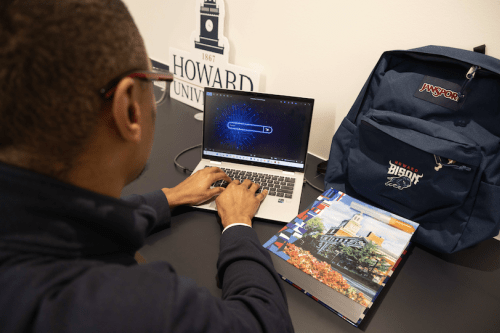
Howard University Teams Up with Industry Experts to Launch Transformative Applied AI Course
Keep Reading
-
 *Accolades
Howard University CEA Professor Sonya Smith Elected to AIAA Class of 2026 Fellows
Sep 28, 2026 3 minutes -
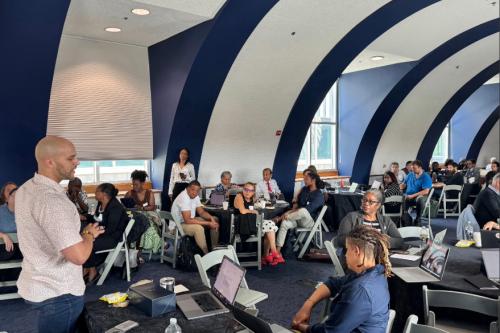 Artificial Intelligence
Howard University Launches Its First AI Certificate Program for Undergraduate Students
Aug 20, 2026 4 minutes -
 Legacy and Lineage
Howard University Honors Retirees, Inaugurates Academic Year at 159th Opening Convocation
Sep 25, 2026 6 minutes