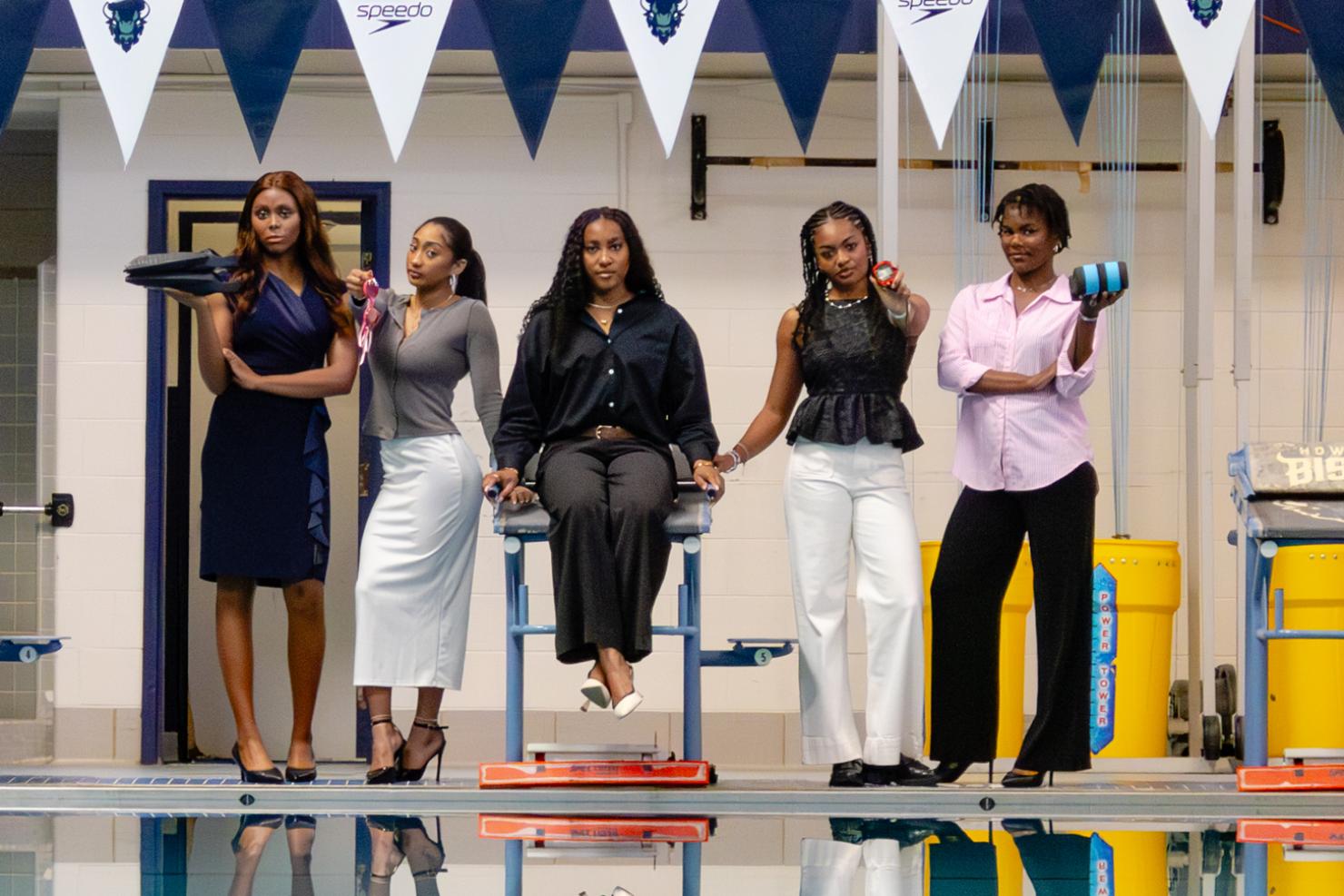
Sacrifice is nothing new to Debnam, who said that sacrifice is common to competitive swimmers. Being around teammates who all understood each other wasn’t always her experience, however. At Howard, she found a swim family who weren’t afraid to show tough love for one another and keep each other accountable.
“Growing up in this sport of swimming, something that you're used to is giving up a lot of things and making the sacrifices,” Debnam said. “I feel like coming here wasn't really any different. I think, instead, it was just coming into a more supportive environment because most of us came from environments where we were one of few or one of the only, so the teammates that we were around weren't able to fully understand or uplift us in the way that we needed. It made the sacrifices that much more meaningful because we were able to be around people who also were sacrificing the same things and also able to understand us in a deeper way and uplift us in the way that we needed.”
Especially as they have gained notoriety this season, the team members are aware they are history makers. That visibility has added to their motivation, and they see themselves as a bridge that will help more people engage in the sport they love. They have embraced their role model status and hope they can inspire others by their example.
“I think a lot about all of the people in this program who have come before me, and all of the people who look up to us — a lot of the Black girls who come to the ‘Battle of the Burr’ and senior meets and any of our home meets,” said Jackson. “There's so many people who genuinely look up to us — just doing what we can to make their journey easier to inspire people to motivate more black people, not younger people, but just all black people in general, to become water safe, to get in the pool, to even try competitive swimming, to even try diving for the first time — is really what gets me through the practices.”
Howard’s swim team belies the stereotype that Black women do not swim, but, whether the narrative is the catalyst or the end product, it does have ring true at some level. According to the Centers for Disease Control and Prevention (CDC) drowning deaths among Blacks under thirty are 150% higher than for whites in the same age group, and Black children aged 10-14 are 7.5 times more likely to drown in a pool when compared to white children. The reason for the disparity appears to be simple — many Blacks simply don’t know how to swim. An article in “Psychology of Black Womanhood” posits that 70% of Black women have little to no swimming ability.
More than a third of Blacks, 36.5%, reported not being able to swim, a rate more than five times greater than the number of whites. That could be because fewer than 37% of Blacks have ever taken a swimming lesson, as opposed to more than half of whites. Like many things, an inability to swim often becomes part of intergenerational family cycles. USA Swimming reports that only 13% of children will learn how to swim if their parent doesn’t know how, so the cycle continues to perpetuate itself.
Some of the reasons for the disparity have obvious roots in historic inequities. As explored by NPR, Blacks and whites were not allowed to share pool water during the Jim Crow era, so Blacks were often denied access to pools in towns were there was just one. Race riots erupted when Blacks tried to swim in public pools, and it took a Supreme Court decision for Blacks to be granted equal access to private pools. In the 1920s, Congress eliminated Washington D.C.’s segregated Tidal Basin Beach rather than fund its integration.
People are also more likely to learn how to swim in more expensive homes with pools, and systematic economic disparities work against Black aspiring to buy homes in more elite neighborhoods. Swim lessons also often cost money, so again, the lower incomes that have dogged the Black community have ramifications regarding health, safety, and recreation.
Beyond drowning prevention, swimming has numerous mental and physical health benefits. It is one of the best forms of exercise. It has cardiovascular benefits and helps improve heart and lung strength. Swimmers simultaneously engage arm, shoulder, back, leg, and core muscles and can exercise for longer periods of time. The physical health benefits can add years of life and swimming can also reduce anxiety and stress. A study by Australia’s Griffith Institute for Educational Research found that swimming led to significant advantages for infants in developing motor, math, literacy, and verbal communication skills.
Among all races, women are significantly more likely to report that they can’t swim, according to the CDC report. Historical, economic, and geographic barriers to swimming proficiency all play a role, but there is one elephant in the room for Black women that is hard to ignore. Many Black women just don’t want to get their hair wet and especially do not want to their hair exposed to chlorine.
Many people of African descent have hair that is thick and curly, apparently an early evolutionary adaptation to protect against ultraviolent radiation, giving it an “afro” appearance. Thick and curly hair doesn’t retain water particularly well, and is prone to dryness, especially after water evaporates. Dry, thick hair is often difficult to groom and style and can fray and break. In an article by Nora Jones, Ph.D. and Candrice R. Heath, M.D., an associate professor in Howard College of Medicine’s Department of Dermatology, the scholars point out that hair care for Blacks carries particular familial and social importance and can often involve a multistep process that can take hours.
“Beliefs, attitudes, and behaviors around Black hair have structural roots in the fact that tightly coiled hair is more prone to dryness and breakage, requiring intentional hair-care actions to preserve the integrity of the hair,” wrote Jones and Heath.
Hair is technically categorized by type and texture. Straight hair is categorized as type 1 hair, while curly and coiled hair are categorized as types 3 and 4, respectively. Fine, or thin, hair is categorized by the letter A, while thicker hair carries the letter B.
“There's definitely been challenges, both in my personal life and in my friends' lives, trying to convince my friends to get in the pool and swim just to be more water safe,” said Benoit. “Having 4C, 4B, or any type of coil or crow in her hair being in the water can definitely strip your hair of oils, so I can definitely see why Black women already don't want to get their hair wet and especially seeing the current stigmas around curly hair and coyly hair and being a Black woman, especially in a professional space. So, it's not necessarily a myth.”
Chemicals, sometimes accompanied by expensive hair styling are often used to moisturize hair and make it easier to groom. A more aggressive chemical process may be used to straighten hair, often using the “relaxer” sodium hydroxide, or lye. Mixing the alkaline-based lye with the acidic chlorine can cause a corrosive chemical reaction, producing salt which can damage hair and even cause it to shed.
Africans and Black Americans have long embraced hair styling as a form of expression. Braids, locs, twists, bantu knots, cornrows, curls, shapes, fades, and afros have been used to communicate not just personal panache, but also to signify marital availability, group belonging, spirituality, political resistance, social status, and more. During the age of Western colonization of Africa and the concurrent slave trade, however, curly natural African hair began to be stigmatized as inferior as a tool of racial diminishment.
“For Black women, hair is never ‘just hair,’” said Nicole Dezrea Bao, Ph.D., an assistant professor in Howard’s Department of Sociology and Criminology. “Historically, in many African cultures, hairstyles were intricate markers of identity, indicating age, marital status, religion, wealth, and rank. Today, we often refer to hair as a ‘crown,’ reflecting both its royal ancestral roots and its connection to the crown chakra, the seat of spiritual connection and the divine.”
“However, Black women must also navigate the "white gaze," where their bodies function as a site of strategy. Choosing a hairstyle for a job interview is often a high-stakes decision; research consistently shows that Black women face economic consequences and are perceived as "less professional" when wearing natural textures, braids, or locs. This is why the CROWN Act — ‘Creating a Respectful and Open World for Natural Hair’— is so critical. While it has been adopted in over 20 states, it is not yet federal law. Until it is, wearing natural hair remains an act of resistance and self-love against a backdrop of systemic policing.”
There is ample evidence that the straightening of hair can be correlated with the glamorization of the straight, thinner hair associated with Europeans, but today, Black women are as likely to set style trends then to follow them. Black women certainly have the agency to wear their hair any way they want, and their choices embrace a wide variety of creative styles, from natural, chemical-free hair to chemically straightened chair to braids and weaves. Regardless, the often intricate styles can be destroyed by the pressure of the water, along with the chlorine and salt.
“The ‘fear’ is actually a practical calculation of time, labor, and capital,” said Bao. “This is often passed down through maternal lines. Many of us remember being children and being warned not to "sweat out" or "ruin" our hair after it was freshly done for church or school. This phenomenon was poignantly captured in the film ‘Nappily Ever After,’ where the protagonist’s childhood is defined by sitting on the sidelines of the pool to preserve a pressed look. It is reasonable because, for Black women, hair maintenance is an investment in both social capital and self-preservation. When you consider the hours spent in a stylist's chair and the significant financial cost of professional hair care, "protecting the style" is a matter of respecting one's own resources. Furthermore, in a world where Black women's bodies are constantly policed and scrutinized, maintaining one's hair is a way of reclaiming agency and presenting oneself with dignity and intention. Researchers have indicated that this isn't limited to swimming. Many Black women and girls may avoid high-intensity physical activity in school or gym settings to maintain their hair. It is a cycle of "maintenance and policing, "because society demands a certain aesthetic for Black women to be respected, the labor required to maintain that aesthetic often comes at the cost of physical recreation and health.”
Bao is leading research called “Global Crowns” that studies the political, emotional, and cultural dimensions of how Black women wear their hair around the world. She wants to shine a light on systematic discrimination against Black women who wear their hair in its most natural forms, but also to celebrate the power of the hair as an expression of resistance and pride.
“In my own research, I have found that Black women take an exceptional amount of pride and joy in their hair across the globe,” she said. “It is a marker of confidence and an element of binding sisterhood.”





 News
News Culture Creators: Arts and Entertainment