

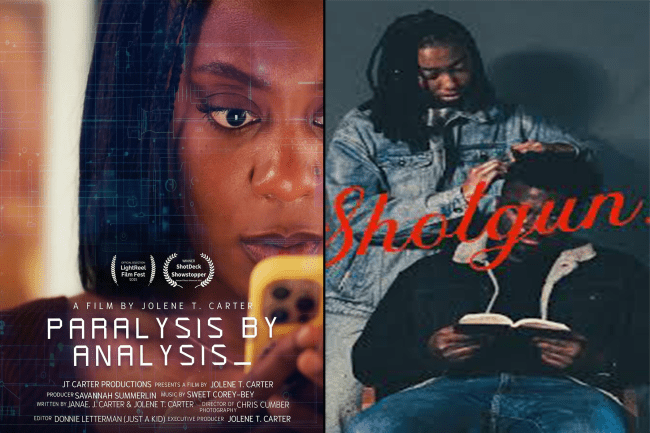
Did you know the third Saturday of every February is National Black Movie Day?
Created by Agnes Moss, founder and president of the National Black Movie Association, the day is a simple, but powerful call to action: watch, share, and support Black cinema, and in doing so help to strengthen representation and equity across the film industry.
Yes, we love the classics (see The Dig’s “Save The Culture” list of Black movie selections in case you need one, two, or a few to choose from). But as we head into National Black Movie Day on Sat., Feb. 21, we’re also excited to spotlight two emerging filmmakers from Howard University whose work is earning national attention.
Howard Wins Big at New HBCU Film Festival
Last month, two Howard-produced short films were announced winners of the inaugural HBCU Week NOW Student Film Festival: “Paralysis by Analysis” by Jolene T. Carter (MFA ’25) and “Shotgun” by Quaran Ahmad (B.Arch ’25).
The festival selected 10 winning films from a pool of 36 nationwide submissions, with each recipient earning a $5,000 award. The slate is currently available to stream on the HBCU Week NOW YouTube channel, part of a public media partnership led by Maryland Public Television and Black Public Media, with partners including WHUT-TV, Howard University Television.
Keep Reading
-
 News
NewsHoward University Honors Dr. James K. Fortson with Distinguished Alumni Award
Feb 13, 2026 4 minutes -
 Accolades
Howard Student Stanley Scott Named the 2026-2027 ESU Luard Morse Scholarship Recipient
Feb 12, 2026 3 minutes -
 News
NewsHoward School of Social Work Students Travel to Cape Town to Serve the Community
Feb 11, 2026 5 minutes