

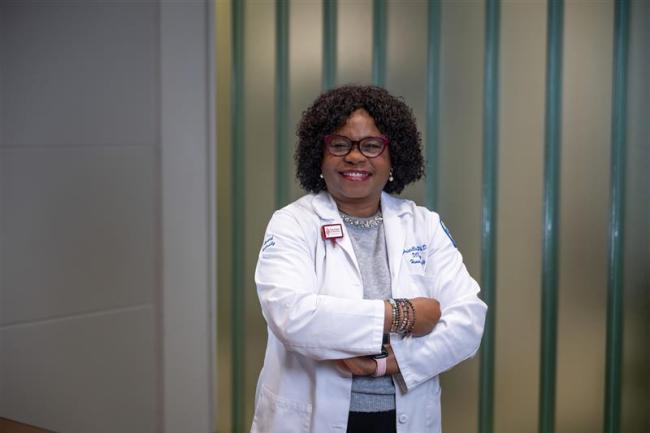
Howard University’s Priscilla Okunji, Ph.D., a nationally recognized nursing researcher and leading faculty member in the College of Nursing and Allied Health Sciences, is participating in a new multi-year program that trains researchers to study how people’s living conditions affect their health.
The Scholars for Applied Research and Impact (SARI) program is supported by a multiyear training grant funded by the National Institute of Nursing Research, the federal agency within the National Institutes of Health (NIH) that supports science to improve health and reduce illness through nursing-led research.
SARI is a cross-institution collaboration between Villanova University, Johns Hopkins University, and Howard University, the nation’s only historically Black university classified as an R1 research institution. Howard researchers in the program, under Okunji’s leadership, will study housing instability, food insecurity, educational disparities, and other systemic factors that contribute to health inequities.
If we want to close health gaps, we have to look beyond the hospital walls and into the systems that shape people’s lives."
“These are the conditions in which people live, work, and age that profoundly shape their well-being,” Okunji said. “If we want to close health gaps, we have to look beyond the hospital walls and into the systems that shape people’s lives. If we can prevent people from being ill, that’s better than curing them. Why not prevent them from being sick?”
Felecia M. Banks, Ph.D., the interim dean of the College of Nursing and Allied Health Sciences, praised the research grant initiative.
"This project aligns with Howard University’s R1 trajectory and the college's priority goal to increase competitive scholarly productivity," Banks said. “It fosters innovation across disciplines, seeks to translate scientific knowledge into practical applications, and demonstrates our commitment to reducing health inequities and improving health outcomes.”
The grant marks another major research achievement for the Nigerian-born scholar, who has trained dozens of Howard nursing researchers to confront, through science, the very disparities they understand firsthand. Despite being the backbone of health care, nurses often lack the time, training, and resources to conduct research.
“Nurses are doing so much in health care — we hold the health care system together — but we don’t have time to do research,” said Okunji, who joined Howard in 2009 as an instructor and earned her doctorate in 2010. She became assistant professor in 2013, associate professor with tenure in 2018, and was named full professor in 2024. “So this is one of the gaps we have to close.”
Okunji’s Path into Nursing Research
When Okunji joined her husband in United States with their children, she already held three degrees — two in microbiology and one in education. But starting over in a new country, especially in the sciences and health care, often means beginning again.
She enrolled at the University of Maryland in an accelerated bachelor’s program in nursing. There she discovered the emerging field of nursing informatics, a discipline she said she might never have encountered otherwise. That discipline became her calling as a researcher after her master’s in nursing informatics with a leadership minor.
Later, while studying for her dissertation at Trident University in Cypress, California, Okunji remembers two of her committee members, Frank Gomez, Ph.D., and Mihaela Tanasescu, M.D., introducing her to a revelation: she could use already collected datasets from national inpatient stay (NIS) databases to answer research questions without undertaking new data collection.
She used the NIS datasets of inpatients with myocardial infarction and type 2 diabetes as the study population. The big data approach launched a prolific vein of research that has spanned more than 60 publications, book chapters, including a textbook in Nursing Informatics.
Expanding the Nursing Research Pipeline
The SARI program is designed for nursing doctoral students, early-career faculty, and mid-career nurse scientists. The grant will run for three years and will support two cohorts of scholars.
Okunji leads the initiative as the principal investigator and director. Other Howard collaborators include Devora Winkfield, Ph.D., interim associate dean and chair of the Division of Nursing; Thomas Fungwe, Ph.D., associate dean; and Nkechi M. Enwerem, Ph.D., associate professor, each bringing expertise in health equity, clinical research, and community engagement.
Student researchers in SARI receive funded course enrollment, travel support for a week-long summer intensive, one-on-one mentoring from experts, and a certificate in systemic and institutional factors research upon completion. Scholars will also receive guidance on NIH grant applications, dissertation proposals, and peer-reviewed manuscripts.
“We really need the younger generation,” Okunji said. “Without research, no discipline can exist. So, we need to sustain the discipline of nursing.”
Over her 16 years at Howard, Okunji has mentored dozens of students and junior faculty in grant development, artificial intelligence and machine learning research, and health equity methodology. Many now hold leadership positions at NIH, in the military, and in major hospital systems. She also initiated, developed and implemented the Howard’s RN-to-BSN online program in 2010 which she coordinated till 2016.
The SARI program extends that mentorship mission nationally. Scholars who complete the program will become ambassadors, recruiting future cohorts and advancing research on social determinants of health.
“I am here to make a difference, to continue mentoring students — undergraduate, graduate, doctorate — and junior faculty,” Okunji said. “This is what the SARI grant is for.”
###
Keep Reading
-
 *Accolades
Howard University CEA Professor Sonya Smith Elected to AIAA Class of 2026 Fellows
Sep 28, 2026 3 minutes -
 Epiphanies, Discovery, and Research
Howard University Doctoral Student Receives Competitive Dissertation Fellowship, Examines Faith in Educational Experiences of Black Students
Sep 4, 2026 5 minutes -
 Epiphanies, Discovery, and Research
Howard University Chemical Engineering Professors Secure Nearly $1M DoD Award to Expand Bioindustrial Manufacturing Research and Student Training
Sep 1, 2026 4 minutes