

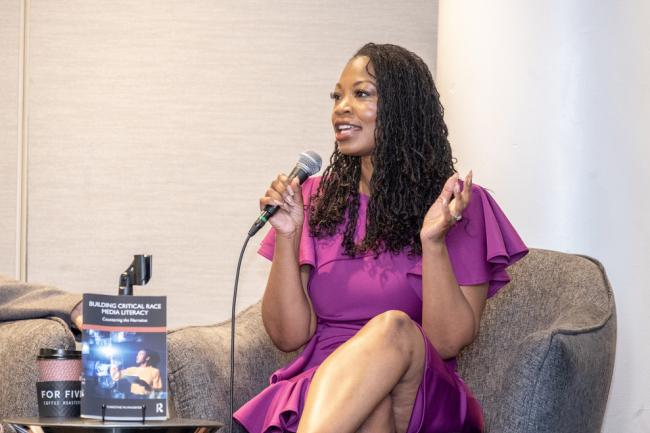
Critical media literacy that accounts for race and focuses on understanding and critiquing systematic racial inequalities within media is needed now more than ever, says Howard University associate professor Christine McWhorter, Ph.D, Department of Media, Journalism, and Film.
McWhorter is author of the new book “Building Critical Race Media Literacy: Countering the Narrative (2025; Routledge). She defines "critical race media literacy" as a set of skills that help people understand, evaluate, and combat harm in media.”
“The book looks at the ways media harms people of color through negative representation, inaccurate or incomplete histories, algorithms, racialized misinformation and disinformation, and the control powerful media owners have over what we watch, read and hear,” said McWhorter, who is teaching the Broadcast Journalism and Advanced Broadcast Reporting course this semester. “Media has enormous power over how we see other people and understand the world. I wanted to give people tools to recognize when that power causes racial harm and challenge it.”

McWhorter brought the book to the National Association of Black Journalists' recent 2026 Convention & Career Fair in Atlanta, where she participated in the NABJ Authors Showcase & Bookstore. All available copies sold out.
The conversation surrounding the book at NABJ encompassed topical media issues such as how Nolan Wells, the 18-year-old who was found dead after hanging out with his high school friends off the Mississippi coast July 4, is being covered by Black media versus mainstream media. Other conversation points included how race shows up in AI, the ways media narratives shape how Black people are seen, and the responsibility of Black journalists today.
Nikole Hannah-Jones, Knight Chair of Race and Journalism at Howard and founder of the Center for Journalism & Democracy at the Cathy Hughes School of Communications, wrote the forward to McWhorter’s book. Prior to the book event at NABJ, the two scholars introduced the book to a Howard audience with a Feb. 9, 2026, book event at the Moorland-Spingarn Research Center (MSRC).
“I want the book to be a snap of the fingers, a moment where suddenly people see race, racism and media more clearly than they did before they picked it up,” McWhorter said.
“And then I want people to use whatever tools they have to push back. For journalists, that may be a pen, a camera or the way they frame a story. For educators, it may be the way they teach. For others, it may be the way they talk about what they see in the news, question a narrative or challenge the idea that ‘I don’t see race’ is somehow neutral.”
McWhorter talked more about her book and why critical race media literacy matters.
Q: What's the most important thing we need to know about critical race media literacy?
A: That everybody needs it. Race is not a side consideration that only becomes relevant when a story is explicitly about race. It can affect whose stories are believed, whose behavior is considered threatening, whose history is remembered, whose expertise is valued, whose pain receives attention and how entire communities are represented.
Q. What inspired you to write the book?
A: Part of the inspiration came from my years working in television. I saw firsthand how much power media has to shape people's understanding of the world. Media is one of our most powerful teachers because we often do not realize we are being taught.
The murder of George Floyd also shaped the book. In 2020, the country had an enormous conversation about race and racism. Companies issued statements. News organizations made commitments. People bought books and attended training. But then a sweeping backlash took hold, and Diversity, Equity and Inclusion (DEI) became dirty words.
That backlash made one thing clear to me: awareness is not enough. People need tools to recognize racism in media and challenge it. That became a major motivation for the book.

Q: Though “Building Critical Race Media Literacy: Countering the Narrative” is a textbook, how does the book exist outside the classroom?
A: I deliberately wrote it to be accessible beyond the classroom. I wanted a student to be able to read it, but I also wanted it to be useful to a parent, journalist, educator, content creator, or anyone who wants to better understand the media they encounter every day.
Q: How have your students received critical race media literacy?
My students respond very well to it because much of it gives them language for things they may already recognize or have experienced but have not necessarily had a framework for discussing.
It also becomes very practical very quickly. We are not just talking theoretically about representation or racial bias. We can look at an actual story and ask: Who is centered? Who gets to speak? What historical context is missing? What assumptions does this framing ask an audience to make? Could this story unintentionally reinforce a harmful narrative?
Once students begin asking those questions as part of the reporting process, they see how much power exists in every journalistic choice.

Q. Will you teach a course in critical race media literacy, or incorporate it into a particular course?
A. One of my biggest hopes is that I will eventually be able to teach critical race media literacy as a standalone course. I do not currently teach one, but I incorporate many of its concepts into my journalism classes. I teach students about the power they have as journalists to interrogate narratives, add historical context, question stereotypes and tell stories about racially marginalized communities in ways that are fair, accurate and true. For me, that is part of what responsible journalism requires.
Q: What can you say about the reception your book received at NABJ?
A: I felt humbled and incredibly grateful. The event was very well attended, the books available for the event sold out, and the audience was attentive and genuinely invested in the conversation. As an author, you spend so much time alone with the work that you really do not know how people will respond once it is out in the world. To have a room full of journalists show up, ask thoughtful questions, buy the book, and stay engaged in the conversation meant a great deal to me.
Top photo: Christine McWhorter promoting her book "Building Critical Race Media Literacy: Countering the Narrative" at the National Association of Black Journalists' 2026 Convention & Career Fair, Aug. 12-16, in Atlanta. Photo courtesy of Christine McWhorter
Keep Reading
-
 *Accolades
Howard University CEA Professor Sonya Smith Elected to AIAA Class of 2026 Fellows
Sep 28, 2026 3 minutes -
 Epiphanies, Discovery, and Research
Howard University Doctoral Student Receives Competitive Dissertation Fellowship, Examines Faith in Educational Experiences of Black Students
Sep 4, 2026 5 minutes -
 Global and Diaspora
Former President of Trinidad and Tobago Visits Howard University for Fireside Chat on Global Leadership
Sep 3, 2026 6 minutes