

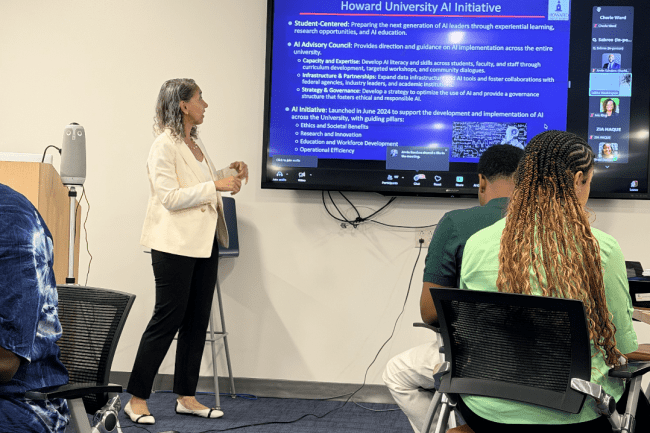
This summer, Howard University’s Talitha Washington, Ph.D hosted a multi-day event for faculty exploring how agentic artificial intelligence can transform teaching and learning. During the Faculty Bootcamp on Building AI Curriculum Across Disciplines event, an intensive design sprint hosted by the Howard AI Network and powered by Amazon's Machine Learning University (MLU), educators specializing in a range of disciplines from Howard and other universities gathered to learn how to bring AI into the classroom.
Supported in part by Amazon Web Services (AWS) and the National Science Foundation, the hybrid boot camp, held July 21–22, 2026, brought together faculty from disciplines spanning mathematics, education, music, entrepreneurship, environmental science, political science, health sciences and economics to examine how agentic AI can be thoughtfully integrated into the classroom.

Through hands-on workshops, participants worked on collaborative design sessions and technical demonstrations. Participants developed assignments, learning modules, and course materials that will help prepare their students for an AI-enabled workforce while also emphasizing ethical and responsible AI use.
Unlike generative AI, which creates content such as text and images in response to prompts, agentic AI is designed to complete tasks, coordinate workflows, and make decisions within established guardrails, all overseen by a human operator.
"Many of our students are entering a workforce that expects them to be AI ready, AI enabled, AI equipped," said Washington, executive director of Howard's Center for Applied Data Science and Analytics (CADSA). "There's an expectation that they know how to use AI. They also know how to use agentic AI."
Responsibly Leveraging AI in the Classroom
As an AI influencer in academia, Washington said the boot camp challenged faculty to think beyond simply using AI tools and instead challenged them to consider how students can responsibly leverage emerging AI technologies within their respective disciplines.
"We're diving into agentic AI, what it is, what it can do, thinking about guardrails, thinking about the responsible aspects of it, and then how do we create learning experiences for our students that resonate with their discipline, that resonate with their future job, and that resonate with this evolving AI expectation in the workforce," she said.
Throughout the program, faculty worked in interdisciplinary teams to design classroom experiences that incorporated agentic AI into assignments, projects, and course modules. Participants also developed student learning outcomes, assessment plans, and responsible-use frameworks before presenting their curriculum ideas during a final showcase.

Washington emphasized that AI literacy is no longer limited to technical fields and that nearly every discipline now intersects with the technology.
"We have music, to computer science, to education, to entrepreneurship, environmental science, health sciences, political science, mathematics, and economics," Washington noted. "I don't know what field, at this point, does not somehow interplay, interact, or employ AI."
Sessions throughout the boot camp explored the differences between generative and agentic AI, workflow design, responsible AI deployment, assessment strategies, and human oversight. Faculty also received hands-on experience using AWS-powered tools to build and evaluate AI agents while considering how these technologies can enhance teaching without replacing human judgment.
Washington acknowledged that agentic AI remains an emerging technology, but said thoughtful implementation is essential to realizing its potential in higher education.
"Agentic AI has not been around that long, and so to have questions and be curious about it, I think is normal and healthy," she said. "You have to think about what tasks you want it to do, develop guardrails so it doesn't go off the rails, test whether it's performing the way you want it to perform, and have checks and balances."
By the conclusion of the boot camp, faculty developed discipline-specific curricular materials designed to help students understand, evaluate, and responsibly apply agentic AI as they prepare for careers in an increasingly AI-driven economy.
"We're here for the novel and emerging technologies," Washington said, "and thinking about how we can create educational experiences for our students."
Keep Reading
-
 *Accolades
Howard University CEA Professor Sonya Smith Elected to AIAA Class of 2026 Fellows
Sep 28, 2026 3 minutes -
 Artificial Intelligence
Howard University Launches Its First AI Certificate Program for Undergraduate Students
Aug 20, 2026 4 minutes -
 *Upgrade
Howard University’s Campus Store Reopens in Grand Fashion with Its Biggest Renovation Ever
Sep 18, 2026 5 minutes