


Howard University electrical engineering assistant professor Fadel Lashhab, Ph.D., recently received a $500,000 award from the National Science Foundation to train K-12 Educators in robotics and automation.
The five-year project will serve a national need to equip STEM educators with innovative teaching strategies and hands-on research experiences. The focus of this project is to empower K-12 educators from underrepresented school districts in the Washington, D.C., metropolitan area.
In collaboration with Katherine Picho, Ph.D., Howard University associate professor of educational psychology, and Imtiaz Ahmed, Ph.D., Howard University associate professor of electrical and computer engineering, Lashhab will lead the efforts to integrate robotics and automation into K-12 curricula, inspiring students from all communities to pursue STEM careers, addressing systemic disparities.
"Our team is committed to advancing robotics and automation education through an innovative, accessible learning model," said Lashhab. "This project reflects our shared vision of empowering STEM educators and students with hands-on, inquiry-based experiences that connect directly to real-world technologies. This initiative will strengthen the pipeline of future engineers and deepen the impact of STEM education across our community."
Curriculum modules supported by virtual and physical labs including Howard University’s Autonomous Vehicles, Robotics, and Control Laboratory (AVRC Lab), are accessible through the AVRC Lab website, enabling nationwide replication and scalability. The curriculum emphasizes foundational robotics and automation concepts, supported by rigorous evaluation methods to measure changes in teaching efficacy, STEM self-efficacy, and classroom implementation.
Lashhab and his research team are also partnering with industry partner Quanser to provide participants with resources, mentorship, and research opportunities. Together they aim to train over 60 educators, integrating guided inquiry-based learning into classroom practices and developing replicable educational models.
Through its focus on teacher development, the project has the potential to significantly advance STEM education and contribute to a technologically proficient workforce. This project is supported through the Robert Noyce Teacher Scholarship Program (Noyce).
About the Noyce Program
The Noyce program supports talented STEM undergraduate majors and professionals to become effective K-12 STEM educators, and experienced, exemplary K-12 teachers to become STEM master teachers in underrepresented school districts. It also supports research on the effectiveness and retention of K-12 STEM educators in underrepresented school districts.
Keep Reading
-
 Epiphanies, Discovery, and Research
Howard University Doctoral Student Receives Competitive Dissertation Fellowship, Examines Faith in Educational Experiences of Black Students
Sep 4, 2026 5 minutes -
 Global and Diaspora
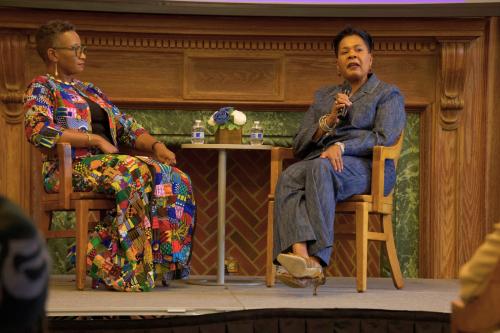
Former President of Trinidad and Tobago Visits Howard University for Fireside Chat on Global Leadership
Sep 3, 2026 6 minutes -
 Epiphanies, Discovery, and Research
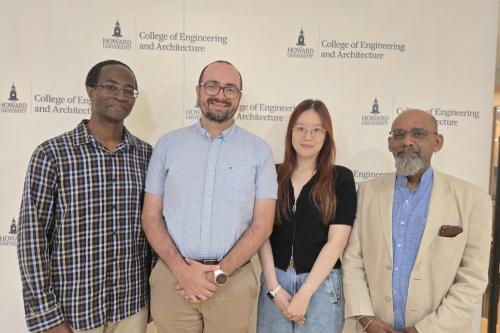
Howard University Chemical Engineering Professors Secure Nearly $1M DoD Award to Expand Bioindustrial Manufacturing Research and Student Training
Sep 1, 2026 4 minutes