

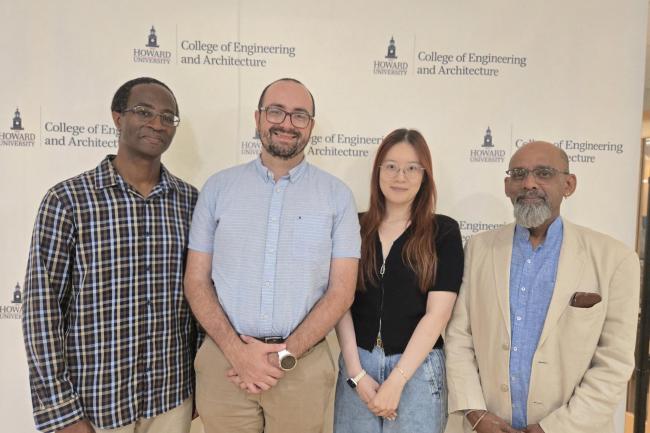
Cristiano Reis, Ph.D., chemical engineering assistant professor at Howard University's College of Engineering and Architecture (CEA), has been awarded nearly $1 million from the U.S. Department of Defense (DoD) to expand Howard's capabilities in bioindustrial manufacturing and biorefinery research while creating new opportunities for students to gain hands-on experience with advanced scientific equipment.
The one-year project, Bioindustrial Manufacturing and Biorefinery Research and Education, is funded through the federal HBCU/MI Equipment and Instrumentation Program. The award supports research and teaching capacity at HBCUs and other minority-serving institutions. Reis serves as principal investigator (PI), joined by fellow Howard chemical engineering professors Anqi Ji, Ph.D., John Tharakan, Ph.D., and Patrick Ymele-Leki, Ph.D., as co-PIs.
The funding will significantly expand Howard's Bioindustrial Manufacturing and Biorefinery Research and Education Laboratory (BIOMARE), a research hub founded by Reis after he joined Howard as a faculty member in 2024. The lab focuses on transforming renewable resources and waste-derived materials into products traditionally produced from petroleum, including fuels, chemicals, biomaterials, and other functional materials.
At the heart of the project is a vision to connect every stage of the biomanufacturing process into a single integrated research platform.
According to the project proposal, the investment will establish advanced bioindustrial manufacturing and biorefinery capabilities through the acquisition of state-of-the-art bioreactor systems, processing equipment, and analytical instrumentation. These tools will support the development of sustainable biomaterials and renewable biofuels while strengthening research aligned with national priorities in energy resilience and advanced materials.
"We didn't want a shelf of instruments that don't talk to each other," said Reis. "The point is for a student to take an idea from a flask of cells all the way through scale-up to a full readout of what they made, without having to run each step in a different building."
Biomanufacturing uses living systems such as microbes and enzymes to create products that can replace conventional petroleum-based materials. The new equipment acquired through the award will enable Howard researchers to perform the entire process under one research framework, from cultivating microorganisms and optimizing biological production systems to converting biomass into useful materials and analyzing the final products with precision.
Among the new acquisitions are advanced microbial cultivation and fermentation systems, an incubator shaker for strain development, a microwave reactor for biomass processing, and analytical instruments used to characterize fuels, materials, and chemical products. Together, these resources will help researchers develop renewable alternatives to petroleum-derived products while enhancing Howard's research infrastructure.
Transforming Student Learning Through Hands-On Research
A central goal of this latest DoD-funded award is to provide students with direct access to industry-relevant technologies and research experience.
Graduate students in many of Howard's STEM programs, such as mechanical engineering, civil engineering, chemistry and biology, will have opportunities to participate in projects that span scientific discovery, process development, scale-up, and product characterization. Undergraduate researchers will also gain exposure to sophisticated instrumentation typically found in research-intensive and industrial settings.
"The ability to train students directly on advanced instrumentation is one of the most exciting aspects of this award," Reis said. "Students learn best when they can connect classroom concepts to real-world systems and see how discoveries move from the laboratory toward practical applications."
The project will directly support graduate and undergraduate researchers while also benefiting dozens of additional students through curriculum integration and hands-on lab experience. Training will focus on advanced bioprocessing techniques, analytical methods, and biomaterials characterization, helping prepare graduates for careers as researchers, educators or technologists in biotechnology, manufacturing, energy, and national defense.
A Resource for the University
While housed within the CEA, BIOMARE is designed as a shared platform that can support interdisciplinary collaboration across Howard University.
The lab's capabilities complement existing research strengths in multiple STEM disciplines. The project will also leverage existing departmental infrastructure and collaborations with other research laboratories to create a broader platform for innovation and discovery.
Reis and his colleagues envision the expanded laboratory serving as a catalyst for new research partnerships, educational initiatives, and externally funded projects.
For Howard students, the award represents more than just new equipment. It provides a pathway to participate in cutting-edge research that addresses global challenges, gain experience with advanced technologies, and contribute to innovation that can shape the future of sustainable manufacturing.
Keep Reading
-
 Epiphanies, Discovery, and Research
Howard University Doctoral Student Receives Competitive Dissertation Fellowship, Examines Faith in Educational Experiences of Black Students
Sep 4, 2026 5 minutes -
 Artificial Intelligence
Howard University College of Engineering and Architecture Expands STEM Pathways with Transformative Summer AI and Robotics Programs
Aug 14, 2026 4 minutes -
 *Legacy and History
Howard University 9/11 Initiative Unites Students with Veterans During 3 Days of Service, Reflection and Awareness
Sep 14, 2026 10 minutes